...
...
Next Story

Revised airport security norms to rationalise personnel deployment

Staffing levels will be reviewed through airport surveys, with the changes also intended to help contain passenger security costs.

Updated on: Nov 17, 2026, 06:31:39 IST
Advertisement

The overall number of Central Industrial Security Force (CISF) personnel deployed at airport terminals across the country will likely decline, and those from private agencies will gradually increase in functions that do not require armed personnel as a consequence of new norms on airport security that have been circulated by the Bureau of Civil Aviation Security (BCAS).
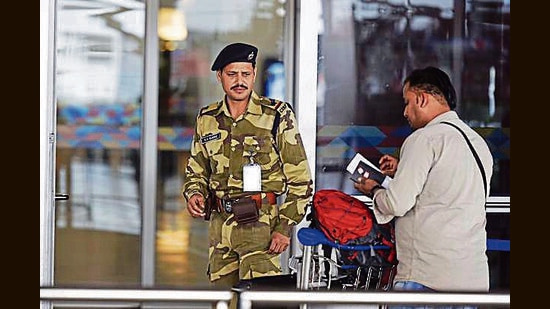
The redeployment will be carried out in phases.

The new security plan rationalises the deployment of security personnel by limiting the presence of the CISF, the primary agency entrusted with airport security, at certain duty points, according to the order. The redeployment will be carried out in phases. Gradually, personnel from private security agencies will handle functions that do not require armed guards, officials said on condition of anonymity.

The plan has been approved by the Ministry of Civil Aviation (MoCA), and was shared with stakeholders through an October 27 BCAS order. HT has seen a copy of the order. It was framed after a year of surveys involving airport operators, the Intelligence Bureau (IB), CISF, and the Home and Civil Aviation ministries, a civil aviation ministry official told HT.

To be sure, these revised norms retain CISF’s responsibilities at critical security locations, including armed protection, perimeter security, mobile patrolling, surveillance and intelligence, quick response teams and other sensitive installations.

MoCA did not respond to a query from HT on this matter.

Asecond official said the exercise is aimed at keeping security expenditure under control and avoiding an increase in the Passenger Service Fee (PSF), from which the expense of CISF deployment is met. “Government wants to avoid passing on additional security costs to passengers through a higher PSF at a time when demand is lower, airfares remain high and airlines are facing financial pressure due to elevated fuel costs,” this official said.

Staffing Requirements and Airport Categories

The norms prescribe manpower requirements across a range of security functions, including guarding terminal buildings, access control at departure and arrival gates, passenger screening and frisking. The order specifies staffing requirements for DigiYatra lanes, with one passenger service assistant for each lane and an assistant sub-inspector (ASI) to supervise every six lanes.

Separate provisions have been made for vehicle access gates, depending on whether they are equipped with X-ray baggage inspection systems (X-BIS). The norms also cover cargo access control.

Also Read | How 9/11 changed air travel: TSA, cockpit doors, ID checks and more

The order also states changes at airports where security is provided by state police. Out of 119 airports, the CISF guards 74 airports and state police 45.

Several airports, including Delhi and Mumbai, already have private security agencies handling some non-core areas.

“The revised norms prescribe a reserve of 28% for CISF and 14% for state police personnel. They also specify the requirements for supervisory officers based on the overall strength deployed at an airport, with different levels of supervision prescribed for different manpower bands,” a third official said.

Under the revised framework, airports have been divided into three categories based on passenger traffic and flight operations. Airports handling fewer than one lakh passengers a month, or operating up to four flights a day for five days of operations a week, fall under the small category. Those handling between one lakh and 10 lakh passengers a month are classified as medium airports, while airports with a monthly passenger flow of more than 10 lakh are categorised as major airports.

Also Read | Air India resumes direct flights from Delhi, Mumbai to New York as Iraq airspace reopens

Airport Surveys and Deployment Changes

All airports and BCAS regional teams will conduct airport specific manpower surveys for their total security staff requirements by the month end. “The surveys will assess the number of personnel needed at individual airports based on passenger traffic, flight operations, terminal infrastructure and security requirements,” a fourthofficial said.

The extent of any reduction in deployment requirements will become clearer once the surveys are completed, a fifth official said. “The reduction will vary across airports but could be around 10% or more.”

Approvals and Private Security Training

The final numbers will be sent to MoCa for review and MHA for final approval, this officer said.

When asked about concerns regarding the training, accountability and preparedness of private security personnel at airports, this official said, “Once inducted for airport roles, private security personnel work under the CISF’s CASO (Chief Airport Security Officer). They are trained and managed by the CISF in all aspects; hence, preparedness is not a concern. Moreover, this exercise has been conducted in consultation with all stakeholders and deliberated upon at the highest levels within the ministries.”

Frequently Asked Questions

Which security responsibilities will remain with the CISF?

The revised norms retain the CISF’s responsibilities at critical security locations, including armed protection, perimeter security, mobile patrolling, surveillance and intelligence, quick response teams and other sensitive installations.

What functions may private security agencies handle?

Private security personnel will gradually handle airport functions that do not require armed guards, including some non-core areas.

How are airports classified under the revised framework?

Airports are classified as small, medium or major based on passenger traffic and flight operations. Small airports handle fewer than one lakh passengers a month or operate up to four flights a day for five days a week; medium airports handle between one lakh and 10 lakh passengers a month; and major airports handle more than 10 lakh passengers a month.

What happens after the airport manpower surveys are completed?

The final staffing numbers will be sent to the Ministry of Civil Aviation for review and the Ministry of Home Affairs for final approval.
Powered ByAsk HT
 
ABOUT THE AUTHOR
Neha LM Tripathi

Neha LM Tripathi is a Special Correspondent with the National Political Bureau of Hindustan Times. She covers the aviation and railways ministries, and also writes on travel trends. Her work spans national developments, with a focus on policy, people, and the evolving travel landscape. She has 13 years of experience. Before moving to Delhi, she was based in Mumbai, where she began her journey as a journalist. Outside the newsroom, Neha enjoys trekking and travelling.

ABOUT THE AUTHOR
Neeraj Chauhan

Neeraj Chauhan is a senior journalist with Hindustan Times and an investigative reporter specialising in national security, terrorism, organised crime, narcotics, corruption, financial crime and complex investigations. With over 21 years of experience across Hindustan Times, The Times of India, The Indian Express and The Pioneer, he has built deep expertise in India’s internal security and law-enforcement landscape. Neeraj has extensively covered India’s principal investigative, intelligence and security agencies, including the NIA, CBI, ED, IB, R&AW, MHA and other central security forces. His work has included deeply reported investigations into terrorism, terror financing, cross-border crime, narcotics trafficking, cybercrime, financial fraud and political and corporate corruption. He has reported on some of the most significant terror attacks and security developments in India over the past two decades, including the Delhi serial blasts, the 26/11 Mumbai attacks, the 2019 Pulwama terror attack and the recent Pahalgam attack. His reporting has also chronicled the rise and decline of the Indian Mujahideen, the activities and subsequent crackdown on the Popular Front of India (PFI), Islamist extremist networks, the conflict in Jammu and Kashmir, insurgencies in the Northeast and Maoist violence. Some of Neeraj’s major breaking stories are in Aryan Khan drug case, Sushant Singh Rajput suicide, interception of a 3,000-kg Afghan heroin consignment worth about ₹21,000 crore at Mundra port, Sri Lanka easter bombings, Aarushi-Hemraj murders in Noida, 2G scam, coal block allocation scam, AgustWestland VVIP chopper deal and major bank frauds and extradition cases involving Mehul Choksi, Nirav Modi and Vijay Mallya. His reporting is marked by an ability to cultivate sources, analyse confidential and complex documents, and follow investigations over several years—from the initial breakthrough to chargesheets, trials and international legal proceedings. He specialises in making complicated security and investigative developments accessible while examining their wider implications for governance and public policy. A Chevening South Asia Journalism Programme Fellow at the University of Westminster, Neeraj also spent time at the Financial Times as part of the fellowship. He was also a Robert Bosch Media Ambassadors India-Germany Fellow, studying at the University of Tübingen and working with Der Tagesspiegel in Berlin. He has previously taught investigative journalism and crime reporting as a guest faculty member at the Times School of Journalism. Over more than two decades, Neeraj has established himself as an authoritative voice on India’s national security and investigative landscape, with his reporting closely followed by officials, investigators, lawyers, policymakers and readers seeking insight into some of the country’s most complex and consequential developments.

Get Latest News, breaking headlines, and top India News, and today real-time updates from across the nation. Stay informed on politics, government policies, crime, Today Weather, and major developments on Hindustan Times
SHARE THIS ARTICLE ON
Notifications

Get breaking alerts directly from the newsroom

Notifications are on!You'll be notified when news breaks