The Karnataka government on Sunday reiterated that hijab will not be allowed inside the class premises when students of Class 10 appear for their final examinations starting Monday, adding to the uncertainty of the future of thousands of Muslim students.
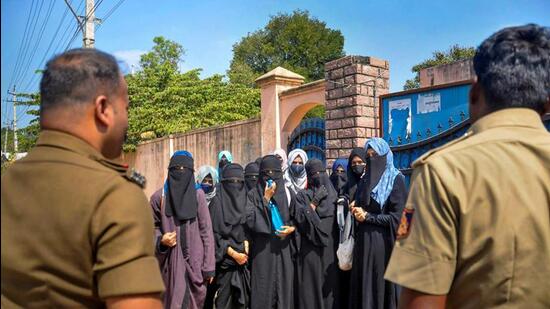
“After the high court (HC) verdict, we have not allowed it (hijab). We have given a clarification that they (hijab-wearing students) can come into the campus wearing the hijab but will now be allowed to wear it while going to the classroom. The same conditions will apply even during the exams,” BC Nagesh, Karnataka’s minister for primary and secondary education said on Sunday.
“There will be no provision for re-exams for those who skip the exam,” Nagesh said, ruling out the possibility of some special arrangements to accommodate Muslim girls who have been denied entry into their schools and colleges.
The statements come a day before around 8.76 lakh students are expected to take Class 10 state board exams after almost two years of online classes and disruption due to the Covid-19 pandemic, the subsequent lockdowns as well as the controversy around the hijab.
There are around 40,000 halls in 3,440 exam centres around the state. The Karnataka Secondary Education Examination Board (KSEEB) will conduct SSLC or Class 10 final exams from March 28. The papers will end on April 11.
{{/usCountry}}There are around 40,000 halls in 3,440 exam centres around the state. The Karnataka Secondary Education Examination Board (KSEEB) will conduct SSLC or Class 10 final exams from March 28. The papers will end on April 11.
{{/usCountry}}“Class-10 examination is starting from. The students should write the exams confidently without any worry or anxiety. All preparations have been done for the smooth conduct of the examination. It is being held in the interest of the students keeping the Covid issue in mind,” Bommai said, refusing to indulge in any conversation around the hijab.
Meanwhile, Nagesh said that the three-judge bench had made it clear that there will be no provision for the students to wear any religious attire to schools and colleges.
After the controversy broke in early January at a Government Girls Pre-University College in town, the issue snowballed and spread to educational institutes in Udupi and across the state. The face-off between hijab-wearing students and their own classmates, clad in saffron shawls and turbans, has now become the defining image of growing polarisation of Karnataka.
Six girls from the PU college first hit the headlines in early January as they protested against the institution’s move to stop their entry to campus while wearing the headscarves. Over the course of the month, four more colleges in Udupi and Kundapur districts issued the same ban.
On February 5, the Basavaraj Bommai-led BJP government issued an order stating that the uniform prescribed by educational institutions at the start of the year should be followed. This order, according to students, was misinterpreted by authorities to clamp down on the hijab.
The Muslim students protesting against the ban then moved the high court seeking that they be allowed to attend classes wearing the hijab. The court issued verdict on March 15 after 11 days of continuous hearings.
Almost immediately, the verdict was challenged in the Supreme Court. On Thursday however, a bench headed by Chief Justice of India (CJI) NV Ramana turned down a plea seeking an urgent hearing of the challenge.
“Exams are approaching. These girl students are not being allowed to enter schools and colleges. One year will go to waste,” the counsel for the petitioners had said.
But the bench, which also comprised justice Krishna Murari, remained unmoved. “This has nothing to do with exams… don’t sensationalise the issue,” the CJI had retorted.
Bommai on Sunday said that students should write the exams without any anxiety.