Shifting agricultural workers to remunerative non-farm jobs, is India’s central challenge on the employment front. The construction sector has been a mainstay of non-farm jobs over the last two decades. However, these jobs are increasingly losing their remunerative potential.
The KLEM (Capital with a K, Labour, Energy, Material) database released by the Reserve Bank of India (RBI) provides sector-wise employment figures from 1980-81 to 2015-16. A compound annual growth rate (CAGR) analysis shows that agricultural employment has been declining since the 2000s.
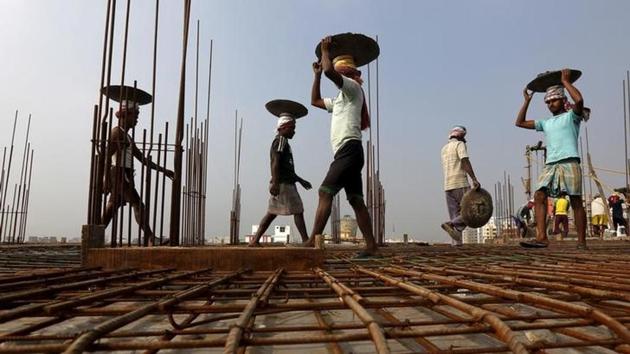
The bulk of the non-farm jobs have been generated in construction. Between 2000-01 and 2010-11, the CAGR in construction sector employment was 9.1% against 2.7% in non-farm employment excluding construction. This asymmetry seems to have gone up between 2010-11 and 2015-16 (See Chart 1).
There would be nothing wrong with this if jobs in construction were also generating higher incomes. Unfortunately,it does not seem to be the case. The KLEM database also gives statistics on value added in each sector.
This can be used to calculate trends in per worker value added – a proxy for income – in different sectors. Between 1980-01 and 2015-16 value added per worker (at 2011-12 prices) in agriculture has always been less than total value added per worker for the Indian economy.
The gap has been increasing overtime. Among the non-farm sectors, trends are drastically different for construction and other sectors excluding construction.
{{/usCountry}}The gap has been increasing overtime. Among the non-farm sectors, trends are drastically different for construction and other sectors excluding construction.
{{/usCountry}}Value added per worker started declining for the construction sector from the middle of last decade. In fact, its value seems to be heading for a convergence with per-worker value added in agriculture (See Chart 2).
This is a result of an increase in construction’s share in total non-farm employment with an almost stagnant share in value added in non-farm economy (See Chart 3). A glut of construction workers seems to have facilitated a squeeze on wages.
This also means that peasants who fled their farm jobs in search of better incomes are being condemned to live with similar income levels (as farming), and probably worse living conditions. A labourer’s life in the city is likely to be more difficult than a cultivator’s in a village.
Unless earnings in non-farm jobs improve, India should brace itself for a proliferation of unrest associated with rural distress in cities.