As Tamil Nadu crossed 10,000 cases on May 15 — the first case, a 45-year-old man with a travel history to Oman, was detected in early March — a wholesale market of fresh fruit, vegetables and flowers in Chennai has become the latest warzone for the administration battling the spread of the coronavirus pandemic. According to a state government official who did not wish to be named, around 4000 people linked to the market have already been tested out of which 1000 are primary contacts. At least 2500 positive cases currently pertain to the Koyambedu cluster, which is higher than the total number of cases, close to 1350, linked to the Tablighi Jamaat religious conference held in New Delhi in mid-March, and which drove up Tamil Nadu’s numbers in April.
The Koyambedu hotspot is also responsible for cases in 10 districts other than Chennai including Ariyalur, Chengalpattu, Kanchipuram, Cuddalore, Perambalur, Madurai and Tiruvallur. “We have either carried out facility quarantine or home quarantine of those who started the journey from Koyambedu,” the official quoted above, said.
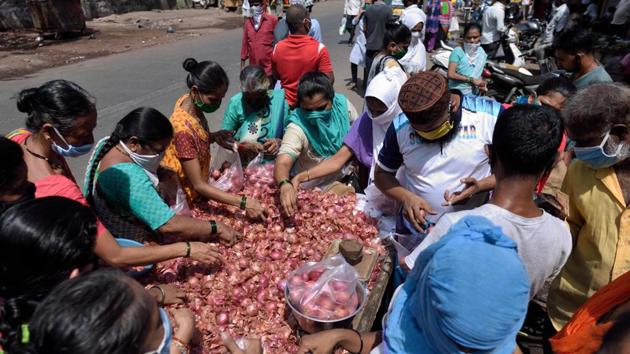
Spread over 54 acres, Koyambedu market complex is one of the largest wholesale market complexes for perishable goods in India. It houses more than 1000 wholesalers and over 2000 retail shops. In non-pandemic times, Koyambedu receives nearly 1500 truckloads of horticultural produce and at least 100,000 visitors, daily. Usually bustling with customers, vendors and trucks ferrying goods from other parts of the state, the market complex often witnesses a rush before festival days. However, by the time that the Tamil New Year was celebrated on April 14, the second lockdown had been announced, and as the work had dwindled — barely 400 trucks now visited the market daily — several labourers returned to their home districts. By then, however, the virus had spread among workers. Now, it began to leave Chennai.
On May 4, 300 of the 527 new cases reported were found to be linked to the market. Within hours, it was shut down.
{{/usCountry}}On May 4, 300 of the 527 new cases reported were found to be linked to the market. Within hours, it was shut down.
{{/usCountry}}According to S Ram Mohan, a core committee member of the Joint Action Committee of vegetable vendors’ associations at Koyambedu market, the district administration had shut down the flower and fruit sales at the market complex well before May 4. By then, even the vegetable retailers had stopped operations from the complex. On April 28, retail traders and fruit sellers from Koyambedu had been relocated to the bus terminus at Madhavaram, a suburb in the city’s northwest. Expecting wholesalers to do likewise would have been difficult as few open spaces in the city have the capacity to handle 3000 tonnes of vegetables each day, GD Rajasekaran, president, Koyambedu Periyar Market Association, said.
Mohan added that in the last week of April, administration officials also issued e-passes to wholesalers, their staff and truck labourers who were still entering the market for work. “We were already operating at 50% capacity, but even that amounted to at least 40,000 persons,” he said. However, the district issued far fewer passes, he claimed. When the announcement was made to shut down the market, Mohan said, there was at least ₹10 crore worth of vegetables making their way to Koyambedu, and ₹3 crore vegetables waiting to be sold inside the complex. The committee managed to extend the time of the shut down to the following morning. By 9 am on May 5, “almost 85% of the vegetables were sold, in a distress sale,” he added.
Panic buying
On April 24, the state government announced a hard lockdown for four days, between April 26 and 29. This led to a spate in panic buying. Mohan recounted scenes of utter chaos in Koyambedu in the two days before the hard lockdown was enforced. On April 30, another round of panic buying ensued after people realized that the second leg of the national lockdown, which was expected to end on May 3, would likely be extended. By this time, however, the first case of Covid-19 had been detected from the market complex.
“We had rushed to the market hours after the announcement [of the hard lockdown] thinking we would stock up for our own homes and for sales, as all stores would be shut for three days. But there was already a crazy rush at the market even though it was late. I could see people jostling. My partner later said the crowd was at least four times the normal amount,” a wholesale trader who refused to be named, said.
Last week, chief minister Edappadi Panaiswami blamed the traders for not vacating the market when asked in March itself. He said that despite several pleas since March they were adamant on staying put citing losses that would be incurred by them. “Now, because many from Koyambedu had travelled to other districts, the number of infected there has gone up. This is the reason for the spike in cases in Chennai also,” he said.
However, Mohan countered this and said that no official meeting was held between the wholesale vendors and the authorities in March or April. “We had decided to declare a holiday on March 27 and 28, after the lockdown was announced and everyone was prepared for it. On March 26, we were called by the officials who were furious that we had announced the holiday. The president of our association informed us after the meeting that we had been instructed by the government to continue to remain open. The concern was that there should be no stoppage of essential commodities,” he said.
The state has now relocated the Koyambedu market complex to Thirumazhisai, 20 km away, in a large vacant plot in a satellite township located between Poonamallee and Sriperumbudur on the Bangalore highway. At 198 licensed wholesale shops have been opened, and the market now opens at 9pm every night. By 6 am, the sales of the day are completed. Watch towers, with policemen, overlook the shops; ever so often, a patrol car would pass by. On Thursday, the district collector of Thiruvallur district held a meeting with the shop owners, stressing on them the need to wear masks, use sanitisers and practice physical distancing, Mohan said.
Pushing up the numbers
Super-spreading events have played a much bigger role in the virus spread in Tamil Nadu than in Maharashtra and Gujarat — two other states that have seen huge numbers of Covid-19 cases, experts said.
The spike in numbers due to the Koyambedu cluster is immediately noticeable. Between April 24 and May 3, the average daily new cases reported in Tamil Nadu were 134; from May 4 to May 13, the average grew to 620 a day.
Persons linked to the market have spread the virus the neighbouring states of Kerala and Andhra Pradesh. At least 70 personnel linked to the Manathavady police station in Kerala’s Wayanad have gone into quarantine as a precautionary measure after three of their colleagues tested positive. The trio is believed to have contracted the virus from a man who was called to the station in connection with a case on April 28 and May 2; he later tested positive for Covid-19. This man is suspected to be a contact of a truck driver, who returned from Koyambedu market, and who has already infected at least 10 persons, including his wife, mother and grandchild. In Andhra Pradesh, eight cases are believed to be linked to the Koyambedu market.
T Jacob John, a former professor of Virology, Christian Medical College (CMC), Vellore blamed ad-hoc decisions and panic among people because of the total lockdown. “A lack of imagination and understanding of ground realities had allowed opportunities for the virus to spread rapidly,” he said, adding that to contain the disease, all people must wear masks outside their home and maintain hand hygiene. “It is a simple solution that should be strictly enforced. It should have done long ago,” he said.
As the state prepares to come out of the lockdown in a phased manner starting May 17, it must also direct its resources towards cases that will arise from the Shramik Special trains, ferrying migrant workers as well as the return of residents from other countries via flights. Since Friday, the daily bulletin issued by the state government has begun to keep track of the Covid-19 positive cases of passengers returning from other countries and states: six from Maldives, 40 from Maharashtra, among others. In such a scenario, the day-by-day rise of cases linked to the market will add to the pressure on the state’s health infrastructure.
The good news is that the state is testing much more than it was even last month. Some other experts pointed out that Tamil Nadu’s high case load was paired with a high testing rate. The state had conducted the highest total number of tests as per the HT dashboard at 280,023 as of Thursday night, which translates into 4179 tests per million people, far higher than the national average of 1540 per million people.
“The more you test, the more you find. Tamil Nadu is finding more cases because they are testing more. The state has a strong public health infrastructure,” said Dr V Ramana Dhara, professor at Indian Institute of Public Health-Hyderabad. “These cases are probably occurring in other states too, but they are not testing more. When testing increases, numbers will also increase,” he added.
On Thursday, a group of public health experts met the chief minister and urged him to step up testing and said there was no need to panic with the high numbers. Speaking to reporters, Prabhdeep Kaur of the National Institute of Epidemiology scientists pointed out that Tamil Nadu’s testing rate was better than many countries and that increased testing was the bedrock to create successful containment strategies.
“The increase in number of cases is something to be expected especially as the most stringent components of the lockdown are relaxed. We are seeing the residual of a couple of major clusters, for instance, the Koyambedu cluster,” Dr Ram Gopalakrishnan, an infectious disease specialist at Apollo Hospital who is a committee of healthcare and medical experts that consults with the government told HT. “The incubation period of this disease is between 2 to 14 days, so whatever happened 2-14 days ago, we are seeing it now. And obviously there was some relaxation in lockdown between the second and third lockdowns, we are seeing the effects of that too now.”
With inputs from Sowmiya Ashok