E-Paper



Covid clusters in Maharashtra, Karnataka under watch for new variant
At least 281 people have tested positive for Covid-19, including students and faculty members, at SDM College of Medical Sciences in Dharwad in the past few days. Another 60 persons at an old age home at Bhiwandi city in Thane district of Maharashtra also tested positive for the viral disease, including inmates, staffers and their relatives.

 Prefer HTon Google


Although no cases of the Omicron variant of Sars-Cov-2 have been detected in India, one cluster each in Maharashtra and Karnataka are being investigated for the new variant, according to people familiar with the development.
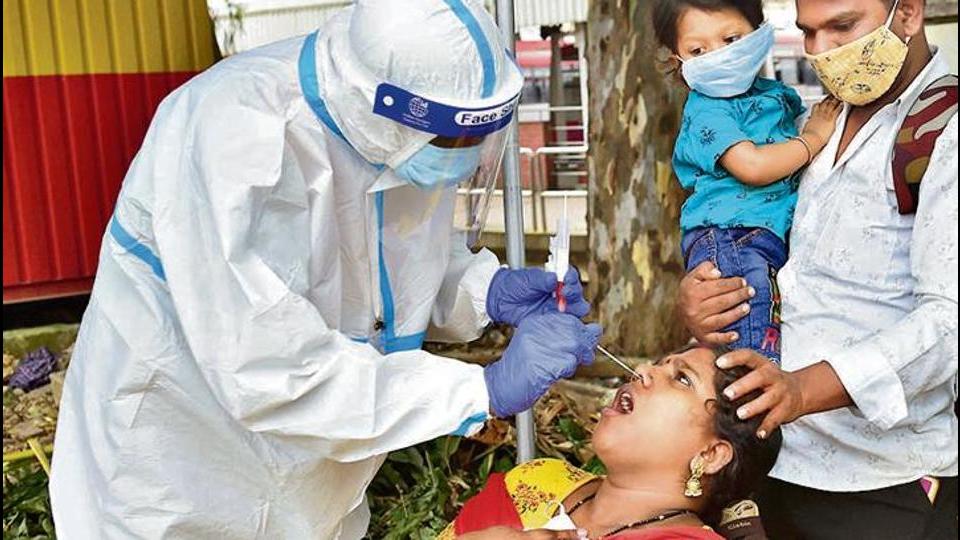
At least 281 people have tested positive for Covid-19, including students and faculty members, at SDM College of Medical Sciences in Dharwad in the past few days. Another 60 persons at an old age home at Bhiwandi city in Thane district of Maharashtra also tested positive for the viral disease, including inmates, staffers and their relatives.
“Its (Omicron’s) presence has not been detected yet. However two clusters, Bhiwandi in Maharashtra and Dharwad in Karnataka, are being currently investigated,” a government official said on condition of anonymity. “Samples have been taken for genome sequencing.”
The infected people and those who have submitted samples and are waiting for test results have been kept in isolation. The advanced genome sequencing results to identify the variant that has caused the infection will take some time. Genome sequencing to detect the new variant is expected to conclude by Tuesday evening, an official said.
“Nothing can be said for sure at this moment. We are being vigilant and samples are being sequenced as fast as possible,” said another government official, who is a member of INSACOG (Indian SARS-CoV-2 Genomics Consortium) formed by the central government to monitor and examine genomic variations in Sars-Cov-2. He declined to be named.
The World Health Organization on Friday declared Omicron as a variant of concern, although it’s not clear if it is more infectious than other variants of the disease.
India stepped up surveillance at all entry points to the country, with rigorous screening and testing being conducted for Covid-19 at all international airports and ports.
The new variant is heavily mutated, with nearly 30 mutations in the spike protein alone. The number of people testing positive has risen in South Africa, where the variant was first detected on November 24. Epidemiologic studies are underway to understand if it is because of Omicron or other factors, said WHO.
It may not be possible to entirely block the entry of the new variant in India in the long run, experts said. The government needs to ramp up surveillance, they said.
“At this point, it should be watch and track,” said Gagandeep Kang, vaccine expert and professor at Christian Medical College, Vellore, Tamil Nadu. “There is no need to panic, as we know some of the most transmissible viruses do not produce severe disease, and we have tools we did not have before, drugs and vaccines (which can be updated quickly, if needed).”
“It is not likely that the country will be able to block the entry of this variant altogether,” Kang said. “However, what we hope to achieve by taking such proactive measures that the government is taking is some delay and decrease in the overall numbers infected by the new variant. To know its clinical implications will take some time.”