E-Paper



Crackers unleashed, toxic haze cloaks Delhi
A reading of 351 qualifies as “very poor” – a category for which NCDC recommends “avoiding physical activity outdoors” and remaining indoors as far as possible

 Prefer HTon Google


Delhi’s first Diwali with legal firecrackers in years delivered the worst air pollution spike since 2021, with fine particulate matter concentrations hitting levels that would register an air quality index of 812—if the official scale weren’t capped at 500—despite warmer temperatures and fewer farm fires that should have kept the air cleaner.
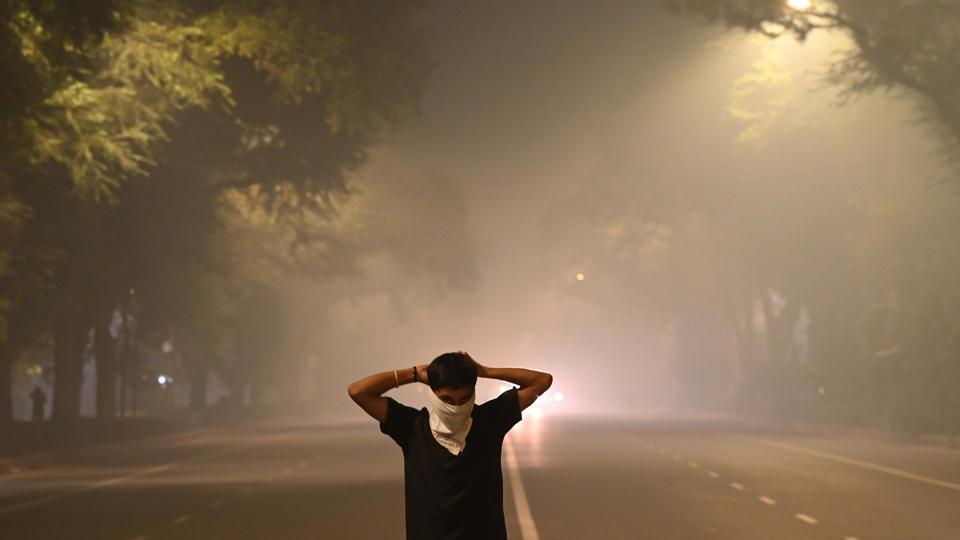
The official 24-hour average air quality index calculated at 4pm on Tuesday stood at 351, slightly worse than 345 the previous day—but this bulletin masks the rapid accumulation of pollutants during firecracker bursting.
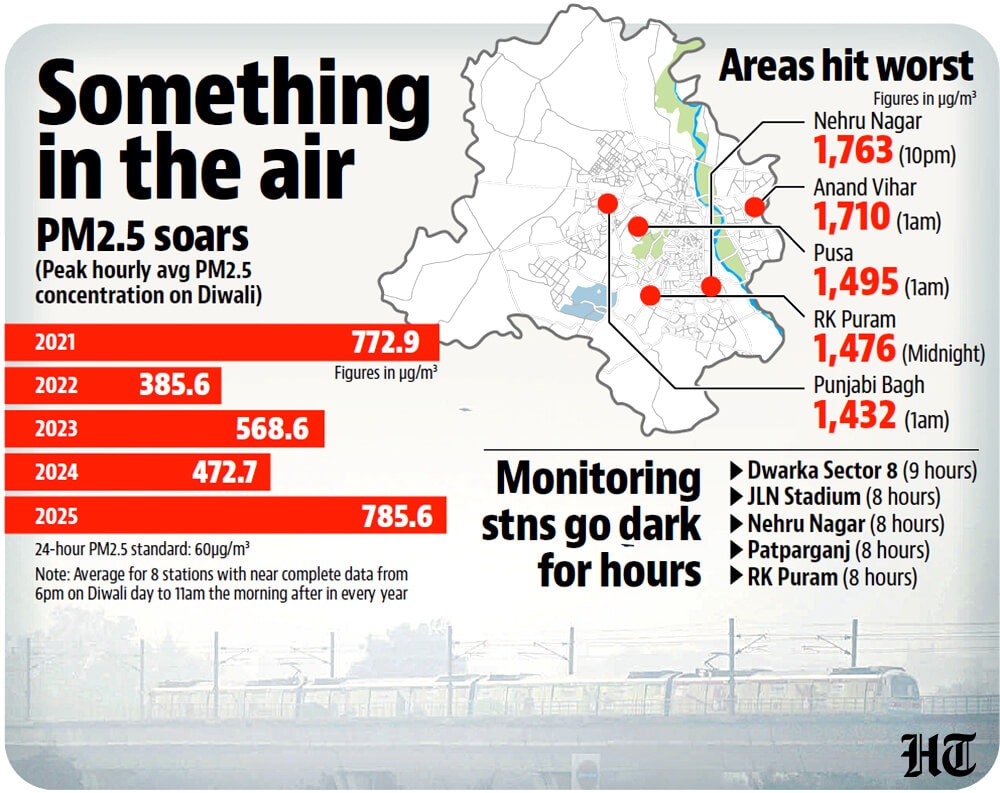
Average PM2.5 concentrations—ultrafine particles 2.5 microns or less in diameter—across eight stations with consistent historical data peaked at 785.6 micrograms per cubic metre (µg/m3) this Diwali, the highest since 2021 when it was 772.9 µg/m3. In AQI terms, 2021’s levels compute to 802.
Among the most intense readings were in Nehru Nagar, abutting Lajpat Nagar, where PM2.5 levels surged to 1,763 micrograms per cubic metre (µg/m³) for an hour on average till 10pm. At East Delhi’s Anand Vihar, this figure was 1,710 µg/m³ till 1am. Both readings were nearly 29 times the safe limit of 60 µg/m³.
Also Read | 283 fire-related calls made in Delhi on Diwali, says fire dept
Data suggests meteorological providence —warmer temperatures and moderate winds on the morning after—helped blow away some of the Diwali pollutants. To be sure, a reading of 351 still qualifies as “very poor” – a category for which the National Centre for Disease Control (NCDC) recommends “avoiding physical activity outdoors” and remaining indoors as far as possible.
PM2.5 ultrafine particles are mostly the by-product of any combustion, and they can reach deep into lungs, enter the bloodstream, and lead to immediate illness such as asthma and bronchitis as well as long-term cardiovascular ailments.
On October 18, the Supreme Court allowed “green firecrackers” on a trial basis to “balance religious celebrations with public health”. The court imposed strict time restrictions—8pm to 10pm on Monday—but those limits were widely violated. The ruling also mandated close monitoring of firecracker emissions.
That monitoring, however, was compromised by significant data gaps. Nine of Delhi’s 39 air quality stations stopped recording data entirely during peak pollution hours between 11pm and 4am—the second-highest number of such failures since 2021. The blackout during the most critical period raises questions about the reliability of official assessments and the government’s ability to track the trial’s impact.
Also Read | GRAP-2 restrictions in Delhi NCR: Do’s and don’ts to brave the toxic haze
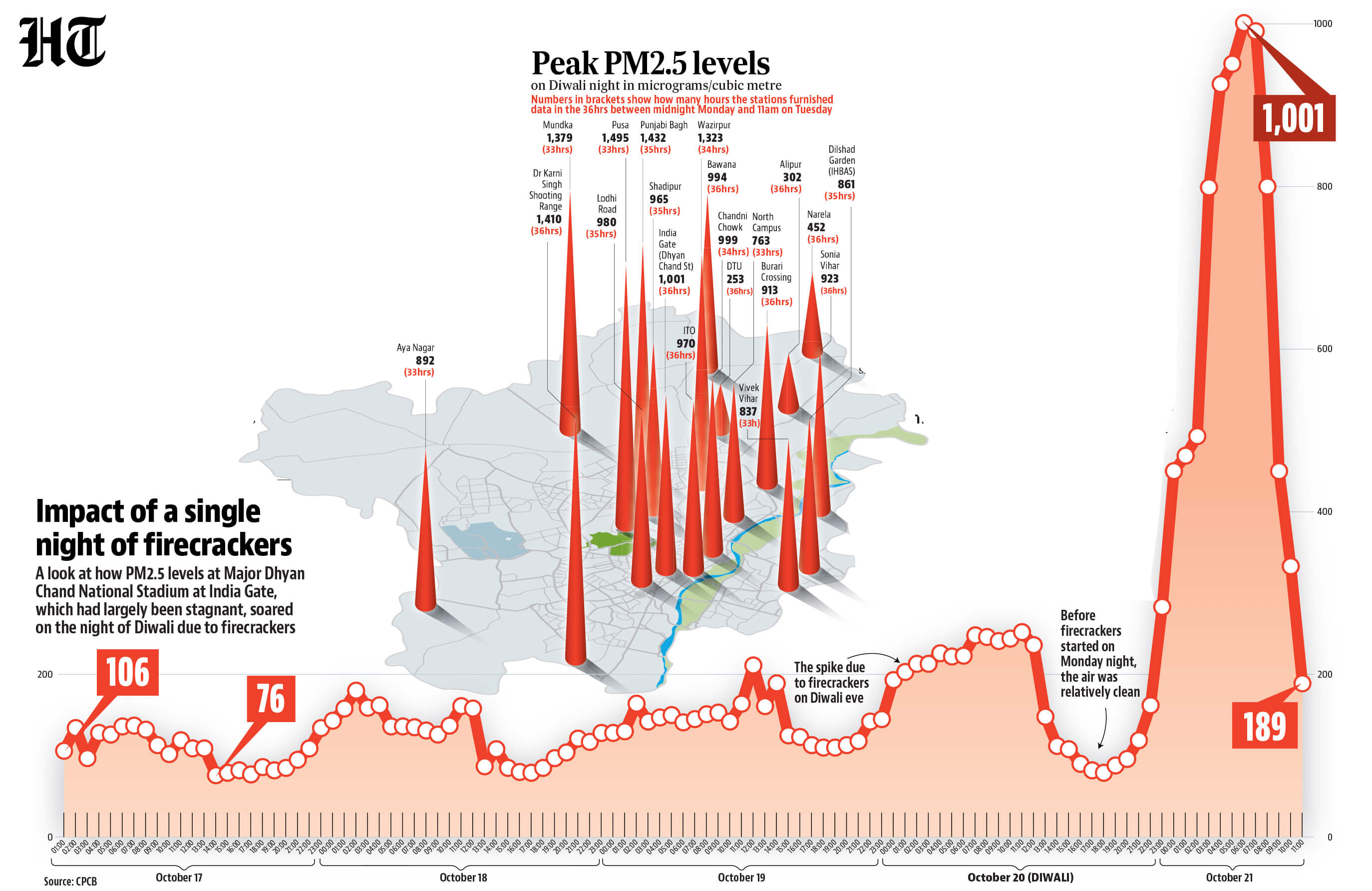
An analysis of the eight stations with the most consistent data—Aya Nagar, Burari Crossing, Punjabi Bagh, Bawana, Sonia Vihar, Narela, Shadipur, and IHBAS-Dilshad Garden—reveals an even starker picture of Diwali’s pollution surge.
Air quality deteriorated from an AQI of 233 at 4pm to a peak of 812 in just seven to nine hours, before winds brought levels down to 385 by 11am the next day. Using only these eight stations excludes incomplete data but enables accurate year-on-year comparisons for identical locations.
The revelry also appeared to more widespread than in recent years. Real-time data from the Delhi Pollution Control Committee (DPCC) showed 23 of the 26 active noise monitoring stations in the city reported noise levels above permissible limits, up from 22 stations last year, and 13 in 2023. Karol Bagh emerged as the loudest, with decibel levels peaking at 93.5 dB(A), or A-weighted decibels, around 11 pm on Diwali night. A sustained exposure to 80-90dbA starts leading to hearing loss.
The contribution to pollution from farm fires, often a factor in Delhi’s winter smog, was substantially lower. Satellite data from NASA’s VIIRS instrument recorded just 280 fires in Punjab and Haryana in the three days leading to Diwali, compared to 990 last year and more than 1,500 annually from 2021 to 2023.
Both farm fires and favourable meteorological conditions become a stronger factor for air quality in the last week of October and the first half of November – making the timing of this year’s Diwali a crucial reason for the crisis not worsening as it has on several occasions.
What was different this year was the ostensible use of “green firecrackers”. Developed by CSIR-NEERI in 2018, such firecrackers eliminate potassium nitrate and sulphur as ingredients to reduce particulate matter and gas emissions by 30-40%. But scientists stress that “less polluting” does not mean “non-polluting” and there has been widespread scepticism on if even a substantial portion of what was witnessed on Monday night were products made to that recipe.
The opposition Aam Aadmi Party, meanwhile, said that the bursting of banned, non-green firecrackers and questioned poor implementation of top court’s orders.
“How did it happen that apart from green crackers, banned firecrackers were sold openly? This clearly indicates that the firecracker lobby, which manufactures products worth billions, was pressuring the government to allow their sale. If this took place under police supervision, it points to clear collusion.” said AAP Delhi state president Saurabh Bharadwaj on Tuesday.
The Delhi government cited the six-point jump in 24-hour average AQI as evidence of the city “responsibly celebrating Diwali”. “This clearly proves that crackers are not the main cause of pollution. Delhiites celebrated responsibly, and our measures ensured stability in air quality,” environment minister Manjinder Singh Sirsa said.
Sirsa also blamed farm fires and sought to blame the Aam Aadmi Party (AAP) government in Punjab: “Over the past four days, stubble-burning incidents in Punjab have surged sharply and this is no coincidence. Farmers are being pressured and provoked to burn stubble so that pollution in Delhi can be used politically to target the Delhi Government”.

Chief minister Rekha Gupta thanked Delhites for their “responsible behaviour”, according to a statement from her office. “The people placed their faith in the Delhi Government and celebrated Diwali with full enthusiasm,” she said.
The key question now is whether the Supreme Court will view its green firecracker trial as a success– the government, as suggested by Gupta’s statement and Sirsa’s comments, sees this as a vindication of the experiment.
But environmental experts attribute the relatively quick clean-up entirely to meteorological providence, not enforcement or responsible revelry.
Experts said a switch in wind direction further reduced any possible farm fire emissions. “Winds picked up from 6 am onwards, the wind direction was predominantly easterly so stubble burning did not impact Delhi and lastly, an early Diwali has meant winter is yet to fully set in and temperatures are still fairly high as compared to November,” said Sunil Dahiya, founder and lead analyst at the think-tank Envirocatalysts.
Mukesh Khare, an air pollution expert from IIT Delhi, made a similar assessment, noting the lack of smoke from farm fires as a mitigating factor. “Stubble burning is almost negligible right now. Even if its contribution was over 10%, the AQI would have shot up to severe. Favourable meteorological conditions have helped disperse pollutants swiftly - which was clearly from firecrackers,” said