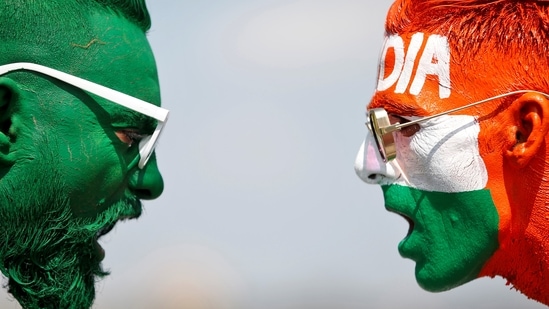
Pakistan’s victory over India in the ongoing T20 cricket World Cup match on October 24 has kicked up a political storm in India. First there was uproar over online trolling which targeted India’s pace bowler Mohammad Shami along religious lines. Many Opposition leaders came out in Shami’s support, and several cricketers and the Board of Control for Cricket in India also spoke up for him. Meanwhile, reports of Muslims celebrating Pakistan’s victory started doing the rounds. Those who did so
Not only do a majority of Indians associate supporting the cricket team with being Indian, an even bigger share agrees that “respecting India” is essential for even being considered a part of one’s religion. (REUTERS)
2. The realpolitik constraint to fighting jingoismon cricket
{{^usCountry}}{{/usCountry}}
Whether or not reports of Muslims supporting the Pakistani team are true, there is a realpolitik problem when it comes to the issue. Not only do a majority of Indians associate supporting the cricket team with being Indian, an even bigger share agrees that “respecting India” is essential for even being considered a part of one’s religion.This number is as high as 70% among both Hindus and Muslims. What this means is that when such incidents do erupt, and there is an attempt to extrapolate alleged celebrations over Pakistan’s victory beyond cricket as disrespect to the country itself, attempts to downplay or criticise such politics (liberal positions do exactly that) are likely to have very little traction even among minorities.
3. Tripura violence was a bigger communalism red flag than cricket jingoism this week
While liberals might find these statistics depressing, communal dog-whistling via cricket nationalism was not the most alarming this week, as far as India’s secular fabric is concerned. What went relatively unnoticed were reports of large-scale communal violence in the northeastern state of Tripura, a first for the border state. The Tripura incidents come on the back of violence against Hindus in neighbouring Bangladesh during Durga Puja.
Pew Survey findings portray India’s North-east as the most communally polarised. More than 30% of both Hindus and Muslims perceive that they are discriminated on religious lines in this region, where there is also a distrust of outsiders, irrespective of their religion. While this number is higher for Muslims in northern India, it is abnormally high for Hindus. This makes the North-east a fertile ground for communal clashes. The growing number of communal flare-ups in this region should be a bigger concern among those who care for India’s secular fabric. But no one should be arrested for supporting or not supporting a particular team.
Roshan Kishore is the Data and Political Economy Editor at Hindustan Times. He heads the newsroom's data journalism team, which produces Number Theory, a daily data-driven feature for the print edition and the HT app. Number Theory uses data analysis and story-telling based on it to add value to the newsroom’s daily coverage by putting stories in a larger context on a range of issues, including politics, macroeconomy, markets, global affairs and climate. Under his leadership HT’s data journalism work has established itself as a niche product in Indian journalism and pushed the boundaries of marrying academic rigour with news sense and speed. Along with writing and editing data stories, he has also been writing a weekly political economy column called Terms of Trade for HT Premium. A trained economist with an MPhil degree from Jawaharlal Nehru University, Kishore has also been a visiting fellow at the Centre for Advanced Studies of India (CASI) at the University of Pennsylvania. Along with his journalistic work, his writings have also appeared in journals such as the Economic and Political Weekly and working papers for CASI and UNESCAP.
Get Latest News, breaking headlines, and top India News, and today real-time updates from across the nation. Stay informed on politics, government policies, crime, Today Weather, and major developments on Hindustan Times
Get Latest News, breaking headlines, and top India News, and today real-time updates from across the nation. Stay informed on politics, government policies, crime, Today Weather, and major developments on Hindustan Times
Home/India News/Cricket and patriotism: What links them in India
{{^htLoading}}
Advertisement
{{/htLoading}}
SHARE THIS ARTICLE ON
{{#usCountry}}{{/usCountry}}
Notifications
Get breaking alerts directly from the newsroom
Notifications are on!You'll be notified when news breaks