Cyclone Sitrang, which crossed the Bangladesh coast on Monday, helped strengthen winds over northwest India and aided the dispersal of air pollution due to Diwali festivities and from other sources such as crop stubble fires.
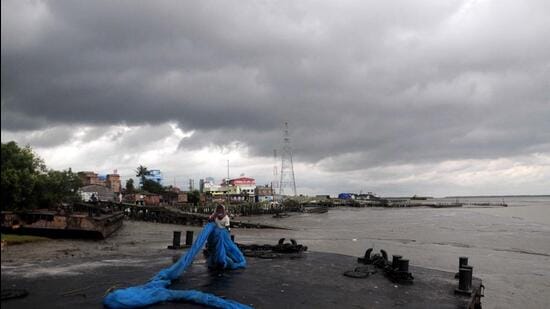
India Meteorological Department (IMD) director general M Mohapatra said a trough in the westerlies (elongated region of relatively low atmospheric pressure, often associated with weather systems) also caused the remnant of the cyclone to move in a north-northeasterly direction. He added whenever a cyclone passes, north-westerly winds also pick up as the cyclone pulls winds towards the system.
“Cold and stronger winds can be felt all over northwest India. That is one of the reasons we are not seeing calm atmospheric conditions this year after Diwali,” he said. “But we are heading towards winter. So these conditions will change gradually and we can see calm, colder days ahead.”
Cyclone Sitrang crossed the coast as a cyclonic storm with a maximum sustained wind speed of 80-90 kmph gusting to 100 kmph and continued to move north-northeastwards and weakened into a deep depression in the early hours of Tuesday. It weakened further into a depression and a well-marked low-pressure area over Bangladesh and adjoining Meghalaya. Meghalaya and Arunachal Pradesh recorded heavy rainfall on Tuesday.
Delhi recorded an Air Quality Index (AQI) of 303 in the very poor category on Tuesday compared to 462 last year on November 5, a day after Diwali. Most towns and cities in northwest India, particularly the Indo-Gangetic plains, recorded severe air last year.
{{/usCountry}}Delhi recorded an Air Quality Index (AQI) of 303 in the very poor category on Tuesday compared to 462 last year on November 5, a day after Diwali. Most towns and cities in northwest India, particularly the Indo-Gangetic plains, recorded severe air last year.
{{/usCountry}}Former IMD scientist DS Pai said the pollution did not stay because after the remnant of the cyclone moved towards northeast India and the northwesterly winds strengthened. “There is no cloud cover either; so days may be warmer. There is a raising motion of air over northwest and northern India. So pollution from all of the Himalayan foothills is transported to the northeast where it may be raining so the pollution will be washed away.”
Pai said another factor that needed to be considered is the delayed withdrawal of monsoon from northwest India. “Even at the beginning of October, there was widespread rain over the region which washed out accumulated air pollution. So, the build-up of pollutants was not high.”
He said the wind speed has remained favourable for the dispersal of air pollution. “Now with the incursion of northwesterly winds, the temperature over central and peninsular winds will gradually drop.”
Private forecaster Skymet Weather Services vice president (climate change and meteorology) Mahesh Palawat said air pollution accumulation depends largely on the weather. “...there has been a reduction in air pollution sources like firecrackers also but Sitrang played a very important role.”
He said when a cyclonic circulation forms in the Bay of Bengal, it pulls the winds towards its core which happened on Monday so the northwesterlies strengthened. “Now the low-pressure area from the weakened cyclone has moved to northeast India. It will gradually dissipate. Northwesterly winds will continue over north India but the flow will normalise.”
Palawat said when the next western disturbance approaches, winds may calm down temporarily leading to a spike in air pollution in the first week of November. “When Diwali is in November, there is a tendency of pollutants to attach to shallow fog in the morning which later turns into smog. That also did not happen this time.”
Authorities in Delhi, National Capital Region, and adjoining states also took measures such as mechanical and vacuum-based sweeping of roads, using dust suppressants on roads, stopped the use of diesel generator sets under the Graded Response Action Plan (GRAP) before the air quality deteriorated to very poor category.
VK Soni, a scientist who is part of a panel on GRAP, said, unlike in previous years, the wind was not calm. “There was 5 to 6 kmph wind speed on Monday night and 10 to 15 kmph wind speed on Tuesday. ...winds are helping with the dispersal of pollutants. Firecracker bursting was relatively low this time compared to previous years but stubble fires were almost as many as last year. On October 23 and 24, there were 1200 crop fires in Haryana and Punjab.”
Soni said GRAP’s enforcement in advance before air quality deteriorated was also one of the factors. “This year Diwali was in October when the temperature is relatively higher than in November. Winds are also stronger and there is clear sunshine. We have to consider that as well.”