The return of green firecrackers in Delhi this Diwali did little to address a familiar problem—the inability to enforce restrictions on their use, or to establish whether the firecrackers being burst are actually green. Despite the Supreme Court allowing green firecrackers in Delhi-National Capital Region (NCR) between 6am and 7am and 8pm and 10pm for two days ahead of Diwali, fireworks continued well past midnight when a complete ban took effect. The fireworks added to pollution in a city struggling with hazardous air quality, leaving neighbourhoods covered in a thick haze.
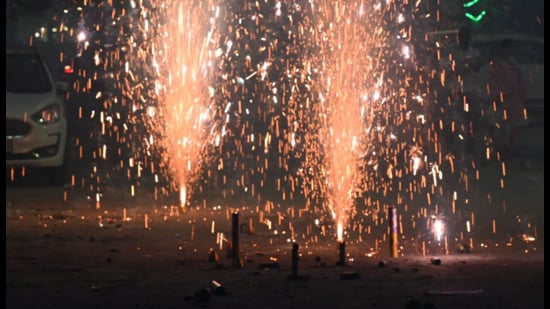
Experts say that even if green firecrackers produce relatively lower emissions than conventional ones, they are far from pollution free. More importantly, there is little effective on-ground monitoring to distinguish between the two. The implementation of the curbs remained lax even beyond the permitted time window. The Supreme Court order was widely flouted.
ALSO READ | Delhi's air quality ‘very poor’ morning after Diwali, capital chokes with AQI at 376
Sunil Dahiya, founder and lead analyst at consulting firm Envirocatalysts, said pollution levels began showing the impact of firecrackers even before Diwali night, with sulphur dioxide (SO2), a tell-tale indicator of firecracker emissions, rising sharply the day before.
Deep Dive
Do green firecrackers prevent Delhi’s Diwali pollution?
When were green firecrackers allowed in Delhi-NCR around Diwali?
Why were Delhi’s firecracker restrictions difficult to enforce?
“This year, the day before Diwali, we saw a sizeable load of fine particles on top of stubble smoke trapped close to the ground.” He said sulphur dioxide rose by about 40% across the city that night, after staying flat on the nights before. “There is no sign the allowed firecrackers burn any cleaner. Green firecrackers are meant to emit only about 30% less than conventional ones, and 30% less of a very large amount is still a very large amount. Calling a firecracker ‘green’ does not clean the air,” he said.
{{/usCountry}}“This year, the day before Diwali, we saw a sizeable load of fine particles on top of stubble smoke trapped close to the ground.” He said sulphur dioxide rose by about 40% across the city that night, after staying flat on the nights before. “There is no sign the allowed firecrackers burn any cleaner. Green firecrackers are meant to emit only about 30% less than conventional ones, and 30% less of a very large amount is still a very large amount. Calling a firecracker ‘green’ does not clean the air,” he said.
{{/usCountry}}ALSO READ | Delhi records 3rd worst Diwali pollution since '21, data gaps cloud full picture
Dahiya said hourly, city-wide PM2.5 levels on Diwali night peaked at nearly 600 micrograms per cubic metre (µg/m³) around 1am, as per Central Pollution Control Board data, over 10 times the 24-hour standard of 60 µg/m³. He added that light easterly winds had kept stubble smoke out of the city, but SO2 levels nearly quadrupled during the period, with most of the increase coming after the 10pm deadline for bursting crackers.
Dahiya called for an end to firecracker bursting during festivals and celebrations and stronger action against other sources of pollution.
Indian Institute of Technology Delhi professor Mukesh Khare said green firecrackers in theory can help bring down peak pollution levels to some extent, particularly concentrations of gaseous pollutants and secondary aerosols, but ensuring only they are sold and used remains a major challenge.
ALSO READ | Mumbai pollution spikes overnight after Diwali firecrackers, AQI crosses 400 at several spots
“Our distribution network is poor, with not enough outlets with green firecrackers. This allows conventional crackers to flood the markets and there are no checks and balances on the ground,” he said.
In 2018, the Supreme Court banned barium salts, which colour the flame green and supply oxygen for the fuel, in fireworks. It allowed only “improved” and “green” firecrackers without barium salts. CSIR-NEERI, the government’s environmental engineering laboratory in Nagpur, developed the first designs in October 2018, including SWAS, which dropped potassium nitrate and sulphur.
The government said the designs cut particulate matter by 30-40%. The court expected green firecrackers to cut PM2.5 emissions by at least 25-30%. But green firecrackers still burn metal salts for their colours, and the claimed cuts apply to particulate matter.
Green firecrackers developed following the 2018 court order replaced barium nitrate with zeolites, reduced aluminum content, and added dust suppressants. CSIR-NEERI claims these modifications cut emissions by 30-35% compared to traditional firecrackers.
The pollution reduction is still negligible, experts say. Green firecrackers still emit 65-70% of traditional firecracker pollution, producing substantial particulate matter, sulfur dioxide, and nitrogen oxides. When millions of firecrackers are burst, a 30% per-unit reduction means little.
Environmental activist Bhavreen Kandhari, who has reported instances of illegal firecrackers being burst during Diwali to the Delhi Police in recent years, blamed the lack of will among authorities for making restrictions largely meaningless.
“No one is checking whether these are green firecrackers or conventional ones. Green firecrackers also pollute an overly saturated air in Delhi, when meteorological conditions are highly unfavourable,” she said.
The court’s directions included provisions for product-specific QR codes on green cracker boxes, designated sale locations and police patrol teams to prevent the sale and use of conventional crackers.
The scale of the problem and the absence of effective verification on the ground continued to undermine enforcement.
The court took cognisance of an HT report on November 3, which flagged the sale of prohibited and unverified firecrackers across Delhi-NCR markets, in violation of its orders.
The experience of previous years offered little reassurance. Delhi had a complete ban on all firecrackers between 2020 and 2024. But the restrictions were widely flouted. Green crackers were subsequently permitted in 2025, and the latest relaxation has once again exposed the difficulty of translating restrictions into compliance.
Residents said the prolonged bursting of firecrackers well past midnight made an already difficult pollution situation worse, with elderly people forced to remain indoors.
“Green or non-green, how can bursting firecrackers be permitted in a city reeling under hazardous air pollution and an acute public health emergency?” asked BS Vohra, who heads the East Delhi RWA forum, stating the time restriction was clearly not followed or enforced.
“When every other activity is being restricted in the name of protecting public health, allowing firecrackers makes little sense. A change in the label from conventional to green does not make the resulting pollution harmless,” he added.
Swagata Dey, policy specialist and group head, Air Quality Policy and Outreach at the Centre for Study of Science, Technology and Policy, said green firecrackers were formulated to produce relatively lower emissions, but questions remained over their quality control at scale.
“Green firecrackers are lab-tested in small batches, with no proven quality control at scale, and they still produce smoke,” she said. “In India, implementing pollution-related bans can be challenging owing to the scale of the population and enforcement constraints. Although conventional firecrackers have been banned in NCR for almost five years, ensuring compliance has been difficult.”