E-Paper



Mumbai pollution spikes overnight after Diwali firecrackers, AQI crosses 400 at several spots
Diwali firecrackers triggered overnight pollution spikes in Mumbai, with Navy Nagar recording an AQI of 497 and several areas crossing 400.

 Prefer HTon Google


Firecracker bursting on Diwali night led to a sharp rise in pollution in Mumbai, with nine of the city’s 25 air quality monitoring stations recording poor air quality on Monday morning. Thick haze enveloped the city after pollution levels surged overnight, marking one of Mumbai’s worst air quality spells of the season.
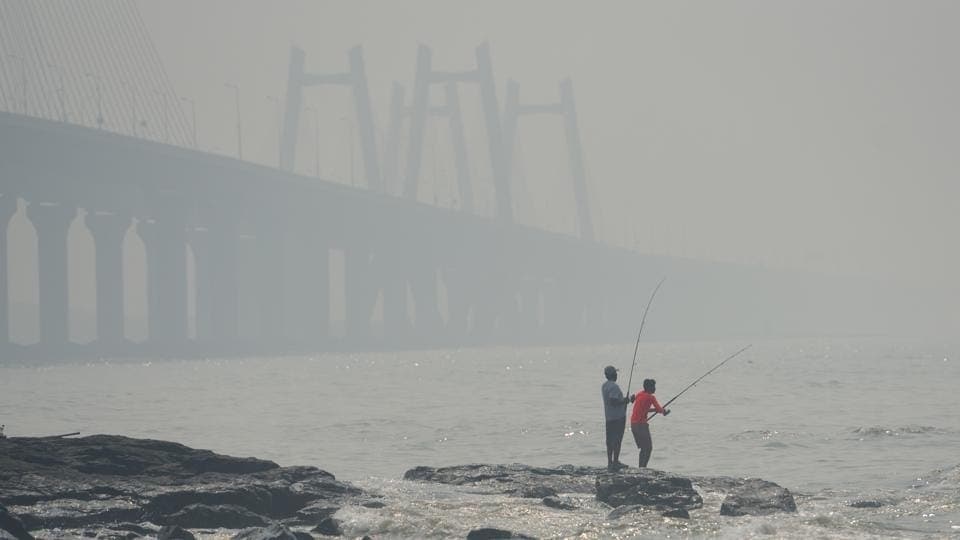
Kherwadi recorded the highest AQI among the city’s monitoring stations at 264 at 7am.
Also Read: Haze thickens over city as AQI worsens, Andheri hits 206 in poor category
Deep Dive

Mumbai’s overall Air Quality Index (AQI) stood at 171 on Monday morning, placing it in the moderate category. However, the citywide average masked considerably worse conditions at several locations. The AQI was also significantly higher than the 24-hour average of 132 recorded on Sunday evening.
According to the Central Pollution Control Board (CPCB), an AQI of 0-50 is considered good, 51-100 satisfactory, 101-200 moderate, 201-300 poor, 301-400 very poor and 401-500 severe.
On Monday morning, nine monitoring stations recorded poor air quality, 12 were in the moderate category, three recorded satisfactory air quality and only Borivali East recorded good air quality.
Also Read: Mumbai AQI falls in moderate category
AQI crosses 400 at several monitoring stations
Data from monitoring stations showed a sharp rise in pollution through Sunday night, with readings at several locations crossing 400.
At the BKC-IITM monitoring station, the AQI stood at 206 at 10pm on Sunday before rising sharply between 11pm and 3am, remaining between 344 and 360. Even at 7am on Monday, it stood at 232.
Chembur recorded similarly high readings, with the AQI rising to 334 before climbing further to 401 overnight. By 7am, the reading had fallen to 216.
Navy Nagar was among the worst-affected locations. Its AQI, already high at 359 around 10pm, remained close to the 400 mark through the night, peaking at 497 at 2am. At 7am, it stood at 274.
At Shivaji Nagar, the AQI spiked to 444 at 11pm. Readings were comparatively lower in the hours before and after the spike, with the AQI standing at 223 at 7am.
Also Read: Mumbai air pollution: What are BMC’s construction ban rules, and when can work be suspended?
Sewri, Ghatkopar and Chakala see sharp overnight spikes
Sewri also witnessed a significant deterioration in air quality. Its AQI stood at 255 at 9pm before climbing to 452 by midnight. It subsequently dropped to 277 at 1am and stood at 226 by 7am.
Ghatkopar recorded an AQI of 221, which rose sharply through the night, touching 257 at midnight before spiking to 421 at 1am. The reading remained elevated at 362 at 2am.
Chakala, which recorded an AQI of 178, also witnessed a sharp overnight deterioration, with the reading climbing to 408 at 2am and 302 at 3am.
Byculla recorded an AQI of 188, with readings remaining particularly high through the night, fluctuating between 300 and 450 from 10pm to 2am.