The Supreme Court on Monday clarified that there was no need to initiate separate suo motu proceedings to examine allegations of sexual assault against women protesters during the July 20 student protests in the national capital, as the issue has been referred to and prioritised by a five-member committee headed by its former judge R Subhash Reddy.
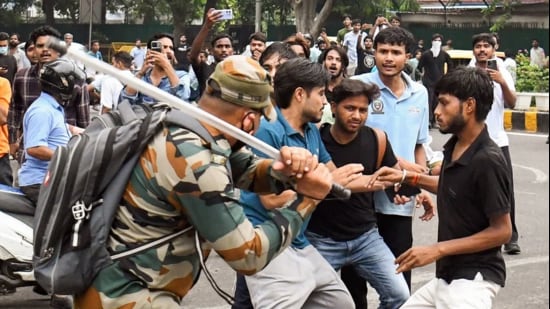
A bench, comprising Chief Justice of India (CJI) Surya Kant and Justices Joymalya Bagchi and V Mohana, said that the high-powered enquiry committee (HPEC), constituted last week to conduct an independent inquiry into allegations of violence during the protests, had specifically been directed to examine complaints of targeted violence, harassment, molestation and secondary victimisation of women protesters on priority.
Also read | Protest at IIT-Delhi over 31-year-old student’s suicide
Deep Dive
What actions is the High-Powered Enquiry Committee taking to address allegations of sexual assault during the July 20 protests?
How can women protesters lodge complaints regarding sexual assault according to the Supreme Court's order?
Why did the Supreme Court decide against initiating a separate probe into the sexual assault claims from the July 20 protests?
The clarification came after senior advocate Shobha Gupta urged the bench to take suo motu cognisance of alleged sexual assault of women protesters during the protests held on July 20.
Gupta submitted that there were widely reported allegations of women being molested and sexually assaulted by police personnel and sought a separate mechanism for investigating the complaints.
Also read | FIRs still not withdrawn, CJP announces September 5 march in Delhi against Centre
{{/usCountry}}Also read | FIRs still not withdrawn, CJP announces September 5 march in Delhi against Centre
{{/usCountry}}The bench pointed to its August 18 order constituting the HPEC and said the issue had been specifically entrusted to the committee. The CJI said that the committee had been asked to examine the allegations on a priority basis and submit an interim report at the earliest.
Court addresses concerns over complaint mechanism
Gupta raised concerns about how women protesters could approach the committee and lodge their complaints.
The bench pointed out that the committee chairperson had been empowered to appoint nodal officers, following which the procedure for submitting complaints would be notified.
HPEC to examine police action
The HPEC was constituted to conduct an independent and impartial inquiry into competing allegations arising from the July 20 student protest—petitions alleging excessive force by police as well as pleas concerning violence against police personnel and legality of the protest.
Also read | ‘How do they explain this?’: Dipke has another question on CJP Jantar Mantar protest
Other members of the committee include Justice (retired) Ravi Shankar Jha, former chief justice of the Punjab and Haryana high court, Justice (retired) Shalinder Kaur, former Delhi high court judge, Rishi Kumar Shukla, former Central Bureau of Investigation director, and LR Bishnoi, retired director general of police, Meghalaya.
Its mandate extends beyond the immediate allegations of police violence. The committee has been asked to examine the use of pellet guns, electric batons, lathis and tear gas, the proportionality of police action, the use of blanket prohibitory orders, surveillance of protesters and the invocation of Section 152 of the Bharatiya Nyaya Sanhita, which criminalises acts endangering the sovereignty, unity and integrity of India.
The committee has also been asked to examine allegations of violence by protesters against police personnel, damage to public property and injuries suffered by security personnel.
On the allegations concerning women protesters, the court specifically directed the panel to examine incidents of targeted violence besides assessing medical and other support provided to victims and the possibility of interim compensation.
The Supreme Court directed the authorities to preserve CCTV and drone footage, body-worn camera recordings, videography, wireless communication records and PCR call logs relating to the protests and hand them over to the committee.
The committee can receive documentary evidence and representations from affected persons and has been permitted to allow anonymous complaints to protect the identities of complainants and witnesses.
The HPEC was asked to submit interim findings periodically, with its first report to cover allegations of grievous injuries caused by police and security personnel and the complaints concerning targeted violence, harassment and molestation of women protesters.