Former Delhi Special Police Commissioner Dependra Pathak has defended some of the most controversial policing decisions taken during his career, arguing that officers often have "seconds" to act in situations where hesitation could have serious consequence.
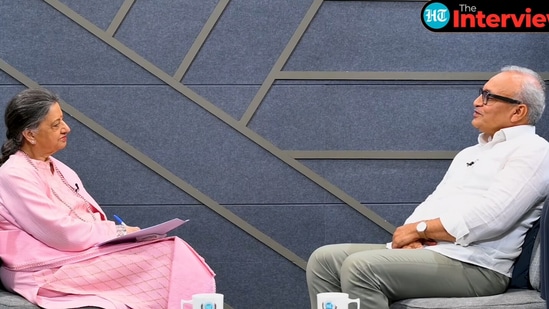
In an exclusive interview with Kumkum Chadha for The Interview, Former Delhi Police Special Commissioner Dependra Pathak spoke about the 2023 wrestlers' protest at Jantar Mantar, VIP security, and an alleged conspiracy to assassinate Prime Minister Narendra Modi in a manner similar to former Prime Minister Rajiv Gandhi.
Reflecting on the wrestlers' protest, Pathak said the situation escalated rapidly when protesters attempted to march towards Parliament despite heavy police deployment. "The lady police were outnumbering them, but in articulation and physical strength... they were throwing the lady staff across the barricades," Pathak said.
According to Pathak, police feared that even a single protester breaching the security cordon could trigger a much larger security failure near Parliament. "If a single wrestler crossed us, Parliament was hardly 400 metres away. They are physically so fit, they would have run and created trouble at the Parliament gate. Our entire police arrangement would have failed," he said.
Also Read | Delhi's untold case files: From protecting the Prime Minister to chasing exam mafias|top cop's story
'The Chapter Was Closed'
{{/usCountry}}Also Read | Delhi's untold case files: From protecting the Prime Minister to chasing exam mafias|top cop's story
'The Chapter Was Closed'
{{/usCountry}}Responding to criticism over male police personnel physically restraining women wrestlers, Pathak said extraordinary circumstances demanded immediate action.
"One decision we took on the ground was, 'Let us remove this tent now,'" he recalled. "Everything was removed and we made it a police camp so that when they came back, there was no place... we would not allow anyone to go inside." Looking back, Pathak maintained that the operation achieved its objective. "After that week, that chapter was closed."
Asked whether he faced criticism for using force, Pathak said the circumstances were very different from many other protests. "The issue was very sensitive," he said, adding that policing "is a very dynamic process... you have to take decisions within seconds."
Also Read | Police file FIR over ‘defamatory’ social media posts against PM
PM Modi Security And A 'Rajiv Gandhi-Type' Threat
The former Delhi top cop also reflected on the immense responsibility of protecting the Prime Minister during a period when intelligence agencies received inputs about an alleged conspiracy to assassinate Narendra Modi in a manner similar to former Prime Minister Rajiv Gandhi.
Without divulging operational details, Pathak indicated that such intelligence alerts fundamentally reshape security planning. He said policing at that level is not about reacting after an incident but preventing one before it happens. "The officer on the ground has to take decisions within seconds," he said, adding that security planning leaves "no scope for failure" when protecting constitutional authorities.
Also Read | At CCS meet, PM Modi orders ‘whole of govt’ plan to protect oil supplies, Indians in West Asia
'Minimum Force' And Maximum Responsibility
Throughout the interview, Pathak repeatedly argued that Delhi Police's objective has always been to use "minimum force" while ensuring public order. He maintained that officers are often forced to make difficult decisions in chaotic situations where there is little time for deliberation.
"At a larger professional canvas," he said, "Delhi Police maintained utmost restraint." While acknowledging that "some infirmities are bound to happen in a real ground situation," he insisted that every major operation is guided by one principle: preventing a situation from spiralling out of control.
Reflecting on decades in policing, Pathak said difficult choices are inevitable. "Law and order is a very dynamic process," he said. "You have to make decisions within seconds." It is those moments, he suggested, rather than hindsight, that ultimately define policing.