
 E-Paper



Don’t allow entry into Delhi without Aarogya Setu App, Lt Guv Anil Baijal told
Covid-19 update: The Delhi government hadn’t taken a decision on the Aarogya Setu recommendation yet. But it hasn’t knocked it off the table either, a senior official told Hindustan Times.

 Prefer HTon Google


The Delhi government is taking a hard look at a “strong recommendation” to require people to install the Aarogya Setu app launched by the central government before they enter the national capital.
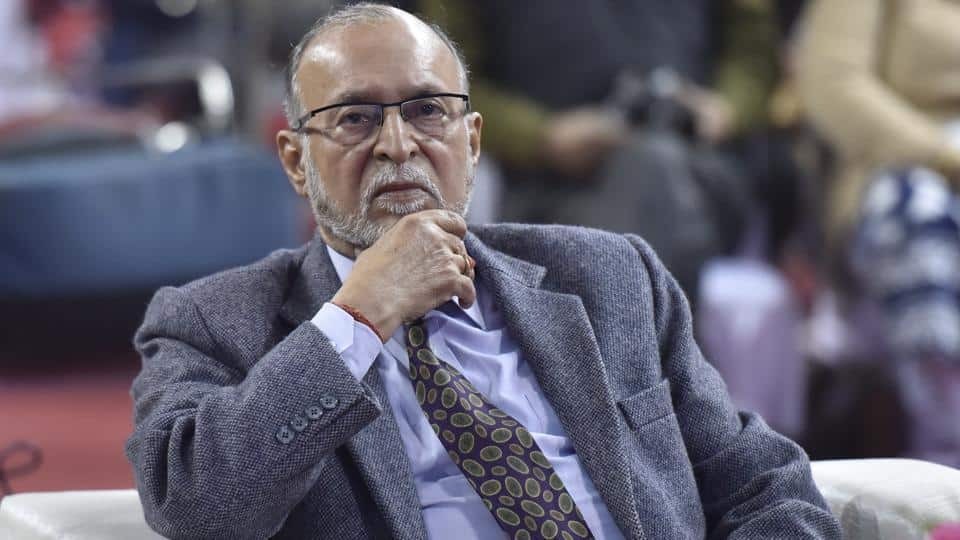
The recommendation was made at Lt Governor Anil Baijal’s review meeting on the spread of the Covid-19 pandemic on Friday.
National Centre for Disease Control director Surjit Kumar Singh, who had been asked to advise the city government, strongly recommended that the government allow people to enter the capital only after they have installed the Aarogya Setu app.
Dr Singh also pushed for raising the number of people who were being tested in the capital and supported repeated rapid testing - on the 3rd, 5th and 14th day - so that a Covid-19 positive individual does not get left out due to a false report.
It was at this meeting that Lt Governor Baijal decided to rationalise and carve out safe zones within large containment zones to prevent micro-transmission.
A senior official told Hindustan Times that the government hadn’t taken a decision on the Aarogya Setu recommendation yet. But it hasn’t knocked it off the table either.
The big hurdle to mandating the mobile application would be that there could be lakhs of people who may not have a smartphone. It has been downloaded on 75 million phones by Friday evening.
India has 1.2 billion mobile phones; only 350 million have smartphones.
‘In Delhi, we are told 80 percent of the mobiles are smartphones,” an official said.
“Let us weigh the pros and cons,” he said.
Dr Singh isn’t the first person to push the mobile application. Prime Minister Narendra Modi has been nudging people to download the application launched on April 2. He made the same request when he spoke to a group of village heads via video conference on Friday.
Already, the Central Industrial Security Force - which is responsible for security at key airports and Delhi metro - has made a similar recommendation.
Why the app? First, the disease
The problem stems from the insidious nature of Sars-CoV-2, the virus that causes Covid-19: it can be spread by a person who does not show symptoms, and is thus probably unaware of the illness, and merely breathing, coughing and sneezing could pass it on to anyone close by.
There is also some evidence, according to studies, that the Sars-CoV-2 virus may spread as an aerosol that lets it linger in the air for longer and disperses over longer distances.
How do you trace the contacts of such a person? Say two people who come close to each other in a metro, a bus (when the lockdown lifts) or at a grocery shop. Anywhere. One of them is positive, but doesn’t know it yet.
Tracing contacts through conventional methods, would therefore be ineffective.
Now the app
Aarogya Setu app could address this critical handicap in contact tracing.
“You need to have a way of focusing (contact tracing) as an asymptomatic person travels over various distances, over time. We need to find out who all were close to that person and warn the others after the person is identified as positive. This is what Aarogya Setu also does – it will find the symptomatic person and also identify all asymptomatic people around them in the past few days and advise them too,” said Dr K VijayRaghavan, principal scientific advisor to the government of India
Also Read: How to setup the Aarogya Setu app
Eric Feigl-Ding, an epidemiologist at Harvard University, told Hindustan Times earlier this month that a mobile phone-based tool would take care of an infected person having difficulty to recall who they met. “You don’t need the manpower and it is instantaneous – the speed is the most crucial aspect,” he said.
How Aarogya Setu app works
Like similar mobile applications being used elsewhere, the phone exchanges details with phones that are within range of their Bluetooth radios. This information will be shared by the Aarogya Setu app with health authorities once the mobile phone subscriber confirms that he has tested positive, triggering an alert to all other devices that may have been in the proximity.


