The Election Commission of India (ECI) on Saturday announced a series of changes to how it will handle the ongoing Special Intensive Revision (SIR) of electoral rolls and ordered a review of its ECINet portal. This comes days after reports disclosed objections raised internally by two of its three commissioners over control of the poll panel's IT systems.
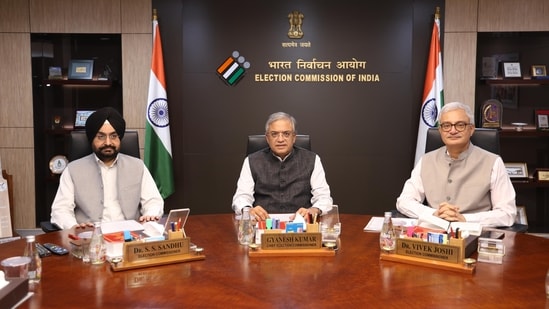
At a meeting held at Nirvachan Sadan, and attended by all three members of the poll body, the Commission said voters issued notices during the SIR "for being unmapped and logical discrepancies" will no longer need to appear for a personal hearing before the Electoral Registration Officer (ERO). Booth Level Officers (BLOs) will visit such voters at home to collect documents, which will be uploaded to the ECINet portal "for decision by the ERO."
ALSO READ: Chirag Paswan, other BJP allies seek EC clarification on 'dissent' row: 'Not to satisfy Oppn, but…’
A hearing will be held "only in exceptional circumstances, as decided by the ERO," and will "preferably" be conducted online, with such facilities to be strengthened. The Commission said "any adult member of the family can be authorised by the elector to attend the hearing on their behalf, if required."
Deep Dive
What are the new deadlines for claims and objections for the Special Intensive Revision (SIR) in Delhi?
Why is there controversy surrounding the changes made to Form 6 for young voters?
How will Booth Level Officers (BLOs) assist voters concerning the notices they received?
District election officers have also been asked to "create adequate number of help desks/hold special camps" for people living in night shelters, and for labourers, the poor and the homeless, "as per requirement."
{{/usCountry}}District election officers have also been asked to "create adequate number of help desks/hold special camps" for people living in night shelters, and for labourers, the poor and the homeless, "as per requirement."
{{/usCountry}}The Commission said the declaration attached to Form 6 for the SIR "has been upheld by the Hon'ble Supreme Court," and that outside the SIR period, forms "applicable as per Rules (the Registration of Electors Rules 1960) will be used."
On the ECINet system, the Commission said a committee headed by a senior deputy election commissioner, "including an independent expert from IIT/IIIT," will "review the ECINET to double-check that it complies with the provisions of the Acts and Rules" and submit a report to the Commission.
It said any further flexibility required by field officers "will be made operational," and that going forward, "all the new initiatives about IT modules and portals will be discussed in the Committee of Officers (COO) before approval by the Commission."
The decision follows a report published by The Indian Express, based on internal documents and interviews, which said election commissioners SS Sandhu and Vivek Joshi separately wrote to cabinet secretary TV Somanathan objecting to changes in work allocation that they said had stripped away a layer of their oversight over the IT backbone of the electoral rolls.
Addressing the letters, the Commission said in its press note that they were "not related to any policy matter of the Commission or IT division but related to working of an officer on deputation to ECI."
It said the "work re-distribution orders issued by the concerned officer were not actually implemented" after directions from the two Commissioners, and that "the oversight over the IT division by the DEC was never actually withdrawn."
Acting on requests from the chief electoral officers of Delhi and Maharashtra, the Commission also extended the deadline for filing claims and objections in Delhi "till 30th October, 2026," with disposal of notices and claims and objections extended "till 30th November 2026."
In Maharashtra, the filing deadline was extended "till 12th October, 2026," and the disposal deadline "till 10th November 2026."
The Commission reiterated that its SIR order of June 24, 2025 was issued "with the unanimous approval of the Commission," and had "been upheld by the Supreme Court of India," with schedules for SIR issued with unanimous approval.
The Commission said SIR "has already been completed in 20 states/UTs including Bihar and West Bengal," and directed chief electoral officers, district election officers and EROs to "immediately launch a special drive for enrolment" of voters left out of the rolls, including "young/first-time voters," under the process of continuous updation.
It cited Goa as an example, where BLOs were directed to conduct "house to house visits to left out voters to collect their forms," with "81 voters out of 97" having already filed Form 6 for inclusion. The final elector count nationwide, the Commission said, "will be known only after final publication in the remaining 12 states of Phase-III."