Climate activist Sonam Wangchuk on Thursday ended his 26-day hunger strike after the government assured him in writing that families of students who died by suicide due to the NEET paper leaks would be compensated accordingly. The issues of irregularities in the country's examination system would also be taken up in Parliament in the ongoing monsoon session, the government assured the 59-year-old. Track the July 24 protest at Jantar Mantar live here
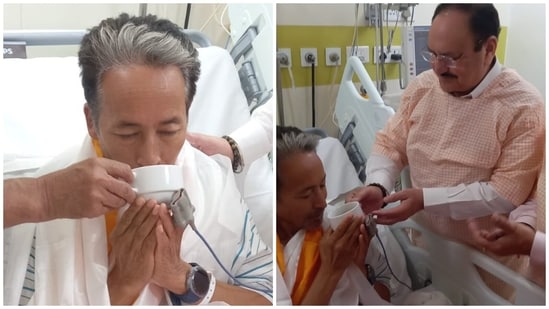
In a video, recorded from Medanta Hospital after ending his fast, Wangchuk said Union ministers JP Nadda, Jitendra Singh, along with leaders of the Ladakh Apex Body, met him late at night and conveyed the government's assurances.
The Centre, in a written statement, said it was "positive on not registering cases against those protesting peacefully at Jantar Mantar in Delhi and those participating in the march to Parliament on July 20."
ALSO READ | Sonam Wangchuk ends hunger strike after 26 days; PM Modi, Abhijeet Dipke react
The government also said it had "already assured threadbare discussions to find solutions to paper leaks and educational reforms for exams in the Parliament." It added that it was "also positively considering suitable compensations for the suicide victims of recent NEET paper leaks."
{{/usCountry}}The government also said it had "already assured threadbare discussions to find solutions to paper leaks and educational reforms for exams in the Parliament." It added that it was "also positively considering suitable compensations for the suicide victims of recent NEET paper leaks."
{{/usCountry}}Why Sonam Wangchuk broke his fast
“A short while ago, Union Ministers JP Nadda and Jitendra Singh came here. The top leaders of the Ladakh Apex Body were also present," Wangchuk said in a video posted to X.
He said the meeting followed support from lawmakers across party lines.
"Before that, as you all know, around 65 Members of Parliament from different political parties came here and signed a letter requesting me to end my hunger strike. They assured me that the issue of the NEET paper leak and the country's examination system would be discussed in Parliament. The ministers who came on behalf of the government also gave the same assurance," he said.
Wangchuk said he had insisted on a written commitment before ending his fast.
ALSO READ | CJP calls for nationwide stir today, firm on Pradhan’s exit
"For the past two days, we had been engaged in very tough negotiations because I wanted an assurance, and I wanted it in writing. That process took two days, which is why I had to continue my hunger strike for two more days. I was prepared to continue even longer if necessary, but finally today they have given the assurance," he said.
‘No action against peaceful protesters’
He added, "The statement from the government's side says that the government is positive about not registering cases against those who protested peacefully at Jantar Mantar in Delhi and those who participated in the ‘Chalo Sansad’ march on July 20.
The government has also assured a detailed discussion in Parliament to find solutions to paper leaks and bring reforms in the examination system. Besides this, the government is also positively considering suitable compensation for the families of students who died by suicide following the recent NEET paper leak.
From our side, I am grateful that the government has shown sensitivity towards the children who became victims and towards the youth who were peacefully protesting on those days."
‘End of hunger’
Announcing the end of his fast on X, Wangchuk wrote, "END OF HUNGER... BEGINNING OF ACCOUNTABILITY...!" He said he ended the fast after getting assurance from the government and MPs across political parties that "the issue of accountability in the failing examination system will be discussed on the floors of the Indian Parliament."
Wangchuk had been on an indefinite hunger strike since July 28. He was demanding accountability for the NEET paper leak and reforms in the country's examination system.
His fast drew support from opposition leaders, student groups and civil society organisations.