Grocery store owner
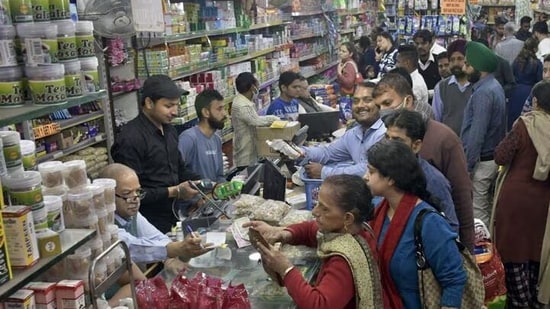
Musharraf Ali, 35, lives with his wife Rihanna Ali, 27, in a small two-bedroom house in northeast Delhi’s Ghonda neighbourhood. Originally from Uttar Pradesh’s Hardoi district, the couple does not have any children.
For the last 13 years, Ali has run a grocery store selling soft drinks, snacks, chocolates, rice, lentils, butter, ghee, etc. His annual income comes up to around ₹3.5 lakh per annum or around ₹30,000 a month.
He owns a two-bedroom house
Ali and Rihanna have been married for three years but not once have they gone out on vacation. Now, they are, however, saving up for a trip to Manali next year. “We have planned to go to the hills. We really hope we are able to execute it,” he said. The new changes in the Goods and Services Tax (GST) regime could help him – hotel rooms that cost less than ₹7,500 are set to get cheaper.
The grocery shop is open on all days but sometimes, the couple goes to the zoo or Jama Masjid. But they are careful. “We never spend more than ₹1000,” he said.
For Ali, the biggest benefit of the GST rejig will come in his household bill because milk, milk products, food, fruits, are set to become cheaper.
“It’s a welcome step as medicines, milk and other dairy products which people like me think twice about before spending on will become cheaper. We may start buying that without thinking a lot,” he said.
It’s a double-edged sword. A small seller like him stocks items in bulk for his shop, often on credit. Many items that he sells in the shop – such as ghee and packaged foods – will become cheaper. Depending on how much of the rate cut benefit the company chooses to retain, pass on to the wholesaler, and finally the consumer, his margins might also come under pressure.
“I am assuming that if prices come down, people will be able to buy items more frequently, which, in turn, would mean that my sales will go up, but it may also mean that my margin will become less. I will have to wait and watch,” he said.
But he’s sure of one thing. The GST cuts will not tempt him to make a big purchase soon. “A few thousand less on a television or air conditioner wouldn’t make me buy it because the cost will still be a lot,” he said.
Advocate
Delhi-based trial court advocate Ravi Drall, 37, lives in a joint family of 14 people, with his siblings working as teachers and government servants.
The joint family lives in a 10-bedroom family house in Tikri Kalan. Over the years, as the family has grown and children have married, they have added more rooms to accommodate more people.
Drall, who has a two-and-a-half-year-old son, earns about ₹10-11 lakh per annum but said his savings are minimal due to expenditure on groceries, utilities, play school fee and other bills. He said his four brothers and him pool in money and spend between ₹2-3 lakh per month on domestic expenses.
“Each day, we get close to 5 litres of milk. We also spend a lot on butter, bread, oil, ghee and vegetables. My brother’s wife just gave birth to a baby and as a family, we have to think of managing expenses now. I also have to think of a budget for blood pressure and sugar medicines,” he said.
On milk, bread, butter and other grocery items, the GST rate cuts hold good news. They are set to become significantly cheaper. “We will definitely benefit as right now, I feel that prices of milk and oil keep increasing,” he said.
But he is apprehensive about health care and life insurance. While the GST Council has reduced the tax on these products to nil from 18% earlier, Drall said companies might add other charges or taxes. “If I am taking a ₹1 lakh insurance for my son, why should I pay ₹18,000 as taxes? This was completely foolish and greedy…I hope the changes get implemented in the right way,” he said.
He was particularly happy over the rate cuts on life-saving medicines because the family has to spend thousands on young children and the elderly. Since he is a lawyer and has teachers and other working professionals in the family, the decision to reduce GST prices on stationery has made him happy. “Everyone likes to buy stationery at our home…it will definitely benefit us. I can’t say that some huge changes will be there. But we will have some relief, I think.”
Poultry business owner
At 42, Vikas Dhull epitomises the new-age wealthy entrepreneur in Gurugram.
A poultry business owner, Dhull lives in one of Gurugram’s upscale residential sectors with his wife and two school-going children. His life is defined by global travel, premium conveniences, and high-ticket indulgences. Yet, even for someone like Dhull, who embodies the lifestyle of India’s high-income families, the recent GST rationalisation can precipitate material changes.
The family lives in a sprawling five-bedroom apartment, equipped with the latest home appliances, gym equipment, and smart technology. Their monthly expenses reflect their status – school fees for his children run into ₹3 lakh a quarter, groceries and utilities amount to nearly ₹1 lakh a month, and another ₹2-3 lakh goes into paying for the domestic help, fuel, and dining out. His monthly income is around ₹1 crore.
He travels abroad every other month for business, mainly to West Africa, and combines work with short family getaways to destinations such as Dubai, Singapore, or Europe. “We are used to planning spontaneous trips. For us, travel has always been about freedom and comfort,” he said.
Dhull is worried that the new GST structure, while simplifying the regime, could make certain luxuries more expensive, particularly travel and high-end hospitality. Airfares, hotel tariffs, and international spends might bite into his planned expenses, even though everyday spends might track lower.
“Travel might get expensive now, and our plans for holidays will definitely be more thought-out. Instead of three or four trips abroad, we may settle for one long vacation and one domestic trip,” he said.
But Dhull sees an opportunity in other areas. With GST on goods such as ACs, refrigerators, and home appliances rationalised, he believes it’s the right time to invest in upgrading household equipment. “I was planning to change all the air conditioners at home, and now they have become cheaper. We will go ahead with that. In fact, for home appliances, GST changes are a boon,” he said.
The family is also evaluating bigger investments. Dhull has his eye on a luxury SUV (which might become more expensive), while discussions around upgrading to a larger apartment (which might also become more expensive) in Gurugram’s Golf Course Road remain on the table. His wife is keen on redoing the interiors of their current home, an expense likely to run into several lakhs.
For Dhull, the GST changes have introduced a balancing act. On one hand, everyday luxuries such as high-end gadgets and home improvements are becoming more attractive. On the other hand, discretionary spending on foreign travel will likely be pared down. “Luxurious life is going to get expensive in some ways. It’s about planning better now, not stopping,” he said with a smile.
Hemani Bhandari is a Special Correspondent with Hindustan Times in New Delhi, where she reports on crime, policing, governance and social issues. With over a decade of experience in journalism, she specialises in combining on-ground reporting with evidence-based storytelling to examine the human impact of public policy, law enforcement and urban governance. Over the years, she has reported extensively on major developments in the capital, including crime investigations, civic challenges, protests, and issues affecting vulnerable communities. As a Special Correspondent, she focuses on producing exclusive investigations, enterprise stories and long-form features that go beyond daily news cycles. She has a keen interest in using public records, official data and field reporting to uncover systemic issues and present complex subjects in an accessible manner. A graduate of the Asian College of Journalism, Hemani believes in rigorous, ethical and evidence-based reporting. She is passionate about investigative journalism and continuously seeks to expand her skills in data journalism, open-source investigations and digital reporting techniques.
Jignasa Sinha is a Special Correspondent at Hindustan Times in New Delhi. With more than six years of reporting experience, she covers crime and policing in the national capital. Her beats also include Delhi prisons, the Delhi Fire Services and Delhi courts, while she regularly reports on gender, labour and social justice. Over the course of her career, Jignasa has reported on major criminal investigations, international crime syndicates, high-profile cyber fraud cases, law-and-order developments, protests, disasters and public institutions. Her reporting combines breaking news with in-depth, long form, human interest stories that examine the human impact of public policy, policing and the criminal justice system. In addition to reporting for the newspaper, she contributes to the Hindustan Times website and app, and plays an active role in coordinating on-ground coverage of major developments and breaking news across Delhi. Before joining Hindustan Times, Jignasa worked at The Indian Express newspaper in New Delhi, where she spent five years covering crime, Delhi airport, courts and health. She began her journalism career as an intern at an AI magazine in Bengaluru while pursuing her postgraduate diploma in multimedia journalism at the Indian Institute of Journalism and New Media.
Leena Dhankhar is Senior Editor and Bureau Chief, Gurugram, at Hindustan Times, where she has spent over 17 years chronicling the transformation of one of India's fastest-growing urban regions. From starting her career as a crime reporter to leading the Gurugram bureau, her journalism has been defined by investigative reporting, in-depth storytelling and an unwavering focus on public interest. Over nearly two decades, she has reported extensively across crime, politics, civic governance, elections, real estate, environment, courts, sports, education and entertainment, covering Gurugram, Faridabad, Nuh and Palwal. Her reporting has exposed several major scams and systemic failures, including insurance frauds, waste management irregularities, illegal arms manufacturing units in Nuh, illegal mining in the Aravallis, organised crime networks and governance lapses affecting millions of residents. Known for her investigative work and exclusive stories, Leena has reported on high-impact national issues, including the Nicaragua charter flight carrying Indian migrants that was turned back amid allegations of human trafficking, exposing the growing network of illegal immigration rackets. Her work has also focused on gang wars, prison administration, juvenile crime, women and child protection systems, the functioning of the Juvenile Justice Board and Child Welfare Committee, and environmental challenges such as pollution, waterlogging and deteriorating civic infrastructure. Beyond hard news, Leena has extensively documented Haryana's rich heritage, forests and wildlife, bringing attention to the state's historical landmarks, biodiversity, conservation efforts and ecological challenges through immersive reportage and feature writing. Her journalism has consistently gone beyond breaking news. She has documented Gurugram's rapid urbanisation through long-form narratives and enterprise reporting on issues ranging from pothole-ridden roads, flooding and waste management to the changing social fabric of India's Millennium City. She also writes widely read feature columns, including The Outsider, Changemaker, and Concern for Gurugram, profiling people, places and ideas shaping the city's identity. Leena is the author of Gurugram School Murder, published by Juggernaut Books, a deeply reported account of one of India's most high-profile school murder investigations. She is currently working on her second book, an investigative work exploring some of India's most significant scams and fraud investigations. Beyond print journalism, she has expanded her storytelling through public speaking and digital media. She is a TEDx speaker and has produced podcasts exploring Gurugram's transformation, civic challenges and untold stories. Her work reflects a commitment to narrative journalism that combines rigorous reporting with compelling storytelling. A law graduate with an MBA in Human Resources, Leena brings a multidisciplinary perspective to her reporting, particularly on governance, public policy and legal affairs. She has travelled extensively across India to pursue investigative assignments, often reporting from remote locations and conflict-prone areas in search of stories that matter.