The Supreme Court on Wednesday reserved its judgment while hearing the review petitions on its order allowing entry to all women in the Sabarimala Temple.
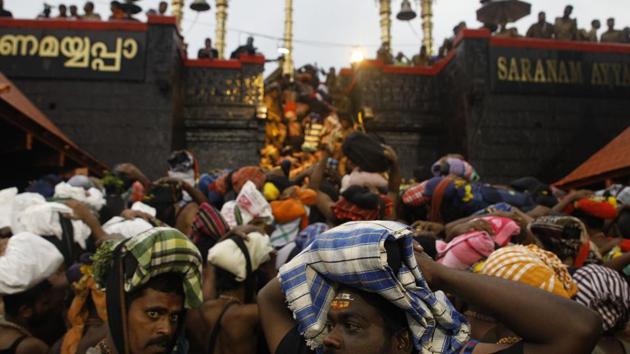
During the course of the hearing on Wednesday, the Kerala government submitted before the Supreme Court that exclusion of women is “not essential to Hindu religion”. The state government made its submission during the hearing of the review petitions against the Court’s Sabarimala order allowing women entry into the hill shrine.
Subsequently, the entry of two women into the shrine had sparked off massive protests in Kerala by traditionalists and had triggered a political slugfest between the CPI(M) and the BJP.
The Kerala government’s counsel, Jaideep Gupta, said, “The essential practice of a religion and essential practice of a temple cannot be confused. The Court found that the practice was not an essential practice of Hindus. Essential practice of an individual temple will not amount to essential practice of the religion for the purpose of constitutional test.”
The Kerala government’s counsel said that the state was opposing the review. “Nothing has been placed before the court that requires reconsideration. The matter is not required to be reviewed at all,” the state’s counsel said.
{{/usCountry}}The Kerala government’s counsel said that the state was opposing the review. “Nothing has been placed before the court that requires reconsideration. The matter is not required to be reviewed at all,” the state’s counsel said.
{{/usCountry}}Also read: Not 51, only 2 women entered Sabarimala Temple, Kerala govt concedes
The Kerala government submitted that when the court had given its order on Sabarimala, it had reached a consensus on three issues: One is that Sabarimala is not a denominational temple, second was that a person’s right to worship in a temple is taken away together for a major part of that person’s life, and the third aspect was that the rule violated the act governing temples itself.
The Travancore Devaswom Board on Wednesday said that it supported the entry of women of all ages in Sabarimala Temple.
“Text and scriptures do not speak of exclusion of women or the practise,” senior advocate Rakesh Dwivedi representing the Board said.
When Justice Indu Malhotra, the lone woman judge on the bench and who was part of the bench that issued the order on Sabarimala Temple, reminded Dwivedi that the board had earlier argued against the entry of women to the temple, he replied, “The Board has decided to respect the court’s verdict.”
“Equality is the dominant theme under the constitution and the practice violates equality. Spirit of the judgment is equal treatment to a man and woman,” Dwivedi said.
“Women can’t be excluded on the basis of biological attributes,” Dwivedi said.
Senior advocate Indira Jaising who was appearing on behalf of the two women who entered the temple said that it was not an exclusion but a social boycott.
“Purification ceremony validates the argument that practice is based on notions of untouchability,” she said.
She said that the Sabarimala Temple is a public and not private temple.
“Lord Ayyappa does not discriminate between man and woman. There is no difference in the eyes of God. If my conscience dictates me to worship the Sabarimala deity, I like to know who will stop me,” Jaising said.
Jaising says, “If the judgment was against women they would not have rioted. Women do not go to war.”
Earlier, opening his argument senior advocate K Parasaran, appearing for the Nair Service Society, said, “The exclusionary practice in Sabarimala is based on the character of the deity.”
“Untouchability has nothing to do here. Entry (to Sabarimala temple) is sought to be prohibited only due to nature of deity. It is not an exclusionary practice,” said advocate V Giri appearing for the priest.
Talking about the exclusion of women at Sabarimala temple, the Kerala government submitted, “If it’s a denominational temple only then the question of essential practice will arise.”
“The Jagannath temple is unique in it’s practise and yet this court has held it’s not a denominational temple. Similarly, Kashi Vishwanath and Tirupati have been said not to be denominational,” it said.
“This is a public temple and because it is one, there is a Kerala Act which deals with it and says it shall be open to all Hindus of all classes of all categories without exception. It is not a private law issue but one of public law,” the Kerala government said.
Referring to the petitions that stated that the Court’s order had destroyed social peace, the state government said, “Social peace has been destroyed is a ground cited by the petitioners. This cannot be a ground for review. We know social peace will come.”