Farm fires gone, weather now polluting Delhi’s air?
The recent spike in Delhi's air pollution comes despite a fall in the contribution of pollutants from stubble burning and underlines the importance of climatic conditions in pollution levels, not just in Delhi but entire north India.
The Union government told the Supreme Court on Friday that it is constituting an enforcement task force and 17 flying squads to implement pollution control measures through surprise checks, inspection and closure of polluting units. On Thursday, the top court observed that it could set up a task force itself since “nothing is really happening to control pollution”.
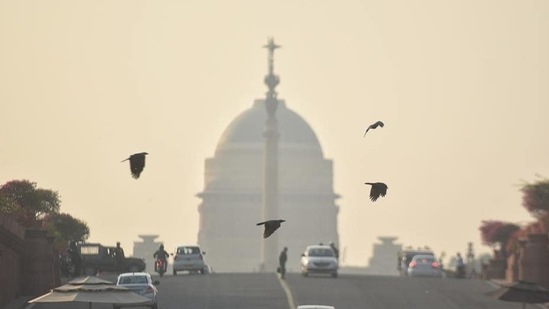
Delhi’s Air Quality Index (AQI) has been in the “severe” category in four out of the last seven days ending December 2, (HT Photo/Sanchit Khanna)
The court is not wrong about the pollution problem. Delhi’s Air Quality Index (AQI) has been in the “severe” category in four
Data from the SAFAR database shows that the farm fires had a very different role to play in the spike in overall pollution levels in the beginning and end of November. Stubble burning contributed to 8% of the PM2.5 concentration in the period between October 30 and November 3. This increased to 30% between November 9 and 13. The average contribution of stubble burning to PM2.5 levels was 4% in the last week of November. This data corroborates a satellite-based count of number of farm fires in the adjoining states.
To be sure, there need not be a one-to-one correspondence between farm fires and their polluting impact on Delhi, as was explained by HT on November 16.
What explains the recent spike in pollution?
Probably it’s the weather. There has been very little rain, low wind speed and day time temperatures have been lower than average.
Low rains in November didn’t help
One reason why October air in Delhi and large parts of north India was cleaner than usual was the very high rainfall washing away the pollutants in air in the literal sense. The tables have turned in November, with most north-Indian states experiencing lower than normal rainfall in November. Punjab, Haryana, Delhi, Uttar Pradesh, and Bihar – all received rainfall 150% or more above the long period average or LPA (the average of rainfall in 1961-2010 period) for October. This was among the top 10 years of highest October rainfall since 1901 in all these states except Haryana, where it was the 18th highest. This helped these states in October, as rainfall washes away the pollutants. This advantage vanished in November. None of these states received even half a millimetre of rainfall when the LPA for November ranges from 3.6 mm in Haryana to 6.2 mm in Bihar.
Neither did low day-time temperatures
Higher day-time temperatures can prevent accumulation of pollutants close to the ground during the day when vehicular and industrial pollutants are more likely to be added to the air. While November in itself is colder than October, this year the day-time temperatures in November also deviated further below normal. Average maximum temperature for November in Delhi was 6.1% below the 1981-2010 average in the month of November.
The statistics described above show clearly how Delhi’s pollution levels remain at the mercy of meteorological factors. The December 2 air quality forecast on the SAFAR website speaks for itself, “The AQI today (December 2) indicates ‘very poor’ air quality. For the next three days, winds are likely to be calm reducing ventilation leading to deterioration of air quality but within the same category. From 6th Dec onwards winds are expected to increase dispersing pollutants but AQI likely to remain in ‘very poor’ category. Partly cloudy sky and low mixing layer height are preventing efficient dispersion of pollutants”, the forecast says.
Abhishek Jha is Assistant Editor-Data at Hindustan Times. He uses statistical programming to generate newsworthy insights from large datasets. He is part of the team that produces Number Theory, a daily data story feature of the paper’s print edition. Since March 2024, he has been writing Weather Bee, a weekly column for the Hindustan Times website. He is a chemical engineer by training, who specialises in stories related to weather, climate, and the environment. Jha has been at HT since 2018, where he offers data-driven perspective and analysis on politics, environment, weather, climate, economy and society. His work includes data coverage of elections in India and abroad, including the 2019 and 2024 Lok Sabha elections; the disasters and extreme weather resulting from changing climate, such as floods, droughts, heat waves, cold waves, and dwindling snow cap in the Himalayas; the factors that drive poor air quality in northern India; the changing patterns of land use; the Covid-19 pandemic and its impact on labour market conditions; the changing pattern of consumer spending seen in the new consumer spending surveys; and social norms seen in the surveys such as the National Family Health Survey.
Get the latest India News, breaking headlines, and real-time updates from across the nation. Stay informed on politics, government policies, crime, weather, and CEC Gyanesh Kumar row Live.
Get the latest India News, breaking headlines, and real-time updates from across the nation. Stay informed on politics, government policies, crime, weather, and CEC Gyanesh Kumar row Live.
Home/India News/Farm fires gone, weather now polluting Delhi’s air?
{{^htLoading}}
Advertisement
{{/htLoading}}
SHARE THIS ARTICLE ON
{{#usCountry}}{{/usCountry}}
Notifications
Get breaking alerts directly from the newsroom
Notifications are on!You'll be notified when news breaks