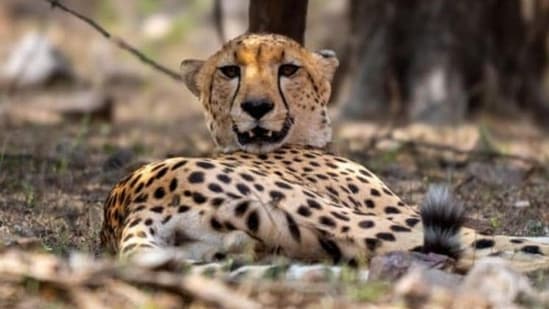
All four wild-born cheetah cubs at Kuno National Park were found dead, likely killed by a leopard. Their mother is safe, and investigations are ongoing.
All four cubs of cheetah KGP12, born in the wild at Kuno National Park (KNP) in Sheopur, were found dead on Tuesday, senior KNP staff aware of the matter said, adding that a leopard allegedly killed them.
An African Cheetah spotted in the Ranthambore Tiger Reserve, Rajasthan. (X/Arijit Banerjee)
{{^htLoading}} {{/htLoading}}
The carcasses of the cubs, born a month ago on April 11 and celebrated as the country’s first wild-born cheetahs, were discovered near their den site, and the monitoring team found their half-eaten bodies in the forest. Their mother was located safe and roaming nearby, according to an official.
{{^usCountry}}{{/usCountry}}
“The cubs were constantly monitored. On May 11, they were alive and healthy. But on Tuesday morning, they were found dead with deep wounds and partially eaten bodies. Prima facie, a leopard attacked them,” said KNP field director Uttam Sharma. He added that the carcasses have been sent for post-mortem to ascertain the cause of death.
KGP12 is the offspring of Gamini, a South African-born cheetah. Her litter marked the first time an Indian-born cheetah raised in the wild had given birth outside an enclosure. Forest officials had hailed this as a significant milestone toward the project’s core objectives including ensuring survival and breeding under natural conditions.
{{^htLoading}} {{/htLoading}}
{{^usCountry}}
Currently, forest officials are closely monitoring the area and the other 14 adult cheetahs roaming freely in the wild.
{{/usCountry}}
{{#usCountry}}
Currently, forest officials are closely monitoring the area and the other 14 adult cheetahs roaming freely in the wild.
{{/usCountry}}
Over the past three years, 57 cubs were born at KNP. Of the 37 remaining, only four were born in the wild, while 33 were raised in a soft-release enclosure. Following this incident, only 33 cubs remain alive. In total, 50 cheetahs are present at KNP, with an additional three at Gandhi Sagar Wildlife Sanctuary.
I have spent over a decade chronicling Madhya Pradesh’s political and social landscape, covering politics, investigative journalism, crime, human interest, and government policy, blending sharp insight with ground‑level depth. I have closely tracked three assembly elections, three Lok Sabha elections, leadership transitions in MP while exposing governance lapses, tender irregularities, and flawed policy rollouts. My reports have revealed gaps in the Cheetah project, irregularities in medical education, rigging in recruitment exams, and loopholes in policy implementation. In crime reporting, I have moved beyond FIRs to map systemic patterns — from organised crime networks and gender‑based violence to custodial accountability — balancing urgency with sensitivity. My journalism is defined by a commitment to human interest. I have profiled the marginalised Bancchda community, documented atrocities against tribal groups, and highlighted efforts to preserve their culture through heritage liquor and revival of spiritual practices. I have reported on farmers struggling with failed MSP promises, giving voice to those often reduced to statistics in policy files. Passionate about field reporting, I have reported on rampant sand mining in Chambal and Narmada, pharmaceutical companies supplying medicines under altered names, the dire condition of schools and colleges, the plight of commercial sex workers, and skewed sex ratios in specific districts. Beyond deadlines, and as HT’s state correspondent and assistant editor in Madhya Pradesh, I engage with ministers, farmers, students, and activists, believing the best policy stories begin with a single human voice. A postgraduate in Journalism and Mass Communication, I also hold a diploma in sports journalism.
Get Latest News, breaking headlines, and top India News, and today real-time updates from across the nation. Stay informed on politics, government policies, crime, Today Weather, and major developments on Hindustan Times
Get Latest News, breaking headlines, and top India News, and today real-time updates from across the nation. Stay informed on politics, government policies, crime, Today Weather, and major developments on Hindustan Times
Home/India News/Four newborn cheetah cubs found dead at KNP
{{^htLoading}}
Advertisement
{{/htLoading}}
SHARE THIS ARTICLE ON
{{#usCountry}}{{/usCountry}}
Notifications
Get breaking alerts directly from the newsroom
Notifications are on!You'll be notified when news breaks