A diplomatic gift is rarely just a gift. For centuries, world leaders have exchanged everything – from statues and artworks to elephants, pandas, dogs and even cats — objects and animals that showcase a country’s culture and signal goodwill.
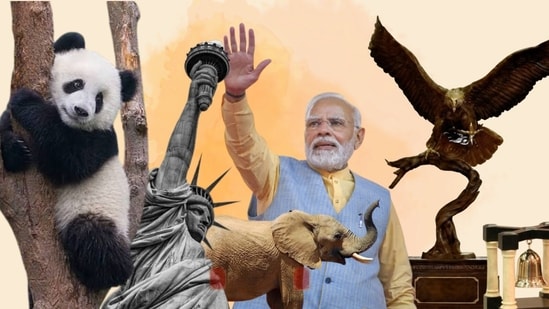
In a more recent show of “gift diplomacy”, US President Donald Trump on Thursday presented Chinese President Xi Jinping with a sculpture of a bald eagle, a bird native to North America and Washington’s national symbol.
In turn, the Chinese leader promised two giant pandas to Zoo Atlanta, reviving Beijing’s decades-old tradition of using pandas as a diplomatic gesture, on the opening day of his first state visit to the US in more than a decade.
Deep Dive
What is the significance of diplomatic gifts exchanged between world leaders?
Why are pandas historically used as gifts in China's diplomacy?
How does India's gift diplomacy reflect the country's cultural values?
Why do leaders give gifts?
Diplomatic gifts come in all shapes and sizes. Some as quirky as metal wine cooler shaped like a giant grasshopper, which was gifted to the Queen by President Pompidou of France in 1972, to monumental gestures such as the Statue of Liberty, presented to the United States by the people of France in 1884.
{{/usCountry}}Diplomatic gifts come in all shapes and sizes. Some as quirky as metal wine cooler shaped like a giant grasshopper, which was gifted to the Queen by President Pompidou of France in 1972, to monumental gestures such as the Statue of Liberty, presented to the United States by the people of France in 1884.
{{/usCountry}}Over time, these gifts have come to serve several purposes: representing national identity, commemorating shared history, showcasing a country’s culture, signalling friendship or a thaw in relations, and creating a personal connection between leaders. At times, they can also carry a political or diplomatic message.
In a stark example of commemorating shared history, Belgian Prime Minister Bart De Wever, who was on a visit to New Delhi in early September, said that he had a “fitting gift” for India - a sculpture of India Gate made entirely out of the finest Belgian chocolate. While the sculpture did not survive the journey to India, it marked a small, sweet reminder of the ties between the two countries that began more than a century ago on the battlefields of Flanders.
China’s Panda diplomacy
Since the founding of the People’s Republic of China in 1949, Beijing has used giant pandas as a gesture of goodwill towards its international allies and competitors. The first such instance came in 1957, when Chinese leader Mao Zedong gifted two giant pandas, Ping Ping and Qi Qi, to the Soviet Union to mark the 40th anniversary of the October Revolution, according to the BBC.
In 1965, Mao gifted a panda to North Korea for the first time. And by 1980, at least five pandas called North Korea home. China has also gifted Pandas to the United States, Japan, and Malaysia. Australia was loaned two Pandas in 2009, while Canada and France received pandas in 2012.
India and its gifts to world leaders
India’s gift diplomacy began as soon as 1949, just two years after its independence, when the children of Japan wrote a letter to then Prime Minister Jawaharlal Nehru, asking him to send them an elephant, saying that they had never seen one live. The prime minister took up the offer and sent to Japan on October 1, an elephant named after his own daughter, Indira.
In a similar request from the children of Berlin, Nehru sent to them “Dhatri”, found in the forests of Malabar in South India. “An elephant is one of our biggest and strongest animals and yet, for us, it is a symbol of peace,” he had said.
As per orfonline.com, Atal Behari Vajpayee, who was the Prime Minister then, had gifted then US President Bill Clinton a silk carpet in 2003.
Manmohan Singh, who became the prime minister in 2004, gifted George W Bush a marble tabletop inlaid with precious stones that reflected the colours of both the Indian and the American flags. The next year, a silver box with the designs of the Diwan-e-Am (Hall of Audience) was presented by PM Singh to Bush.
Prime Minister Narendra Modi is also known for gifting foreign leaders objects that showcase India’s diverse art and craft traditions. In a speech, Modi said that when he meets foreign heads of state, he tries to ensure that the gifts he presents are made by India’s tribal artisans.
In 2015, PM Modi gifted then-British PM David Cameron with handcrafted bookends made of wood, marble and silver, featuring silver bells engraved with verses from the Bhagavad Gita.
He also presented South Korean President Park Geun-Hye two finely woven pashmina stoles on which a poem that Rabindranath Tagore had written specially for Korea is hand embroidered in English and Korean.
In 2004, PM Modi gifted a silver antique train model to the then US President Joe Biden and a pashmina shawl to his wife, then First Lady, Jill Biden. The train model is made of 92.5 per cent silver and is a rare hand-engraved piece exhibiting the craftsmanship of artisans from Maharashtra.
In another thoughtful gift, the prime minister gave then US First Lady Jill Biden a 7.5-carat green lab-grown eco-friendly diamond. The diamond was placed in a box made of paper pulp, known as kar-e-kalamdani.
Also Read: Modi’s gift to Putin: A Tamil classic that offers army lessons on statecraft
In May 2026, PM Modi gifted the Prime Minister of Sweden, H.E. Mr. Ulf Kristersson a set of collected works of Rabindranath Tagore, along with a specially handcrafted bag from Shantiniketan with motifs that Gurudev chose to empower local artisans.
In turn, Kristersson gave PM Modi a box containing two replicas of hand-written epigrams by Gurudev Rabindranath Tagore, accompanied by a small explanatory text and a photograph of Gurudev Tagore taken in 1921 during his visit to Uppsala University.
These gifts symbolise the shared cultural and intellectual heritage between India and Sweden, and pay tribute to the enduring legacy of Rabindranath Tagore. It also serves as a striking example of how historical and cultural ties can shape the gifts chosen in diplomacy.
During the recent BRICS Summit held in New Delhi, media delegates were given goodie bags filled with Sattu from Bihar, coffee from Odisha, a scarf from Gujarat.
These exchanges between leaders are not merely a formality; but symbolise mutual respect, shared cultural and historical ties, and the bonds between nations. In diplomacy, a gift may be a simple object, but the meaning behind it can extend far beyond the gesture itself.