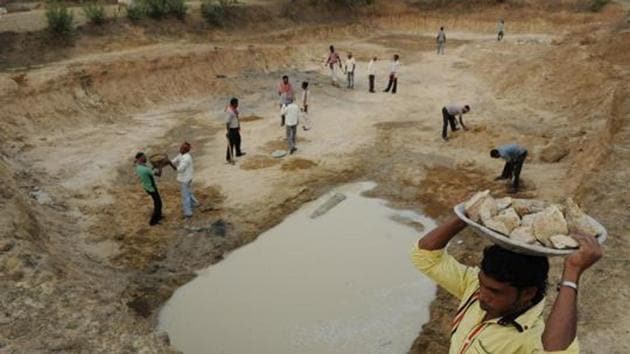
The government is reorienting its flagship rural employment guarantee scheme, the Mahatma Gandhi National Rural Employment Guarantee Scheme (MGNREGS), towards water conservation by reserving at least 75% of the 2.58 billion person days expected to be generated during 2019-20 to boost water storage and agricultural activities in the country, according to the rural development ministry. The corresponding proportion was 67% in 2018-19.
The move comes even as large parts of India reel under the impact of a water shortage, and with drought looming large in some cases. The IMD said on Monday that at 33%, the month of June saw the biggest deficiency in rains since 2015. Data from the Central Water Commission on June 27 said of the 91 major reservoirs in the country, 62 reported 80% or below normal levels.
The Centre has also targeted completing one million natural resource management (NRM) projects linked to water during its first 100 days, according to official documents reviewed by HT. These projects include both individual and community assets such as farm ponds, dug wells, check dams and trenches. “There are 168 different types of structures that can be built under MGNREGS, mostly for water conservation. In the past four years, the Narendra Modi government has invested roughly ₹1.20 lakh crore in water conservation under MGNREGS,” said rural development secretary Amarjeet Sinha.
In terms of funds, 74% of MGNREGS funds have been earmarked for water management in FY19-20, up from 63% in FY18-19. The rural ministry’s initiative coincides with the ambitious Jal Shakti Abhiyan, piloted by the Jal Shakti ministry, to put in place measures for rainwater harvesting, water conservation and replenishing water bodies. The Jal Shakti Abhiyan was rolled out on Monday. Water has become the key focus area of the government and Prime Minister Modi called for turning conservation of water into a mass movement, in his first Mann Ki Baat radio programme after the national election. On Sunday, during the widely broadcast outreach initiative, which was launched in his first term, Modi urged the people to save every drop of water and share traditional methods of water conservation. He also asked them to share information on people who have been able to make significant progress in the movement.
{{/usCountry}}In terms of funds, 74% of MGNREGS funds have been earmarked for water management in FY19-20, up from 63% in FY18-19. The rural ministry’s initiative coincides with the ambitious Jal Shakti Abhiyan, piloted by the Jal Shakti ministry, to put in place measures for rainwater harvesting, water conservation and replenishing water bodies. The Jal Shakti Abhiyan was rolled out on Monday. Water has become the key focus area of the government and Prime Minister Modi called for turning conservation of water into a mass movement, in his first Mann Ki Baat radio programme after the national election. On Sunday, during the widely broadcast outreach initiative, which was launched in his first term, Modi urged the people to save every drop of water and share traditional methods of water conservation. He also asked them to share information on people who have been able to make significant progress in the movement.
{{/usCountry}}Officials familiar with the matter said high-level teams have been constituted in 254 districts before the launch of the programme, and engineers and technical staff have been placed in 1,539 blocks across the country to take stock of the ground water levels, the state of aquifers, and ponds and water bodies that may have been encroached upon over the last two decades.
On October 2, the birth anniversary of Mahatma Gandhi, the government will recognise villages that come up with “exemplary” innovations in water management.
According to the documents reviewed by HT, of the 2.58 billion person days of work to be generated in this financial year under the job guarantee scheme, 1.95 billion will be on projects related to water and agricultural activities, while 630 million person days are expected to go into another focus area for the government: housing. Specifically, this time will be spent on building seven million rural houses under the Pradhan Mantri Aawas Yojna. The Centre has so far released ₹26,891.54 crore under the scheme.
With only 4% of the world’s water resources and 16% of the global population, according to the National Water Policy 2012, India’s water crisis is headed towards an inflection point. The country’s per capita availability of usable fresh water is about 1,123 cubic metres, down from about 4,000 cubic metres in 1947, and against the current global average of 3,000 cubic metres.
MGNREGS, a landmark anti-poverty programme launched by the previous UPA government, has been more tilted towards asset creation under the present government, rather than being a purely wage-driven programme. It offers 100 days’ employment to the poor at federally fixed minimum wages and 60% of its funds must go to agriculture and allied activities. The scheme completed 10 years in 2016. According to McKinsey Consulting’s 2030 Water Resources Group, India will be one of the largest centres of agricultural demand for water by 2030, with projected withdrawals of 1,195 billion cubic metres in 2030. This will require a doubling of its usable water generation. About 90% of India’s available water goes into agriculture, according to government data.
Former Union rural development secretary Jugal Kishore Mahapatra said: “From its early days, MGNREGS had spent a considerable part of its funds and person days for water-related work. But this year, there is certainly an added emphasis and importance on water in the MGNREGS work. In states such as Maharashtra, Madhya Pradesh and Jharkhand, a lot of emphasis is given to water under MGNREGA. In the context of the PM’s message and the crisis of water, I think it’s an important step in the right direction.”