A key government committee that decides whether projects can proceed on protected forest land is considering approving a hydroelectricity project in Jammu and Kashmir that is one of six strategic hydropower developments aimed at optimising India’s use of Indus waters while the treaty with Pakistan remains suspended.
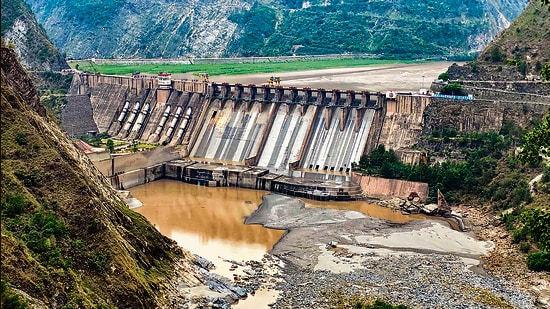
The 1,856MW Sawalkot project in Ramban, which received environmental clearance in 2018, has been awaiting forest approval for over six years. According to documents on the Union environment ministry’s Parivesh website, the project was considered for forest clearance on Tuesday.
Their decision on the project is expected to be published soon in the minutes of the meeting.
India suspended the World Bank-brokered Indus Waters Treaty with Pakistan a day after terrorists killed 26 people in Pahalgam on April 22. The move has accelerated New Delhi’s push to develop hydropower infrastructure on rivers allocated to Pakistan under the 1960 agreement.
While government officials and political leaders have declared that no water from India’s share will be allowed to flow into Pakistan, India does not currently possess any major infrastructure – such as dams or barrages – to exert significantly more control than it does at present.
India has lined up plans for a slew of projects in the J&K region to potentially tap into more of the rivers for its electricity needs. The Sawalkot project has already received clearance from the Geology and Mining department.
{{/usCountry}}India has lined up plans for a slew of projects in the J&K region to potentially tap into more of the rivers for its electricity needs. The Sawalkot project has already received clearance from the Geology and Mining department.
{{/usCountry}}The National Hydroelectric Power Corporation (NHPC) project will involve diversion of 847.17 hectares of forest land and 554.18 hectares of non-forest land across Mahore, Ramban, Batote and Udhampur divisions. The run-of-the-river scheme, estimated to cost over ₹20,000 crores, will harness the Chenab river’s flow for electrical power generation.
Originally allotted in 1999 to the Sawalkot Consortium by the Jammu and Kashmir government, the project remained dormant for over two decades with minimal progress. The Chenab river currently hosts three operational hydro projects: the 390 MW Dulhasti power station at Kishtwar, 890 MW Baghliar project in Ramban, and 690 MW Salai hydro project in Reasi.
The clearance process has highlighted security sensitivities surrounding Indus basin projects. When the ministry of environment, forest and climate change sought carrying capacity and cumulative impact studies in January, NHPC responded on May 14 that such data cannot be published due to security reasons, given that the Chenab and Jhelum rivers fall under the Indus Water Treaty framework.
This week’s FAC deliberations follows a high-level meeting chaired by Union home minister Amit Shah on April 25, after which authorities in the Jal Shakti ministry and NHPC began working to expedite all hydropower projects under construction.
As HT reported on May 5, India plans to create nearly 12 gigawatts of additional hydropower from new projects on Indus rivers, for which feasibility studies have been ordered. The projects include Pakal Dul (1,000 MW), Ratle (850 MW), Bursar (800 MW), Kiru (624 MW), and Kirthai 1 and 2 (1,320 MW), all designed to be fully synchronisable with the national grid.
India has been calling for renegotiation of the water-sharing pact due to diminishing flow rates in rivers running through Kashmir, attributed to natural changes in the basin. Recent scientific research has shown that climate change is affecting the Indus basin’s eastern and western tributaries differently, with eastern rivers expected to peak by 2030 while western rivers may not peak until 2070, potentially making previous agreements based on natural equivalences at the time irrelevant.
“The treaty in its preamble says that it is concluded in the spirit of goodwill and friendship. The obligation to honour the treaty in good faith is fundamental to it,” said Kirti Vardhan Singh, minister of state for environment, forest and climate change, at last month’s High-Level International Conference on Glaciers’ Preservation. “However, the unrelenting cross-border terrorism from Pakistan interferes with our ability to exploit the treaty as per its provisions. Pakistan, which itself is in violation of the treaty, should desist from putting the blame of the breach on India.”