The Union government on Monday introduced the Indian Statistical Institute (ISI) Bill, 2026 in the Lok Sabha, proposing to repeal the 67-year-old Indian Statistical Institute Act, 1959 and replace the premier institution’s society-based governance structure with a statutory framework centred on a government-accountable Board of Governors (BoG), a move that would fundamentally alter how the institute is governed, how its director is appointed and how key academic decisions—from admissions and curriculum to new courses and collaborations—are taken.
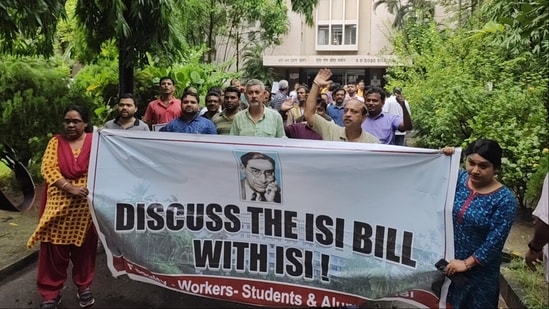
The government said the legislation would modernise the institute and enable it to emerge as a globally recognised centre for statistical sciences and allied disciplines. However, sections of the ISI faculty, students and staff have opposed the move, arguing that it would dilute the institute’s autonomy by centralising decision-making through BoG and increasing the Centre’s control over academic and administrative affairs. A CPI(ML) MP has also sought the Bill’s scrutiny by a parliamentary committee.
Introducing the Bill, minister of state for statistics and programme implementation Rao Inderjit Singh said it seeks to provide a “comprehensive statutory framework” to enable ISI to “excel as a globally recognised centre in statistical sciences and allied fields.”
Under the existing legal framework, ISI is an Institution of National Importance under the ISI Act, 1959, but is administered through the ISI Society, which is registered under the West Bengal Societies Registration Act, 1961. The proposed legislation repeals the 1959 Act instead of amending it and converts ISI into a statutory body corporate governed by a Board of Governors. The new bill proposes that ISI would be incorporated as a statutory “body corporate,” replacing its current status as a registered society. This is aimed at strengthening its governance, promoting academic excellence and research, and enabling it to serve the emerging needs in the field of statistics and allied disciplines towards Viksit Bharat, bill says.
Founded by statistician Prasanta Chandra Mahalanobis in 1931, ISI played a pioneering role in developing India’s statistical system, laid the foundation for the National Sample Survey Organisation (NSSO), contributed to the country’s planning process and housed India’s first electronic computer in 1956. Parliament declared it an Institution of National Importance through the ISI Act, 1959, which was amended in 1995 to expand its degree-awarding powers beyond statistics to subjects such as mathematics, quantitative economics and computer science. Under the existing Act, ISI runs 3 undergraduate, 8 postgraduate, 6 diploma, certificate courses apart from the PhD programme.
{{/usCountry}}Founded by statistician Prasanta Chandra Mahalanobis in 1931, ISI played a pioneering role in developing India’s statistical system, laid the foundation for the National Sample Survey Organisation (NSSO), contributed to the country’s planning process and housed India’s first electronic computer in 1956. Parliament declared it an Institution of National Importance through the ISI Act, 1959, which was amended in 1995 to expand its degree-awarding powers beyond statistics to subjects such as mathematics, quantitative economics and computer science. Under the existing Act, ISI runs 3 undergraduate, 8 postgraduate, 6 diploma, certificate courses apart from the PhD programme.
{{/usCountry}}The new Bill expands the institute’s mandate beyond statistics to include data science, computer science, cryptology and other quantitative sciences, while empowering it to establish campuses in India and abroad, promote industry collaborations, create endowment funds and generate its own revenue.
Governance overhaul
The most significant changes relate to governance. At present, ISI is governed through three principal bodies—the ISI Society, the ISI Council and the Academic Council.
The ISI Society, comprising elected and nominated members from within and outside the institute, is the apex representative body. Its president appoints the chairperson of the ISI Council. The Council, consisting of elected and nominated members, including eminent scientists, academicians and government nominees, oversees the institute’s administration and appoints the director. The director, in consultation with the Council chairperson, appoints the heads of ISI’s centres, all of whom report to the director at the Kolkata headquarters.
The Bill replaces this structure with a Board of Governors (BoGs), which will become the institute’s principal executive and policy-making authority. The Board, headed by a chairperson appointed by the President on the recommendation of the Central government, will appoint the director and exercise final authority over academic, administrative, financial, personnel and developmental matters. The Bill also states that the Board will be accountable to the Central government. The legislation further strengthens government oversight by making the President of India the Visitor of the institute with powers to order reviews and inquiries and authorising the Centre to issue directions to the institute.
Academic changes
The Bill retains the Academic Council, headed by the director and comprising all full-time professors and faculty members, as the institute’s principal academic body. However, several of its powers become recommendatory.
Decisions relating to admissions, curriculum, introduction or discontinuation of academic programmes, award of degrees and diplomas, academic collaborations and other academic matters would originate in the Academic Council but require the approval of the Board of Governors, which will have the final say. The appointment process for the director will also change. Under the existing system, the director is appointed through the institute’s society-based governance mechanism. Under the proposed law, the appointment will be made by the Visitor from a panel recommended by a search-cum-selection committee constituted under the new statutory framework.
Although the Bill enables ISI to institute fellowships and scholarships, it does not provide a statutory entitlement to research stipends, an issue flagged by sections of the student community.
Opposition from faculty and students
Sections of the ISI community have argued that the proposed law fundamentally alters the institute’s governance without adequate consultation. In a joint statement issued on August 1, faculty, students and staff said the Bill replaces a democratically represented Council with a central government-appointed Board of Governors, curtails the role of the Academic Council and converts ISI into a statutory body corporate “without consulting the ISI Society or the institute’s other bodies.”
Faculty members have further expressed concern that the Bill does not explicitly recognise Kolkata as ISI’s headquarters, could require years of rewriting rules and regulations and may disrupt academic functioning during the transition. Opposing the Bill, faculty members along with students and non-teaching staff held a protest March at ISI headquarters in Kolkata on Monday.
Separately, CPI(ML) Liberation MP Raja Ram Singh on Monday wroted minister Singh seeking that the Bill be referred to a parliamentary committee, arguing that legislation affecting an Institution of National Importance should undergo wider stakeholder consultation before being enacted as it has “far-reaching consequences.”