While Prime Minister Narendra Modi was celebrating the victory of 1971 war at a reception hosted by Army Chief Gen Manoj Pandey, the Defence Research and Development Organization (DRDO) conducted the developmental trial for India’s nuclear missile spearhead Agni-V from A.P.J. Abdul Kalam Island in Odisha.
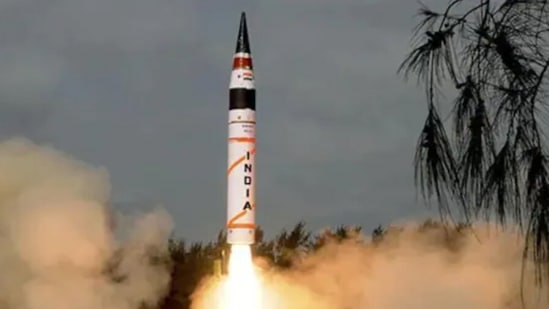
While the national security establishment is tight-lipped about the test, indications are that the DRDO was testing use of composite material including composite motor to develop an enhanced range missile. “For a missile, there is no such thing as night or day trial…..as it is, the trial was conducted at 530 pm….the development trial went off in a perfect fashion….with this the missile range could be enhanced by a couple of hundred kilometers to suit requirements of the Strategic Forces Command,” said a government missile expert.
The timing of the test firing of the three-stage solid fuelled delivery platform with single warhead was interesting as it came soon after Indian Army repelled some 600 belligerent PLA troopers from occupying heights for tactical reason in Yangtze area of Tawang sector in Arunachal Pradesh on December 9. The Agni V ballistic surface launched ballistic missile and 3000 km range K-4 nuclear submarine launched ballistic missile are the spearheads of India’s nuclear triad and as part of its minimum credible deterrent nuclear doctrine. The newer range of India’s ballistic missile submarines will be carrying the K-4 missiles to deter any belligerence in the Indo-Pacific. The last Agni V user trial was conducted in October 2021 with DRDO having capacity and capability to build longer range missiles if the government so desires as part of its nuclear strategy.
While Agni-V has the range to deter any Chinese misadventure with its capacity to strike in Han main land China beyond Buddhist Tibet and Sunni Muslim Xinjiang, the DRDO is awaiting a green signal from the Modi government to roll-out the 5000 km range K-submarine launched ballistic missile to complete the nuclear triad.
{{/usCountry}}While Agni-V has the range to deter any Chinese misadventure with its capacity to strike in Han main land China beyond Buddhist Tibet and Sunni Muslim Xinjiang, the DRDO is awaiting a green signal from the Modi government to roll-out the 5000 km range K-submarine launched ballistic missile to complete the nuclear triad.
{{/usCountry}}India, however, is still in the initial stages to develop an anti-ship ballistic missile to counter any naval armada threatening its 7500 km shore line. While China has DF-21 anti-ship missiles to deter US carrier strike force from coming in defence of Taiwan and DF-26 to target US main base in Guam, the US has enough arsenal to neutralize the Chinese missile park on the eastern coast by using nuclear submarine launched missiles so that its super carriers can freely operate in South China Sea. For India, the anti-ship missile is work in progress, but the new Agni missile series is enough to deter any adversary.