
 E-Paper



Heartland’s socialist Netaji breathes his last
Mulayam Singh Yadav, who rose from the muddy wrestling pits of central Uttar Pradesh to shape the grammar of politics in the heartland and propelled backward caste assertion to power in India’s most-populous state, died in Gurugram after a short bout of illness on Monday. He was 82.


Mulayam Singh Yadav, who rose from the muddy wrestling pits of central Uttar Pradesh to shape the grammar of politics in the heartland and propelled backward caste assertion to power in India’s most-populous state, died in Gurugram after a short bout of illness on Monday. He was 82.
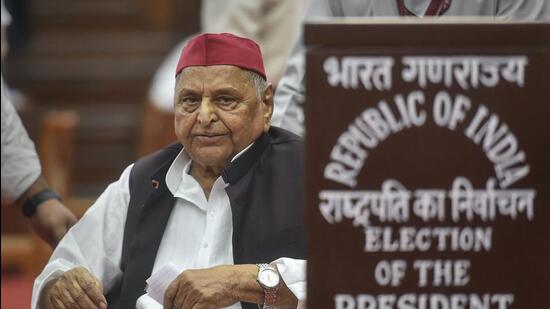
Yadav breathed his last at Gurugram’s Medanta Hospital at 8.16am due to multiple organ failure. He was in a critical state in the Intensive Care Unit (ICU) and was administered life-saving medication, according to statements issued by the hospital. Yadav was hospitalised on August 22, and moved to ICU on October 2 after his condition deteriorated.
“My respected father and everyone’s Netaji is no more,” tweeted his son and former chief minister, Akhilesh Yadav.
Yadav formed the core of the Mandal moment in Indian politics, first as a leader in the Janata formation who fused agrarian and socialist politics into a potent electoral force, and then as the undisputed patriarch of the Samajwadi Party (SP). He became chief minister of UP three times, was India’s defence minister between 1996 and 1998, and remained a key player in national and regional politics for three decades.
But in recent years, the brand of politics championed by him also came in for criticism for promoting narrow patronage networks, dynasty politics, and undermining law-and-order and state institutions in favour of cronies and associates. His party lost two consecutive assembly elections and two national elections to the Bharatiya Janata Party (BJP).
“Mulayam Singh Yadav ji distinguished himself in UP and national politics. He was a key soldier for democracy during the Emergency. As defence minister, he worked for a stronger India. His parliamentary interventions were insightful and emphasised on furthering national interest,” tweeted Prime Minister Narendra Modi.
Uttar Pradesh CM Yogi Adityanath expressed grief over the demise, announced a three-day state mourning and said the veteran leader’s last rites would be conducted with full state honours.
Yadav’s body reached his village of Saifai on Monday evening. It will be kept at the Saifai festival ground for “darshan”, and the cremation will take place on Tuesday afternoon. Thousands of people from across the region, known as the Yadav heartland, had gathered at the spot by nightfall.
“My mind is filled with memories of our time together. Saifai has lost its father,” Mulayam’s childhood friend, Ram Phal Valmiki, said.
Yadav was born on November 22, 1939, in Saifai. He came from a poor rural family. His original aspiration was to become a wrestler — and he was a competitor of some repute — but he ended up becoming a government school teacher after obtaining a master’s degree from Agra University.
He was wrestling in a local competition in the early 1960s when then Jaswant Nagar (Mainpuri) lawmaker Nathu Singh was impressed by the young man in his early 20s and got talking to him.
Yadav had developed a keen interest in politics at 15, inspired by socialist leader Ram Manohar Lohia. Singh offered Yadav his own assembly seat. Yadav took the offer, and won the seat as Samyukta Socialist Party (SSP) candidate in March 1967. He would go on to fight and win 10 assembly polls and seven Lok Sabha elections.
“Dharti putra (son of the soil) Mulayam ji was a veteran leader and was connected with the land. He was respected by people of all parties. My deepest condolences to his family members and supporters,” said President Droupadi Murmu.
By the time of the Emergency, Yadav had joined the Bharatiya Kranti Dal (BKD), a party founded by the late Charan Singh, a socialist leader who left a huge impression on Yadav. The Emergency heightened his political profile; he went to jail for the first time for staging a protest against then PM Indira Gandhi.
After the 1977 general elections — the BKD had become the Bharatiya Lok Dal by then — the Opposition came together to form the Janata Party, and Yadav was one of its firebrand leaders. When the Janata Party imploded, Yadav went on to the surviving fragment headed by Charan Singh, the Lok Dal.
He became chief minister for the first time in 1989 as a leader of the Janata Dal, backed by the BJP. He was just 50. It was in 1992 that he formed the Samajwadi Party, which would define UP politics for the next 25 years.
“As the defence minister of the country and chief minister of Uttar Pradesh, the contribution of Yadav will remain unforgettable. More than that, his struggle for the oppressed and downtrodden will always be remembered,” Congress chief Sonia Gandhi said in a statement.
In 1998, with no party with a majority at the Centre, Yadav had come together with Sharad Pawar to deny Gandhi a chance at cobbling together a majority coalition. However, 10 years later, in 2008, he saved the United Progressive Alliance government when its fall seemed imminent over the India-US nuclear deal.
In his 50-odd years in politics, the 1990s were by far the most important. Yadav not only propelled himself onto the national stage but also fuelled the churn in heartland politics after the Mandal commission report was accepted and instituted 27% reservation to backward classes in educational institutions and government jobs. It was also the first stirrings of a political impulse that would ultimately come to hurt the SP – the entrenching of associates and family members in positions of power.
Alongside him was another leader from the Mandal agitation – Lalu Prasad Yadav in Bihar. “Netaji is immortal. Socialism is immortal,” Lalu Prasad said in a political meeting in Patna, as thousands of his supporters echoed him.
On October 30, 1990, then UP CM Yadav gave an order to the police to open fire at kar sevaks (religious volunteers) who had gathered in Ayodhya to march towards the Babri Masjid. The firing led to chaos and a stampede. Police chased down the kar sevaks on the streets of Ayodhya.
This proved to be a tipping point and in 1991, the BJP withdrew support to his government. The BJP won the elections that followed, and Kalyan Singh was sworn in.
In October 1992, Yadav founded the SP. Just two months later, the Babri Masjid was demolished in Ayodhya. Overnight, Yadav became the face of secular politics, and began to stitch together a coalition of Yadavs and Muslims — a potent formation that would hold good for the better part of the next two decades.
But the chinks in his political armour began appearing with the rise of the BJP.
First, his brother Shivpal fell out with his son Akhilesh Yadav, leading to a split in the party. Then, the party found its electoral footprint dramatically shrinking as its old-style politics of patronage was bested by the BJP in two state and national elections. With his advanced age, Yadav also ceded responsibility to his son and campaigned only sparingly, though his bonhomie with PM Modi was evident in Parliament.
Also evident was his personal touch with ordinary people and his network — he knew someone in every village, block, and district in the state. In resurrecting the SP, his successors will need every bit of his grassroots connect.
“Yadav crafted a space for himself not just in UP but across the country. People only talk about his politics but he was among those rare politicians who cared about the environment too, as was evident when he came up Lohia Park in the heart of Lucknow, one where VIPs and commoners all head to fill up their lungs with oxygen. He kept his party and his family together. His death now leaves a huge vacuum which will take some doing,” said AP Tiwari, a political analyst.


