The government’s tacit directive to state-run oil companies to keep petrol and diesel rates frozen has disrupted the deregulated fuel trade, leading private refiners to sharply divert loss-making domestic sales to lucrative export markets and prompting public sector retailers to adopt restrictive measures to reduce losses, which in turn has led to a scarcity in various parts of the country, according to people aware of the developments.
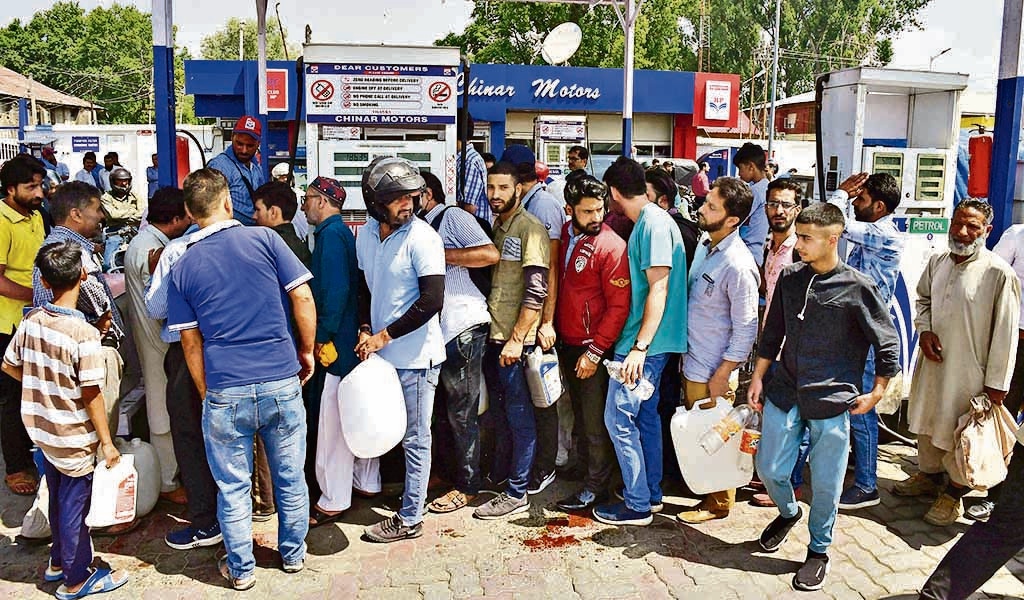
To be sure, there is no fundamental shortage of fuel but an artificial one created by companies seeking to maximise profit (the private ones) or reduce losses (the state-owned oil retailers).
Ground reports by HT correspondents from various locations in Uttar Pradesh, Madhya Pradesh, West Bengal, Haryana, Punjab and Rajasthan pointed to a supply shortage in smaller towns and rural areas, particularly at pumps operated by Hindustan Petroleum Corporation Ltd (HPCL) and Bharat Petroleum Corporation Ltd (BPCL). Several pumps run by private operators such as Reliance and Nayara Energy faced acute fuel shortages, and some of them even went dry.
Indian Oil Corporation (IOC), which is the biggest fuel retailer in the country, appeared to still have stocks, and farmers in these regions were commuting long distances to get fuel (mainly diesel) from their pumps for the sowing season. IOC, BPCL and HPCL enjoy a monopoly in fuel trade, with about 90% market share. These public sector oil marketing companies (OMCs) effectively control pricing.
“Even as petrol and diesel are deregulated fuels, and theoretically refiners are free to link domestic rates with international product prices, predatory pricing by OMCs edge out private players,” an executive working in a privately run refining firm said, requesting anonymity.
{{/usCountry}}“Even as petrol and diesel are deregulated fuels, and theoretically refiners are free to link domestic rates with international product prices, predatory pricing by OMCs edge out private players,” an executive working in a privately run refining firm said, requesting anonymity.
{{/usCountry}}As of June 16, state-run OMCs were incurring a ₹19.7 per litre revenue loss on petrol and ₹31.9 a litre on diesel, a second executive working in another private oil company said, requesting anonymity. “No private firm can bear this kind of loss. As far as public sector OMCs are concerned, they know that ultimately the government will bail them out,” he added.
HT’s ground reports from several locations across six states found that many bulk customers (mainly transporters) shifted to retail because petrol in bulk is about ₹11 per litre costlier and diesel in bulk is costlier by over ₹31 a litre (bulk buyers get charged more).
Officials aware of the matter said that, in order to minimise revenue losses, some state-run firms were using innovative mechanisms to reduce sales. They included reducing the supply timing of fuel from depot to pumps, and denying fuel on working credit to pump owners. HT first reported this trend on May 6.
Parasmal Jain, owner at Hastimal Jain petrol pump in Barmer city, said fuel companies have started rationing. “They are supplying 50% against the demand. They have advised us to reduce the supply time and pumps are closing at 9 pm,” he said. The Rajasthan Petroleum Dealer Association’s steering committee chairman Rajendra Singh Bhati said the situation is grave.
In Madhya Pradesh, about 1,000 petrol pumps out of total 4,900 have gone dry due to a shortage of supply of fuel, said state petroleum dealers’ association president Ajay Singh. Owner of a fuel station in Raisen, Rajesh Kumar, said: “We called the police as a large number of customers reached for refilling after more than a dozen petrol pumps closed down due to shortage of supply.”
In Haryana’s Rohtak, Jind and Bhiwani, some of the HPCL fuel stations were also rationing due to short supply. Sachin Suhag, owner of Suhag fuel station in Rohtak, said, “They are unable to get petrol from HPCL for the last one week and the supply of diesel has been cut.”
The UP Petroleum Traders Association also expressed concerns over ongoing fuel shortage in rural areas. Its president, Ranjeet Singh Gaur, said there were shortages last Saturday and Sunday in HPCL pumps. President of Lucknow Petroleum Traders Association, Dayashankar Singh, said, “About 10% petrol outlets of HPCL went dry over the weekend and even now some pumps are receiving lesser fuel than required.”
In West Bengal, too, HPCL and BPCL station owners complained of fuel shortage. “I have four pumps – two in North 24 Parganas district and one each in Howrah and Hooghly. On an average, I need 14 tankers per month each. Over the past one month, however, I am not getting more than 7-8 tankers per month. Petrol pumps remained dry for a few days,” said Subhodip Lal Maitra.
“There are around 70 HPCL dealers in Jhargram, West Midnapore and East Midnapore districts. Nearly 50% of them have run dry over the past one week or so as the supply has been slashed by around 50%,” said Kalyan Kumar Manna, joint secretary of West Bengal Petroleum Dealers Association.
Meanwhile, in Ludhiana, farmers the dhairperson of Ludhiana Petrol Pump Dealers’ Association, Ashok Sachdeva, said the private companies were not supplying fuel at stations located in rural areas. “Due to this the load has shifted to BPCL and HPCL stations.”
The oil ministry, IOC, BPCL, HPCL, RIL-BP, and Nayara did not respond to an email query on the matter.
A government spokesperson referred to an official statement issued by the ministry on Wednesday, which said: “Production of petrol and diesel in the country is more than sufficient to take care of any demand surge.”
The statement added: “It is a fact that at specific locations in some states, there has been a significant increase in demand for petrol and diesel, with an increase being as high as 50% during the first half of June 2022 over corresponding period of last year. In particular, this has been noticed in Rajasthan, Madhya Pradesh and Karnataka.”
The government also said some private pumps were exacerbating the situation. “These are states where large quantity of supply was being done by retail outlets belonging to private marketing companies and where the distances from supply locations i.e. terminals and depots are longer,” the statement said, and cited a surge in agricultural demand, shifting of bulk buyers to retail pumps, and temporary logistic issues as some of the reasons.
SC Sharma, an energy expert and former officer on special duty at the erstwhile Planning Commission, said, “As the government has deregulated the sector and allowed private investments, it would be prudent on part of PSUs to sell fuel at market rates. However, in order to protect customers of high fuel prices and to contain inflation, the government may ask the oil companies to keep the retail prices unchanged and pay for the under-recoveries to fuel retailers from the Budget, as was being done till few years back.”