Washington: The US Court of Appeals for the Federal Circuit in Washington ruled that the US administration’s reciprocal tariffs were illegally applied.
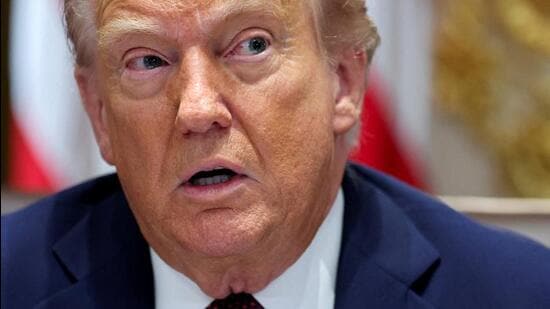
In a judgment on Friday, the court ruled that President Donald Trump did not have the authority to impose tariffs by invoking a 1970s-era law known as the International Emergency Economic Powers Act (IEEPA). Though the tariffs were declared illegal, the court’s decision will not take effect until October 14. This will give the Trump administration time to challenge the ruling in the Supreme Court.
However, the decision does cast uncertainty on the durability of Trump’s tariffs. On April 2 this year, dubbed “Liberation Day” by Trump, America imposed a baseline 10% tariff on every country in the world. Additional tariffs were levied against countries with which America has a trade deficit.
Trump took to Truth Social, his social media platform, and decried the ruling from the “highly partisan” court.
“If allowed to stand, this Decision would literally destroy the United States of America,” Trump said in his Truth Social post. However, the US President noted that the tariffs remained in place.
It is unclear how the court ruling impacts America’s ongoing trade talks with countries like India. New Delhi is grappling with a 50% tariff imposed by Trump, including a 25% “penalty” for purchasing Russian energy. Trump’s tariffs on India and Brazil, as well as the tariff reduction deals agreed to with Japan, the European Union, the UK, and South Korea, are now under question.
The appeals court decision will also impact the tariffs imposed by Trump on Canada and Mexico for their alleged inability to counter cross-border drug trade. The baseline 10% tariff imposed on all goods entering the United States is also affected. The federal appeals court took up the case after the Trump administration appealed an earlier decision by the Court of International Trade, which also ruled against the legality of Trump’s tariffs.
{{/usCountry}}The appeals court decision will also impact the tariffs imposed by Trump on Canada and Mexico for their alleged inability to counter cross-border drug trade. The baseline 10% tariff imposed on all goods entering the United States is also affected. The federal appeals court took up the case after the Trump administration appealed an earlier decision by the Court of International Trade, which also ruled against the legality of Trump’s tariffs.
{{/usCountry}}In a 7–4 ruling, the appeals court found that the IEEPA did give the President authority to deal with a national economic emergency but did not explicitly provide the power to impose tariffs and duties. Power to authorise new taxes and tariffs generally lies with the legislative branch. The Trump administration used the act to authorise tariffs by claiming that large global trade deficits and an unchecked cross-border drug epidemic were causing a national economic emergency. Trump’s critics have argued that the President has usurped a power granted to Congress.
Representatives of the Democratic Party used the opportunity provided by the court ruling to call on Trump to roll back the global tariffs. Congressman Gregory Meeks — who leads the Democratic Party on the influential House Foreign Affairs Committee — pushed for the House of Representatives to consider his resolution to end the tariffs. Meeks has also criticised the Trump administration’s 50% tariff on India on several occasions in the past.
However, the administration is widely expected to challenge the ruling in the Supreme Court.