Ankit Pandey, a final-year student at Bhopal’s Gandhi Medical College (GMC), was among the 22 students who enrolled in the inaugural Hindi MBBS programme launched as part of the Madhya Pradesh government’s “ease of education” initiative.
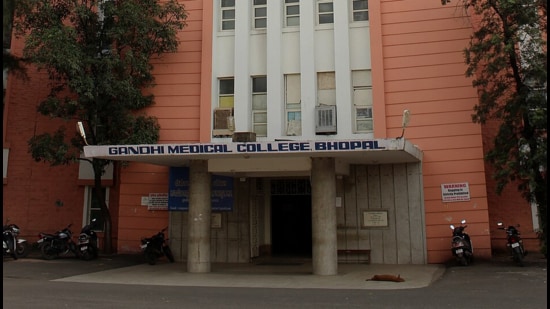
He said they thought Hindi-medium school students like him had an easier path to becoming doctors. But the hybrid language use prompted them to switch to the English medium from the second year for better long-term prospects.
The National Eligibility cum Entrance Test (Postgraduate), NEET (PG), for admission to postgraduate medical programmes is held in English.
Pandey said anatomy books were translated into Hindi, but all the medical terms remained in English. “So, we decided to opt for English books as it would be better for our future,” he said.
Pandey and the rest of the first Hindi MBBS batch took exams in English after switching to English medium in the second year.
In 2022, Union home minister Amit Shah released the country’s first Hindi MBBS syllabus and three books, initiating medical science learning in Hindi. Vishwas Sarang, the then Madhya Pradesh medical education minister, described the books as sort of Hinglish in Devanagari script.
The Hindi MBBS course was started after a committee of Parliamentarians recommended Hindi as the language for higher education in states such as Uttar Pradesh, Madhya Pradesh, Bihar, Rajasthan and Gujarat. The committee recommended books in the mother language of other states.
{{/usCountry}}The Hindi MBBS course was started after a committee of Parliamentarians recommended Hindi as the language for higher education in states such as Uttar Pradesh, Madhya Pradesh, Bihar, Rajasthan and Gujarat. The committee recommended books in the mother language of other states.
{{/usCountry}}Ninety-seven subject experts prepared Hindi MBBS textbooks in Bhopal at the cost of ₹10 crore. They were introduced in state medical colleges from the academic year 2022-23. The students were to take exams in Hinglish and get a degree that would not specify the medium of education.
The National Medical Commission (NMC) Act says the medium of medical education should be English, and the Madhya Pradesh government’s introduction of Hindi books was meant to complement learning.
The idea was described as a paradigm shift towards easing education for Hindi-medium students. The Hindi textbooks for MBBS were introduced after failed attempts to start engineering in Hindi in Madhya Pradesh.
Excerpts had warned that, at a higher level, it is impossible to translate all the books, saying a popular book named Harrison is like a Bible for medical students and translating every word of it is practically impossible.
Pandey’s batchmate, who requested anonymity, said only the teaching was in Hindi. “Teachers spoke in Hindi, but presentations or the diagrams were shown in English. It was very confusing as we were given Hindi textbooks but had to rely on English books to understand the concepts,” he said.
Other students pointed out that both English and Hindi-medium students were taught together. “When we have to learn in English, what is the use of getting Hindi textbooks?” asked Sandeep Puri, another student of the inaugural Hindi batch.
So far, 85 students have chosen Hindi medium out of the total 1,000 who have enrolled for MBBS at Bhopal’s GMC since 2022-23.
A third-year student enrolled in the Hindi programme said it has been a translation exercise. “In the end, everyone has to study in English because NEET (PG) and other competitive exams are in English,” he said.
The students who continue with Hindi are preparing to switch by learning English. A second-year student said they have been told that marks will be awarded for medical knowledge and not language. “Our seniors told us writing the exam entirely in Hindi may not fetch good marks. When I got stuck with English grammar, I wrote in Hindi. I am learning to learn and answer in English only.”
GMC Bhopal library has issued only 10 Hindi MBBS books in four years. Publisher Manish Jain, who printed 5,000 sets of Hindi medical textbooks, said they got orders of 1,800 sets from Madhya Pradesh and 700 from Rajasthan. “Over 20,000 students took admission in MBBS in the past four years in Madhya Pradesh alone. The orders we received were dismal,” he said.
GMC Bhopal dean Dr Kavita N Singh maintained the initiative is good and added that they cannot force students to stick to the Hindi programme. “Hindi MBBS may not have received the expected response, but it helped students from Hindi-medium backgrounds to gain confidence during their transition phase from Hindi medium to English,” she said.
A medical education department official said committees from Rajasthan, Uttar Pradesh and the NMC have visited GMC Bhopal to study the initiative.
“The informal feedback was that without standardised Hindi medical terminology and higher-level examinations in Hindi, teaching medicine entirely in Hindi is impractical,” the official said.
He added that some students raised concerns before the parliamentary committee about getting lower marks for answers written in Hindi.
Dr Lokendra Dave, the translation committee founder-member, said Hindi MBBS currently functions only as a bridge for students from Hindi-medium backgrounds. “We have sown a seed and cannot expect fruits within a few years,” said Dave. He added that the committee and the NMC are preparing a standardised Hindi medical dictionary so students learn the same terminology from school to college.