In a deeply structured society such as the one described in the epics Ramayana and Mahabharat, labour rights did not exist, not at least in the modern sense. Since the Mauryan period which takes us back to the second half of the last millennium before the common era i.e 2,500 years ago, we have both inscriptional and textual evidence that suggests that labour was required mainly for cultivation, for household work and menial tasks at establishments of the elite castes.
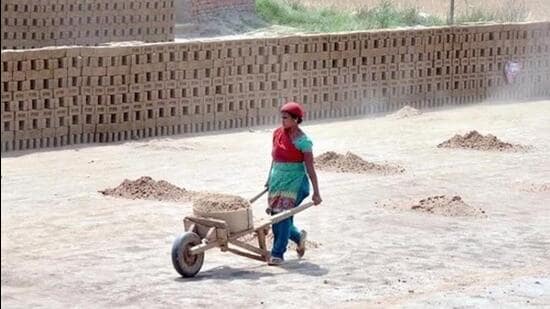
In a deeply structured society such as the one described in the epics Ramayana and Mahabharat, labour rights did not exist, not at least in the modern sense. Since the Mauryan period which takes us back to the second half of the last millennium before the common era i.e 2,500 years ago, we have both inscriptional and textual evidence that suggests that labour was required mainly for cultivation, for household work and menial tasks at establishments of the elite castes. Artisans, craftsmen were valued for their skills and were paid handsomely compared to slaves, forced labourers who came from Shudra castes. Slaves were also captured in large numbers during wars.
During the Mauryan emperor Ashoka’s time we find that Visti or free or forced labour was in vogue. The presence of Vistibandhaka, a state official assigned to arrange such labour for public works and manage it tells us that this was widely prevalent.
RS Sharma writes in Sudras in Ancient India, “During the Mauryan period sudras were employed by the state largely as slaves, labourers and artisans in the middle- Gangetic plains. In spite of the fixation of wages the economic organisation was showing signs of strain. Since sufficient sudras were not forthcoming for agriculture carried on by the state, it was found necessary to adopt the practice of leasing royal lands to share croppers who presumably also belong to the lower orders”.
In the post-Mauryan period (200 BCE- 300 CE) references to rathakaras or chariot-makers, potters, weavers, perfumers, blacksmiths and several other crafts and trades are in abundance. Silk-weavers, armsmakers and makers of luxury items also seem to have thrived during this period of relative domestic and international geopolitical stability. Also present are detailed lists that put down how taxes, duties, tolls were to be paid to the king. They paid duties to the king either in the form of money or goods produced, in addition they had to provide free labour.
Also Read: HistoriCity | Chanakya: A look at the folklore and the facts
For instance, the Manusmriti says that artisans, craftsmen and Shudras should perform a day’s free labour in addition to paying taxes. The dating of Manusmriti remains a challenge but scholars agree on the broad range of 200 BCE to 300 CE.
Rudradaman I (reign 130 CE- 150 CE), the western satrap, informs us in the Junagadh inscription to commemorate the construction of the Sudarshan lake, that he didn’t use Visti or forced labour for this public work, but, used funds from his own treasury. This inscription tells us that taxes and forced labour were the causes of resentment against the king and the ones who wanted to portray a benevolent self-image made public announcements such as the inscription by Rudradaman. However, in the ensuing centuries Visti became more popular, perhaps due to the waning of Buddhist influence.
Wages and Workers’ Rights over the last thousand years
Household servants were given leftover food, worn clothes and old beds. According to the Manusmriti, they should also be given grain. For other workers such as those in agriculture, wages were paid in cash as well as kind. When workers were forced to miss work due to reasons other than sickness, they were fined.
Sharma writes quoting Manusmriti, “a hired workman who fails to perform his work according to the agreement out of pride, without being ill, shall be fined eight krsnalas, and no wages shall be paid to him. Nevertheless, the worker who fails to do his work on account of illness but completes it on his recovery shall be paid his wages for the long period of absence. On the other hand, if he does not complete his work when he has recovered, he shall not be paid any wages even for the period he has worked”.
During the Gupta period, which is generally considered to be between 300-600 CE, the evolution of labourers based on a hierarchy of formality and informality picked up pace. Referencing the various Smritis, Sharma writes, The bhrtakas (wage earners) were divided by Narada and Brhaspati into three categories: i.e those who served in the army, those who were engaged in agriculture and those who carried loads from place to place. The first were considered the best, the second the middle, and the third the lowest type of workers“.
He refers to the wages of those employed in the army are not available, however, those for agriculture, which remains the largest employer as a sector and cowherds, are present. They replicate the rates given in the Arthashastra (dates vary but generally believed to be compiled by at least four authors between 200 BCE and 300 CE). A farmer was allowed one-tenth of the crop, while a cowherd could keep the same share of the butter, and could keep one-tenth of the sale proceeds.
However, other Gupta period texts like Santi Parva and Brhaspat Smriti provide for higher wages. A farmer was allowed one-seventh of the produce if he was supplied with seeds. Brhaspati was even more generous. Farm workers were to be given one-fourth of the yield if they are provided with clothing and food and if not provided those then they could take one-third share. For domestic servants we find references in the Kamasutra of Vatsayan, who says that besides food, servants should receive wages either monthly or annually.
The system of guilds, in existence since ancient times, continued to evolve and acquired both temporal and religious influence and could demand justice from exploitative rulers and their representatives. For the much greater number of workers though, palayan or exodus from the territory of such a ruler was the last resort when pleas for fair compensation went unheeded. An extreme form of a modern day labour strike, this involved living with a permanent vulnerability, and looking for opportunities in distant lands without any certainty. Sanctified by religious texts, the caste-based model has continued to exist in different avatars even in the modern age.
S K Maity writes in The Visti in Ancient Indian Tradition: Its Transformation to Forced Labour, “originally the idea of rendering free labour originated for the development of the community and was actuated with a co-operative spirit which is also suggested by Kautilya in his Arthasastra. But gradually this spirit degenerated and the entire system underwent a complete change and took the shape of forced labour and exploitation caused by landed aristocracy. Remnants of this forced labour were found even in the early twentieth century in the system known as Begar (forced labour). Poorer classes, generally landless labourers, had to render free service to their landlords”.
(HistoriCity is a column by author Valay Singh that narrates the story of a city that is in the news, by going back to its documented history, mythology and archaeological digs. The views expressed are personal.)
One Subscription.
Get 360° coverage—from daily headlines
to 100 year archives.
Archives
HT App & Website