
 E-Paper



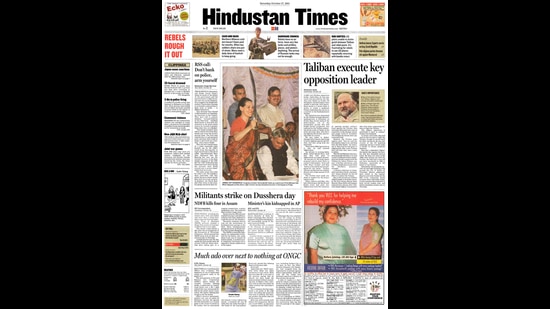
HT THIS DAY: October 27, 2001 — Taliban execute key opposition leader Abdul Haq
Islamabad- A key anti-Taliban opposition leader, Abdul Haq, 43, was captured and executed by the Taliban near Kabul on Friday


Islamabad- A key anti-Taliban opposition leader, Abdul Haq, 43, was captured and executed by the Taliban near Kabul on Friday. US warplanes and helicopters were unable to save him, said reports. Haq’s death is a severe blow to moves to create a moderate Pathan leadership that can act as a counter to the fundamentalist Taliban.
His execution was announced by the Taliban Foreign Ministry spokesperson in Peshawar on Friday. Haq, former head of the Hizb-e-Islami, one of the mujahideen groups that had fought Soviet occupation, was captured by the Taliban authorities 20 km south of Kabul in the early morning. Haq, who lost a leg fighting the Soviets, was trying to flee on a horse.
He was taken to Kabul charged with treason and trying to incite Afghans against the Taliban, and shot along with two associates.
There were differing stories as to why he had entered Afghanistan.
An advisor to ex-king Zahir Shah, Abdul Sarrat Sirat, said that Haq had gone to Afghanistan on a peace mission. “He was part of the king’s peace proposal and he went there to contact tribal leaders.” Sirat told CNN. Haq’s brother said Hag “had no arms and he was not prepared for any battle”. Taliban officials say Hag had two satellite phones and a large amount of US currency.
The Taliban have made any show of support for the king a capital crime.
Other reports said Hag. Who had a following in the Sarobi and Kabul areas, had gone into Afghanistan with the intention of opening another military front against the Taliban. Haq and some 100 armed men took up a position in the Spingar mountain range, north of Jalalabad. The Taliban say 50 men were captured with him.
Bakhtar, the Taliban news agency, said, “One jet and two helicopters came to try and help him, but they failed.” An associate of Haq said he had gone to Afghanistan after some Taliban had told him they were ready to defect.
The US and Pakistan were-promoting people like Haq to try and create a moderate Pathan leadership that would compete with the Taliban for ethnic Pathan support. A further calculation: such a Pathan leadership would dilute the Northern Alliance’s strength.
A western diplomat in Islamabad said Haq’s death represented a “major setback” for the US efforts to replace the Taliban.
Haq is the second anti-Taliban Afghan leader to be killed recently, the first being Ahmad Shah Masood. Haq’s death will dampen expectations among other Pakistan-based Afghan commanders who have been organising soldiers to fight the Taliban.
The Afghan opposition is scheduled to meet in Ankara, Turkey, this weekend.
In recent interviews, Haq had said he did not plan to fight the Taliban though he would work for their overthrow. He was also critical of the US bombing campaign saying it would make it harder to attract moderate elements.
Haq was a legendary fighter during the war against the Soviets and was wounded several times. He went into exile in the 1990s after falling out with the Taliban. His wife and 11-year-old son were murdered in 1999 in Peshawar, reportedly at the behest of the Taliban.
Meanwhile, US warplanes carried out overnight bombing raids around the city of Kabul on Thursday. Eleven explosions were heard in the capital. Reports said some bombs hit the Red Cross compound. Seven civilians were reportedly killed. Cruise missiles were believed to have struck targets near and within Kandahar airport late on Thursday.


