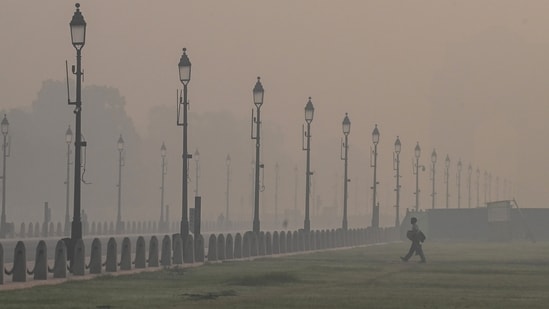
Delhi's overall air quality index (AQI) remained in the 'very poor' category on Saturday morning, with a reading of 365 a day before Diwali. As many as 21 monitoring stations recorded 'severe' air quality, according to the 7am update on the HT Pollution Dashboard, which tracks the average readings from all monitoring stations reported by the Central Pollution Control Board (CPCB).
Delhi's AQI remained in the 'very poor' category on Saturday. (ANI)
{{^htLoading}} {{/htLoading}}
The CPCB calculates the hourly AQI at each monitoring station using a running average of readings recorded over the previous 24 hours. An analysis by the HT Pollution Dashboard showed that 21 stations recorded 'severe' air quality, while 30 were in the 'very poor' category.
{{^usCountry}}{{/usCountry}}
10 most polluted areas in Delhi
The 10 Delhi monitoring stations that recorded the highest AQI readings in the latest update were:
IIT Delhi - 440
Punjabi Bagh - 433
Vivek Vihar - 425
Jahangirpuri - 421
Mundka - 421
Rohini - 418
RK Puram - 414
Najafgarh - 412
Sonia Vihar - 412
Sirifort - 411
Deep Dive
Which areas in Delhi had the highest AQI on Diwali eve?
IIT Delhi recorded the highest reading at 440, followed by Punjabi Bagh at 433 and Vivek Vihar at 425. Jahangirpuri and Mundka recorded 421, while Rohini recorded 418.
How does the CPCB calculate AQI at Delhi monitoring stations?
The CPCB calculates each station’s hourly AQI using a running average of readings from the previous 24 hours. Delhi’s overall figure reflects the average readings from its monitoring stations.
Why did an analysis suggest Delhi’s official AQI could understate pollution?
The analysis found that 13 stations added in October recorded lower readings than nearby older stations. Without those stations, Friday’s 4pm AQI would have been 393 rather than 382, according to the analysis.
Powered ByAsk HT
Check the air at your nearest station, hour by hour, on the HT Pollution Dashboard at hindustantimes.com/breathe.
New stations on periphery may be clouding AQI data in Delhi: HT analysis
Delhi's official AQI reached 382 on Friday, the city’s worst since January 19. However, the figure may still be lower than the actual pollution levels following the addition of 13 monitoring stations to the city's network in October, an HT analysis of CPCB data has found.
{{^htLoading}} {{/htLoading}}
{{^usCountry}}
The analysis showed that without these new stations, Friday's 4 pm bulletin would have recorded an AQI of 393.
{{/usCountry}}
{{#usCountry}}
The analysis showed that without these new stations, Friday's 4 pm bulletin would have recorded an AQI of 393.
{{/usCountry}}
Most of the new monitoring stations, installed by the Delhi Pollution Control Committee (DPCC), the city's pollution regulator, are located on the outskirts. However, older stations in similarly developed areas on the periphery have recorded considerably higher readings.
The HT analysis found that PM2.5 levels at the new stations, the main contributor to winter air pollution, were around 35% lower than those recorded at nearby monitoring stations.
The impact of these additions was evident on Friday, when Dhanteras celebrations typically brought heavy traffic to the city's roads.
Between 7 am and noon on Friday, the AQI remained between 389 and 391, within the 'very poor' category. However, without the 13 new stations, which recorded an average AQI of around 350 at 10 am, the figure would have been between 401 and 403, placing it in the 'severe' category, the worst on the scale.
Follow the latest breaking news, major developments and agenda-setting stories from India and around the world with the newsdesk at Hindustan Times. Operating round the clock, the desk brings together experienced editors, reporters and correspondents to deliver fast, accurate and contextual reporting across subjects that influence public policy, governance, business, society and international affairs. The HT News Desk covers politics, elections, government policies, the economy, business and markets, science and technology, the environment, law and order, infrastructure, education, climate issues and geopolitics, while closely tracking developments across states, institutions and global capitals. The team also leads coverage of major breaking news events, policy announcements, court proceedings, natural disasters, public emergencies and significant international developments. Reports published by the newsdesk are based on information gathered from reporters on the ground, official statements, government agencies, court records, regulatory filings, recognised institutions and other authoritative sources. Stories undergo editorial scrutiny and verification processes to ensure accuracy, fairness and relevance, and are updated as events evolve and additional information becomes available. Whether covering a key political decision in New Delhi, an economic policy shift affecting millions, a landmark court ruling or a major global event, the HT News Desk aims to provide readers with reliable, fact-based journalism that delivers not only the latest developments but also the context and analysis needed to understand their wider implications.
Get Latest News, breaking headlines, and top India News, and today real-time updates from across the nation. Stay informed on politics, government policies, crime, Today Weather, and major developments on Hindustan Times
Get Latest News, breaking headlines, and top India News, and today real-time updates from across the nation. Stay informed on politics, government policies, crime, Today Weather, and major developments on Hindustan Times
Home/India News/IIT to Rohini: 10 most polluted areas in Delhi amid ‘very poor’ AQI on Diwali eve
{{^htLoading}}
Advertisement
{{/htLoading}}
SHARE THIS ARTICLE ON
{{#usCountry}}{{/usCountry}}
Notifications
Get breaking alerts directly from the newsroom
Notifications are on!You'll be notified when news breaks