
 E-Paper


New stations on periphery cloud AQI data in Delhi
Their PM2.5 readings were about 35% lower than nearby older stations, and excluding them would have put the city in the severe category.

 Prefer HTon Google


Delhi’s official air quality index (AQI) hit 382 on Friday, the city’s worst since January 19, and may still be understating pollution levels after 13 new stations were added to the monitoring network in October, an HT analysis of Central Pollution Control Board (CPCB) data has found. Without the new stations, Friday’s 4pm bulletin would have read 393.
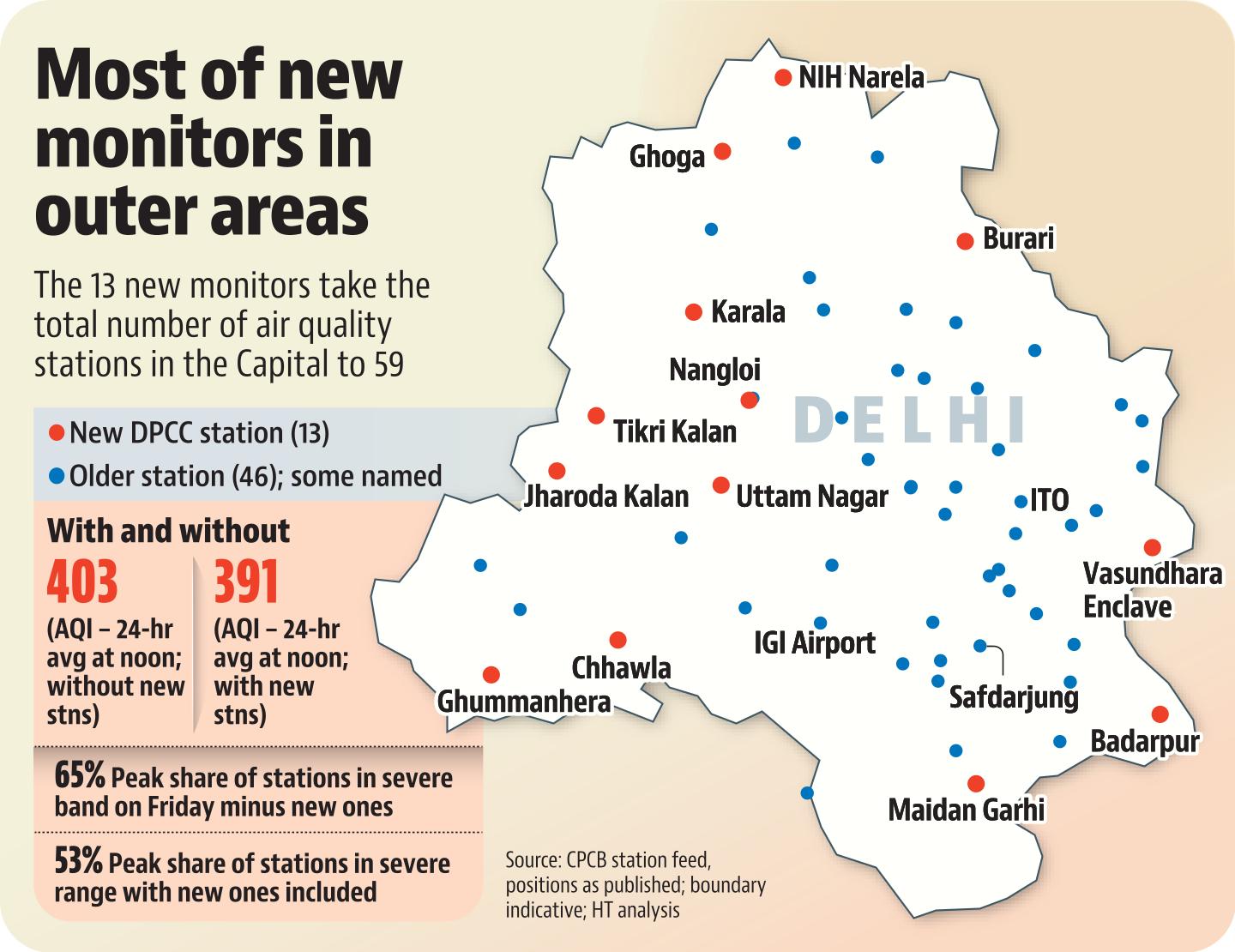
Most of the new monitors, set up by the Delhi Pollution Control Committee (DPCC), the city government’s pollution regulator, are on the city’s periphery, but older stations just as far out, in areas just as built-up, show much higher readings. HT’s analysis found the levels of PM2.5 — the biggest contributor to pollution during the winter smog spell --- at the new stations are about 35% lower than those at their neighbouring stations.
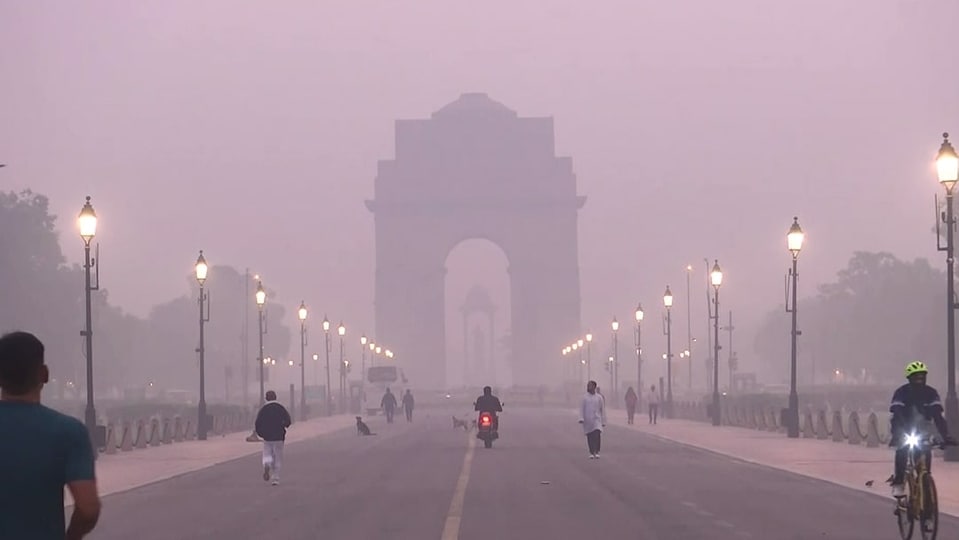
Their effect on the AQI readings showed on Friday amid Dhanteras, which is typically accompanied by heavy traffic on the city’s roads. CPCB’s official figure is a plain average of every station’s AQI, each a rolling 24-hour average (the figure at 4pm becomes the day’s bulletin). From 7am to noon it stayed between 389 and 391, in the “very poor” band.
Without the 13 new stations, which averaged about 350 at 10am, it would have been 401 to 403, in the “severe” band, the worst on the scale.
The share of stations that were in the “severe” band underlines this divergence. At 7am, 28 of Delhi’s 59 stations, or 47%, reached this band. It peaked at 11am and at noon, with 53%, or 31 in the severe band. Without the 13 new stations, 59% of the remaining 46 stations were severe at 7am and peaked at 65% at noon. The median station, the middle one when all are ranked, read 410, itself severe, against 396 with all 59 counted at 7am.
It matters because Delhi’s pollution crisis has not eased as the city heads into Diwali. So-called green firecrackers are allowed this year and illegal sales of banned crackers have continued, in a stretch of the year when the air is usually at its worst, with farm fires at their peak, winds weakening and cooler nights trapping smoke near the ground.
Also Read | Grap 3 curbs implemented in Delhi-NCR as air quality remains in ‘very poor’ category
Friday’s spike began late on Thursday as winds from the farm-fire belt of Punjab and Haryana blew in a few hundred metres above ground. Over the city itself, the wind near the ground fell almost still and a layer of warm air held Delhi’s own emissions close to the ground.
The festive rush added to those local emissions. From Friday morning, shoppers heading to markets for Dhanteras and Diwali, and families driving across the city to deliver sweets and gifts, choked arterial roads. Traffic stood still or crawled on stretches of Ring Road, Outer Ring Road, the Barapullah elevated road, Mathura Road and Mehrauli-Gurugram Road in south Delhi, and around Connaught Place, Karol Bagh, Chandni Chowk and Sadar Bazar in central and north Delhi. In the evening peak, vehicles barely moved for more than an hour on many stretches as office-goers joined the crowds, and drivers who could not find parking left their cars along narrow market lanes.
CPCB’s figure rose from 369 in Thursday’s 4pm bulletin to 389 by 7am on Friday.
The Commission for Air Quality Management (CAQM), meanwhile, imposed stage 3 of the Graded Response Action Plan (Grap) across Delhi-NCR on Friday, citing an AQI of 382, and the Air Quality Early Warning System’s forecast that the air could turn “severe” from Saturday. Stage 3 curbs several construction and demolition activities. It also bars BS-III petrol and BS-IV diesel or older light motor vehicles from Delhi and five high-traffic NCR districts, though vehicles adapted for people with disabilities are exempt.
IIT Delhi and Rohini were the worst stations at 7am, at 474 each, according to the HT Pollution Dashboard. By 9pm, 26 of the 59 stations were severe.
Also Read | Hindustan Times launches pollution dashboard that puts air quality data in context
Delhi had 39 stations at Diwali last year. HT checked every hourly figure CPCB published from October 13, when most of the new stations were included in the count, to November 4. Over that period, the official figure ran a median 17 points below the average readings of the 39 stations that were measuring the AQI last year.
On four October days, CPCB’s 4pm bulletin put the city’s air in a category lower than the 39 stations alone would have. Besides the 13, Delhi added seven stations between December and March. Those seven also record less pollution than the older stations, though by a smaller margin.
The Delhi Pollution Control Committee (DPCC), the city government’s pollution regulator, set up the 13 stations, which Union environment minister Bhupender Yadav and chief minister Rekha Gupta inaugurated on October 13.
Most stand on Delhi’s edge. As a group, the new stations are a median 20 km from Connaught Place, against 10 km for the older ones, and their nearest main road is a median 2.2 km away, against 0.9 km. Five are at government schools, three at Delhi Jal Board or Delhi Transco sites, and the rest at a hospital campus, a college, a stadium, an eco-park and an institute.
A senior Delhi government official, who asked not to be named, said the new stations were set up under the Commission for Air Quality Management’s regional plan, which prescribes one monitoring station for every 25 sq km in Delhi and adjoining NCR cities. They “have been placed primarily in previously uncovered areas, particularly in outer and peripheral parts of Delhi, to bridge the geographical gaps in the existing monitoring network,” the official said. The official added that the sites were chosen for their geographical spread, technical suitability, the availability of government land and the security of the equipment.
Likening the city to a house, whose air could not be judged from the kitchen alone, the official said: “These areas are equally part of Delhi. Their air quality also needs to be measured. Excluding such areas merely because they may record lower pollution levels would itself result in an incomplete and potentially skewed assessment of the city’s air quality.” The official said some of the new stations also read above the city average, and that “the purpose of installing additional monitoring stations is neither to increase nor to decrease the reported AQI”.
HT checked whether location alone explains the gap, and found it does not. Ten older stations are also on the city’s outer edge, more than 15.5 km from Connaught Place, at sites including Alipur, Bawana, Najafgarh, Dwarka and the Karni Singh shooting range, in areas with as many streets and as few main roads as the new ones. Ranked hour by hour against every station in Delhi, nine of those 10 fall in the most polluted half of the city, while nine of the 10 new stations on the edge fall in the cleanest third. Twenty-five older stations stand on a campus or in a stadium, a park, the cantonment or a utility site, and the new stations record 34% less than those too.
HT fixed its method on earlier data before running the test, then compared each new station, hour by hour from October 20 to 27, with a prediction built from the six older stations nearest to it. Twelve of the 13 came in below their neighbours. The gap held whether HT compared them only with DPCC’s own older stations, counted monitors in Noida and Gurugram as neighbours, or looked only at the worst days, ranging from 31% to 42%.
The gap between the new and older stations could mean one of two things. The air right around the new monitors may be cleaner, on a school ground, among trees or away from a busy road. Or the new instruments may be under-counting. To settle it, DPCC would need to release its calibration and quality-assurance records, and CPCB would need to inspect each monitor against its siting guidelines.
Swagata Dey, a policy specialist on air quality at the Center for Study of Science, Technology and Policy (CSTEP), a Bengaluru-based think tank, said long-term data was not yet available. It was possible, she said, that the new stations were in cleaner areas than the older ones, which are typically at kerbside and commercial sites, and were pulling the average down. “At the same time, this is unlikely to make a significant difference to citizens’ exposure, given the prevailing meteorological conditions and very high background concentrations,” she said.
Sunil Dahiya, founder of Envirocatalysts, an independent air-quality think tank, said the new stations may be pulling the city’s average down, though the evidence needed to be firmer before a final judgement. “But even without accounting for that, the air is already hazardous, at nearly four times the national standard,” he said.




Stay updated with all top Cities including, Bengaluru, Delhi, Mumbai and more across India. Stay informed on the latest happenings in World News along with Delhi Election 2025 and Delhi Election Result 2025 Live, New Delhi Election Result Live, Kalkaji Election Result Live at Hindustan Times.


