The government is engaged in a complex exercise to meet foreign requirements for Covid-19 vaccines, with the initial focus on the immediate neighbourhood, though a decision on exports could take some weeks, people familiar with developments said on Saturday.
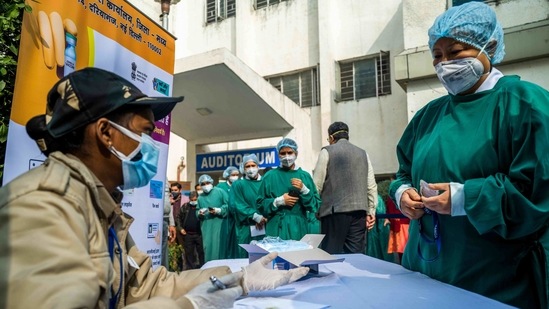
As India rolls out the world’s largest Coronavirus vaccination programme that envisages covering 300 million people by July, authorities are closely tracking domestic requirements and production and delivery schedules of the two Indian vaccine manufacturers, and working out the right mix of grants and commercial sales for foreign countries, the people said on condition of anonymity.
As the world’s largest manufacturer of vaccines, there is considerable pressure on India, especially from neighbours and developing countries, to supply vaccines. Nepal foreign minister Pradeep Gyawali, who was in India to co-chair a meeting of the bilateral joint commission, sought “early provision” of vaccines and was assured his country’s needs, will be a “priority consideration”.
“Obviously, the priority will be the neighbourhood. A lot depends on the production and delivery capacity of the vaccine manufacturers,” said one of the people cited above.
“In case of adequate capacity to meet the immediate needs of the country and neighbours, the possibility of deliveries to developing countries in other regions isn’t ruled out. We also have to work out what portion will be given as grants and what will be commercial sales,” the person added.
{{/usCountry}}“In case of adequate capacity to meet the immediate needs of the country and neighbours, the possibility of deliveries to developing countries in other regions isn’t ruled out. We also have to work out what portion will be given as grants and what will be commercial sales,” the person added.
{{/usCountry}}Several countries, such as Bangladesh, have signed agreements with the Serum Institute of India for millions of doses. The people said in view of these factors, a decision on exports is expected to take a few weeks.
The people brushed aside reports that India had set aside 20 million doses for its neighbours. “The figures are all up in the air. These things are still being worked out,” the person cited above said.
Even within the neighbourhood, the need of some countries, such as Nepal, is pressing as they have no domestic manufacturing capabilities. Gyawali told reporters on Saturday that Nepal has framed four major criteria to determine purchases – the effectiveness of the vaccine, compatibility with Nepal’s cold storage chains, cost effectiveness, and how promptly the doses can be delivered.
However, the rush to acquire Indian vaccines resulted in an embarrassing situation for the Brazilian government. Brazil’s foreign ministry announced on January 13 that an Airbus A330 aircraft was being sent to Mumbai to transport two million doses “purchased” from the Serum Institute.
After the external affairs ministry announced on Thursday that decisions on exports will take more time, Brazil’s communications minister Fabio Faria tweeted on Saturday that the “mission [to Mumbai] was rescheduled due to diplomatic issues between Brazil and India and should take place in the coming days”.
Besides overseas needs, India also has to meet its commitment to Gavi or the global Vaccine Alliance and its WHO-backed COVAX scheme, which aims to help 92 low and middle-income countries secure access to vaccines in 2021. Gavi has secured a commitment for 200 million does from the Serum Institute with the support of the Bill and Melinda Gates Foundation.
The people noted that Prime Minister Narendra Modi reiterated India’s commitment to help the world while launching the country’s vaccination programme on Saturday.
“Today, when we have made our vaccine, the world is looking at India with hope. As our immunisation campaign progresses, many countries of the world will benefit from our experience. India's vaccines and our production capacity will benefit the whole of humanity – this is our commitment,” Modi said.