NEW DELHI: Amid an international backlash against a Chinese coast guard vessel firing a water cannon at a Philippine boat in the South China Sea, India on Friday called for a peaceful settlement of disputes and adherence to international law in the region.
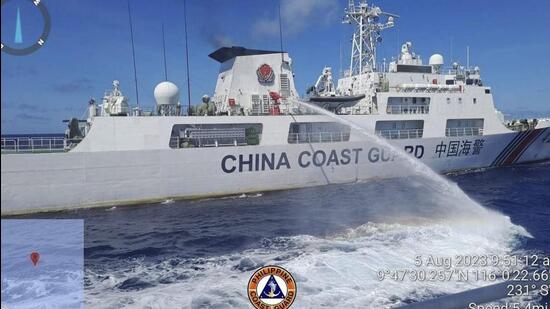
The Chinese coast guard ship fired the water cannon at a smaller Philippine boat carrying supplies to Filipino marines on Second Thomas Shoal, located within the Philippines’ exclusive economic zone in the South China Sea, on August 5. The Chinese vessel also moved dangerously close to Philippine coast guard ships escorting resupply boats.
External affairs ministry spokesperson Arindam Bagchi reiterated India’s long-standing position on the need to adhere to international law in the context of issues related to the South China Sea and for a rules-based order.
Also Read: Eye on China, India signals a larger role for itself in Indo-Pacific
“We have also underlined the need for peaceful settlement of disputes, and I think that’s what we would reiterate,” he said while responding to a question on the incident involving the Philippine boat.
{{/usCountry}}“We have also underlined the need for peaceful settlement of disputes, and I think that’s what we would reiterate,” he said while responding to a question on the incident involving the Philippine boat.
{{/usCountry}}“We have always felt that the issues and disputes need to be resolved peacefully,” he added.
The incident also drew a strong response from the US, a key military ally of the Philippines. US state department spokesperson Matthew Miller said an armed attack on Philippine public vessels or aircraft in the South China Sea would “invoke US mutual defense commitments” under the 1951 US-Philippines Mutual Defense Treaty.
While India earlier only acknowledged the Permanent Court of Arbitration’s ruling of 2016 in favour of the Philippines in its territorial dispute with China in the South China Sea, it recently revised its position. A joint statement issued on June 29 emphasised the need to adhere to the 2016 arbitral award.
In response to another question on China reportedly opposing the inclusion of the term “Vasudeva Kutumbhakam” in G20 documents, Bagchi declined to comment on such reports but said the civilisational ethos reflected by the Sanskrit phrase finds mention in other ways.
Noting that the working language of G20 meetings is English, Bagchi said: “As you are aware, the theme of our G20 presidency in English is ‘one earth, one family, one future’.
“This is based on our civilisational ethos of Vasudeva Kutumbhakam, which has received widespread support and permeates many of the initiatives that India has brought onto the G20 agenda. This also finds reflection in the G20 logo, which has the words in Sanskrit as well as in English.”
Responding to yet another question on whether Beijing has recently given visas to Indian journalists, Bagchi said India hopes that China will allow Indian reporters to stay and work in that country.
“I won’t get into individual cases of visas. We would hope that China ensures circumstances that allow our journalists to stay there and report,” he said. “We have been in contact with the Chinese side on this issue.”
Earlier this year, China informed several Indian journalists in Beijing their visas had either been frozen or wouldn’t be renewed. The visa of the last Indian reporter in Beijing was recently renewed for a year.
The Chinese side had contended its actions were “counter-measures” in response to India’s “unfair” treatment of Chinese journalists. There are currently no Chinese journalists posted in New Delhi. All Chinese journalists posted to India in the past worked for state-run media.