India is coordinating with key partners in West Asia, such as Saudi Arabia and the United Arab Emirates (UAE), and the US to ensure safety of Indian citizens caught up in the intense fighting between the army and a rival paramilitary force in Sudan, people familiar with the matter said on Wednesday.
An Indian resident from Kerala, Albert Augestine, was among the 185 people who have died so far in the fighting and some 2,800 Indians are believed to be in Sudan, where violence between the regular army and the rival paramilitary Rapid Support Forces (RSF) flared up last Saturday.
Video | Sudan clashes: Explosions in Khartoum captured on Live TV
The situation on the ground is “very tense” and any movement at this stage is very risky, one of the people quoted above said. “Our priority is the safety of movement and well-being of individuals, wherever they are located,” said the people.
India is coordinating closely with different countries to ensure the safety and security of its citizens in Sudan. Among these countries are members of the so-called Quartet — Saudi Arabia, UAE, the US and the UK — that has been actively engaged in peace efforts in Sudan.
{{/usCountry}}India is coordinating closely with different countries to ensure the safety and security of its citizens in Sudan. Among these countries are members of the so-called Quartet — Saudi Arabia, UAE, the US and the UK — that has been actively engaged in peace efforts in Sudan.
{{/usCountry}}Also Read| US diplomatic convoy fired on in Sudan amid power struggles, says Blinken
“The Quartet countries have a key role and we are engaging them accordingly. External affairs minister S Jaishankar has spoken to his counterparts in Saudi Arabia and the UAE,” one of the people said, referring to phone conversations late on Tuesday.
The Saudi and UAE foreign ministers assured Jaishankar of their practical support on the ground, the people said.
India’s envoys to the US and the UK are in touch with their host governments, and the Indian side is also working with the UN, which has a substantial presence in Sudan, the people said.
Relatives of Indians stranded in Khartoum said they had heard of dwindling food and water supplies and long power cuts. Several people said they were able to speak to family members who were on business visits to Khartoum when the fighting suddenly erupted. A number of Indian businessmen had travelled to Sudan to finalise trade deals before Eid holidays.
A woman whose businessman husband is holed up in a hotel in Khartoum said on condition of anonymity armed militia members, including teenagers, were out on the streets and had targeted foreign missions and looted shops and supermarkets.
“There are power cuts, though the hotel is using generators. The food situation is bad and my husband had to take shelter in the basement on Tuesday night,” she said.
Mumbai resident Mansi Sheth, whose father is stranded with a group of other Indians at another hotel in Khartoum, said: “Supplies of food and water are running short at the hotel. I spoke to my father on Wednesday morning for the first time since the fighting started. For now, they are safe but they can’t even open the windows in their rooms because of the firing outside.”
The external affairs ministry has set up a control room in New Delhi that is in continuous touch with the embassy in Khartoum to get updates on the Indian citizens. The embassy is in contact with the Indian community and individuals through multiple methods, including WhatsApp groups, the people said.
“While both the ministry and the embassy are continuously monitoring the situation, concerns about safety and security constrain us from putting out specific details,” the person cited above said.
According to the website of the Indian embassy in Khartoum, there are about 2,800 Indian nationals in Sudan. There is also a settled Indian community of about 1,200, which has been in Sudan for about 150 years. Details about where most of the Indian citizens are currently located could not be ascertained. Many Indian expatriates work as professionals in key sectors and a few work with the UN missions and other international organisations.
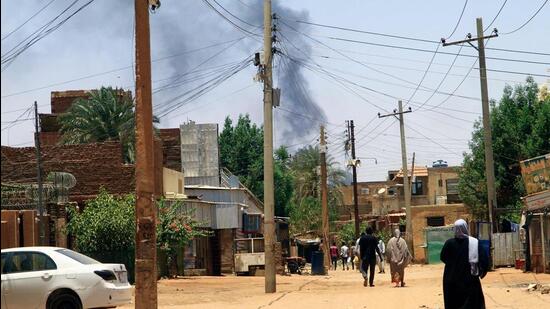
Fighting between Sudan’s army and RSF erupted in Khartoum and several other cities, derailing an internationally backed plan for transition to a civilian democracy and increasing the risk of civil war. The hostilities continued hours after an internationally brokered ceasefire was supposed to come into effect on Tuesday, with the two sides battling for key locations in Khartoum and accusing each other of violating the truce.
Albert Augestine, an Indian citizen working for the Dal Group in Sudan, died over the weekend after being hit by a stray bullet. The Indian embassy in Khartoum has issued several advisories asking Indian citizens not to venture out of their homes in view of the fighting, which it said is expected to continue.
“We have come across many instances of looting. All Indian nationals are advised please not to venture out. Please ration your supplies. The situation may continue for a few more days. Please try to take help from your neighbours. Please stay at home and remain safe,” said the latest advisory issued on Tuesday.
An earlier advisory had asked Indian citizens to stay away from open spaces such as balconies or terraces, and to keep essentials such as medicines, food, water, money, passports and OCI cards ready to “ensure easy mobility, when feasible”.