Rashtriya Swayamsevak Sangh (RSS) chief, Mohan Bhagwat, said on Sunday that India is looked upon as a shining example for dealing with diversity, especially when contradictions are rife across the globe. He also touched on the concept of ‘Akhand Bharat’ saying it was possible when people were no longer apprehensive.
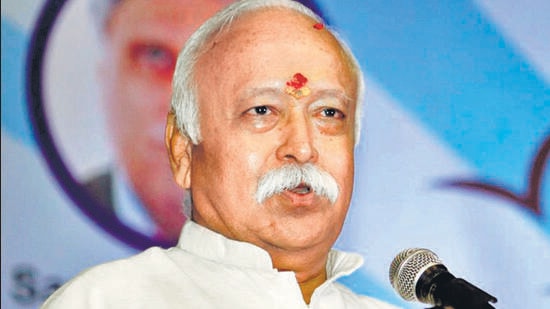
Speaking at a function on ‘Bharat@2047: My Vision, My Action’ in Nagpur on Sunday, Bhagwat said: “The world points to India when it comes to managing diversity efficiently. The world is full of contradictions, but managing dualities will only come from India.” The event was held a day ahead of Independence Day.
The RSS chief added that key historical events were never taught or explained in the country properly. “For instance, the place where Sanskrit grammar was born is not India. Did we ever ask the question why?” he asked.
“It is primarily because we first forgot our own wisdom and ancient knowledge and later, the land was plundered by foreign invaders who mainly came from the northwest region. The 9,000-year-old Indian culture has been subjected to foreign invasions from time to time,” he said.
Systems designed for society’s benefit were used to create differences between people and communities, he said, adding: “We unnecessarily gave importance to caste and other similar (social) structures.... Despite having different language, costumes, cultures, we must see the big picture and not get embroiled in such things.”
{{/usCountry}}Systems designed for society’s benefit were used to create differences between people and communities, he said, adding: “We unnecessarily gave importance to caste and other similar (social) structures.... Despite having different language, costumes, cultures, we must see the big picture and not get embroiled in such things.”
{{/usCountry}}“Even today, efforts are being made by (divisive forces) to spread religion-culture unrest in the society,” he added.
“If we want Bharat to become big, we need a better understanding of languages and cultures. All languages in the country are national languages. The people of the country must respect and have a sense of belonging towards people from different cultures and religious affiliations,” he said
“Having said this,” the RSS chief said, “why should Indians be afraid when we talk about Akhand Bharat?”
“Akhand Bharat is possible if we let go of fear and we will need to become that Bharat and dream about that Bharat,” Bhagwat added.
According to some historians, Indian culture is 2,400 years old, the RSS chief said, adding that “actually, our culture is 9,000 years old and this has been proven. In the future, this subject will also figure in our textbooks”.
He called upon the nation’s youth to work towards making the nation great. “India is enlightened and believes in the unity of existence of the whole universe. This is the thought that needs to be adopted by every youth in life,” he said.
On Saturday, Bhagwat hoisted the tricolour at the RSS headquarters as part of the ‘Har Ghar Tiranga’ campaign. The sangh had changed its display pictures on social media platforms to the Tricolour on Friday, amid criticism from the Congress party for not “hoisting the national flag” at its headquarters and not adhering to PM Modi’s ‘Har Ghar Tiranga’ call.