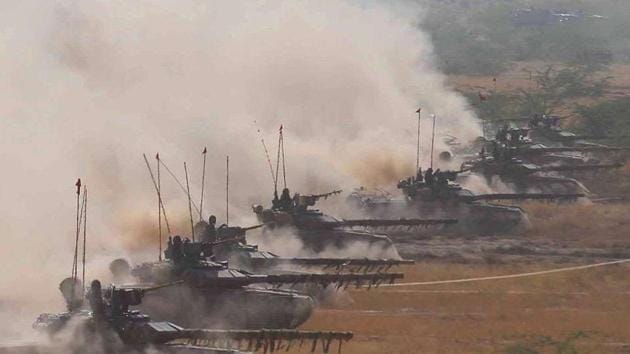
With the Chinese People’s Liberation Army (PLA) deploying close to 50,000 troops in Aksai Chin, the Indian Army for the first time has deployed a squadron (12) T-90 missile firing tanks, armoured personnel carriers (APCs) and a full troop brigade (4,000 men) at Daulat Beg Oldi (DBO) to prevent any Chinese aggression from the Shaksgam-Karakoram pass axis, according to top military commanders familiar with the matter.
India’s last outpost at Daulet Beg Oldi DBO lies at a height of 16,000 feet just south of Karakoram pass and on banks of Chip-Chap river, north of the Galwan-Shyok confluence.
As some bridges on the Darbuk-Shyok-DBO road cannot handle the weight of a 46 ton T-90 tank, the Indian Army commanders sent the T-90 tanks after the June 15 Galwan flare-up by fording the rivers and rivulets using specialized equipment. The armoured personnel carriers (APCs) or infantry combat vehicles , M 777 155mm howitzers, and 130 mm guns had already been sent to DBO after Chinese aggression at patrolling points 14, 15, 16 , 17 and the Pangong Tso finger features.
Also Read: China tried to jab India with a new claim on Bhutan. Why it has boomeranged
While India and China have decided to first totally disengage and then de-escalate from the area, the Indian Army is not only matching troop strength but also keenly watching the PLA deployment of tanks, air defence radars and surface to air missiles in Aksai Chin.
{{/usCountry}}While India and China have decided to first totally disengage and then de-escalate from the area, the Indian Army is not only matching troop strength but also keenly watching the PLA deployment of tanks, air defence radars and surface to air missiles in Aksai Chin.
{{/usCountry}}The disengagement is work-in-progress with each side verifying the movements of the other, the commanders, who asked not to be identified said.
While the Indian military has also decided to black-top the advance landing ground at DBO, the main reason for deploying tanks in the area is to prevent any sudden Chinese move from the north, they added.
Also Read: ‘Gratuitous’: Indian official’s acerbic retort on China’s advice on foreign policy
Already China has built some 36 kilometres of road in the Shaksgam Valley (5163 square kilometres were illegally ceded by Pakistan to China in 1963), and Indian military planners fear that PLA will link the G-219 (Lhasa-Kashgar) highway to Karakoram pass through the Shaksgam pass.
Even though this will require tunnelling under the permafrost of Shaksgam glacier, the Chinese have the technical ability to complete the job.
Also Read: Twin naval exercises with US supercarriers signal QUAD has arrived
The fear is that once the link is completed, the PLA will put pressure on DBO from the north as it needs a buffer to prevent the Indian Army from targeting the road.
According to the military commanders, the main purpose of PLA aggression this summer was to clear all the friction points with the Indian Army along the 1147 km long line of actual control (LAC) in East Ladakh and impose the 1960 map claim. However, this attempt was forcefully repelled by the men of 16 Bihar who took on the 3 Mechanized Infantry of Xinjiang Military district on June 15 at Galwan.
This plan dovetailed into a larger plan of linking the G219 highway to G314 (Kashgar-Islamabad Karakoram highway) via Karakoram-Shaksgam pass axis in order to save not only time but distance.
A fruition of this plan would have made Indian army positions untenable not only at DBO but also at Siachen as the outpost is linked to Sansoma (crucial base on Nubra river before Siachen) via Saser la-Murgo axis.
In many ways, Pervez Musharraf‘s plan to interdict Srinagar-Kargil highway and starve Indian positions at Siachen during the 1999 Kargil war between India and Pakistan has a parallel in China’s Xi Jinping’s attempt to interdict the DSDBO road to cut off DBO 21 years later.