E-Paper



India reacts cautiously to Trump tariffs threat, points to trade deal talks
India and the US announced plans to negotiate a multi-sector bilateral trade deal during PM Narendra Modi’s US visit in February, aiming for mutual benefits.

 Prefer HTon Google


NEW DELHI: India responded cautiously on Friday to US President Donald Trump’s threat to hit trade partners with reciprocal tariffs from April 2, saying the two sides are negotiating a multi-sector trade deal to tackle tariff and non-tariff barriers and increase market access.
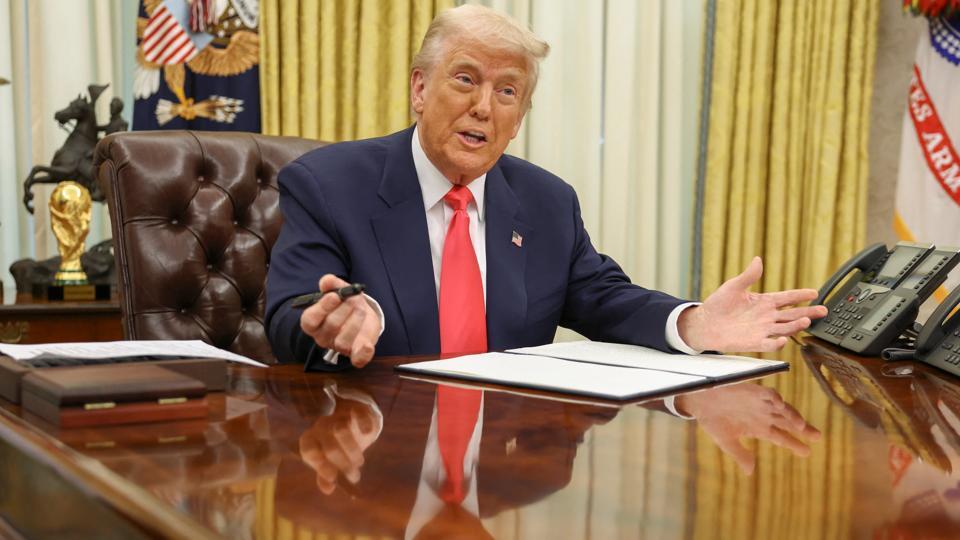
The first official response from the Indian side to Trump’s plans for reciprocal tariffs on every country that taxes US imports, provided by external affairs ministry spokesperson Randhir Jaiswal, was silent on the steps India will take if the US president goes ahead with his threat.
India and the US announced plans to negotiate a mutually beneficial, multi-sector bilateral trade agreement during Prime Minister Narendra Modi’s visit to the US in February. Commerce minister Piyush Goyal travelled to Washington during March 4-6 for meetings with his counterparts on the proposed trade deal, the first tranche of which is to be finalised by the fall.
“The two governments are in the process of advancing discussions on a multi-sector bilateral trade agreement,” Jaiswal told a regular media briefing while responding to questions about Trump’s proposed reciprocal tariffs.
India’s objective, through the bilateral trade agreement, is to strengthen and deepen two-way trade in goods and services, increase market access, reduce tariff and non-tariff barriers, and deepen supply chain integration between the two countries, Jaiswal said.
Goyal met his US counterparts to take forward discussions on trade, tariffs and other issues. “These issues have been discussed and we will see more in the coming days...but both sides are keen on advancing these discussions further,” Jaiswal added.
New Delhi is hoping that the ongoing negotiations for a trade deal will help India escape Trump’s planned tariffs, and people familiar with the matter said on condition of anonymity that the Indian side is looking at reducing tariffs on goods that are of interest to the US, including automobiles and certain agricultural products.
“The US has given its position and the Indian side has its position. It remains to be seen if the two sides can find common ground by April 2, which will not be easy,” one of the people cited above said.
The people said the Indian side is looking at certain agricultural products on which tariffs can be reduced without harming the interests of Indian farmers. At the same time, the Indian side will continue engaging the US to finalise the first tranche of the trade deal.
A joint statement issued after the meeting between Modi and Trump in Washington on February 13 had set a fall deadline for the first trance of the bilateral trade agreement. The statement also spoke of deepening bilateral trade to “promote growth that ensures fairness, national security and job creation”, and the two leaders also set a target of more than doubling trade to $500 billion by 2030.
Addressing a joint session of the US Congress on Tuesday, Trump listed India along with Brazil, Canada, China, Mexico and the European Union (EU) as countries and regions that “charge us tremendously higher tariffs than we charge them” and said he intended to impose reciprocal tariffs from April 2 to balance trade.
“It’s very unfair. India charges us auto tariffs higher than 100%. China’s average tariff on our products is twice what we charge them,” Trump said, with his threat of reciprocal tariffs sparking concerns about an escalating global trade war.
According to the US trade representative’s website, America’s total trade in goods with India was estimated at $129.2 billion in 2024, including US exports to India worth $41.8 billion and imports from India valued at $87.4 billion.
The people also pointed out that the US trade deficit with India, at $45.7 billion in 2024, was much lower than the trade deficits with major trade partners such as China ($295.4 billion), Mexico ($171.8 billion), Japan ($68.5 billion) and Canada ($63.3 billion).