With a trade deal off the table, India and the US are looking to focus sharply on defence cooperation during the two-day visit of US President Donald Trump to India, and will, in all likelihood, indicate a calendar for the signing of the third foundational military communication agreement between the two countries during the visit, top officials familiar with the matter said on condition of anonymity.
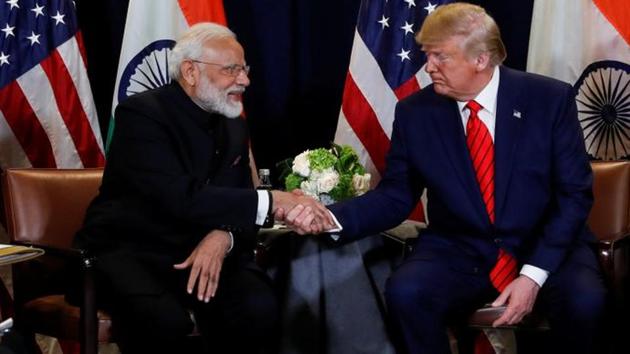
Talks on the finalisation of the Basic Exchange and Co-operation Agreement (BECA) are scheduled to begin as early as March, one of the officials said. BECA will allow India and the US to exchange geospatial maps to get pinpoint military accuracy of automated hardware systems and weapons such as cruise and ballistic missiles, apart from its civilian use.
In addition, the two countries are likely to sign multiple deals for defence purchases, added this person. This includes a $2.4 billion deal for 24 MH-60R Sikorsky helicopters, and a $930 million deal for six Apache AH-64E attack helicopters for the army from Boeing, both of which were approved by the Cabinet Committee on Security earlier this week. There could also be a further order of eight Poseidon P8I multi-mission aircraft for the Indian Navy and a full spectrum missile shield for New Delhi.
Also read | Ahead of visit, Trump talks of a ‘tremendous deal’ with India
{{/usCountry}}Also read | Ahead of visit, Trump talks of a ‘tremendous deal’ with India
{{/usCountry}}The forthcoming visit is a rare one because President Trump will be accompanied by First Lady Melania Trump, daughter Ivanka Trump, and her husband Jared Kushner. Daughter Ivanka was conveyed a personal invite from PM Modi after which she agreed to accompany her parents and husband.The officials said the Trump administration suggested a visit after the US elections, but that the Indian side convinced them otherwise.
The first official said President Trump was only keen on visiting Delhi but that India insisted that he do a public event in Ahmedabad on February 24, as a sort of direct outreach to Indians. Agra, this person said, was added at the First Lady’s insistence. The second person said that the idea is for the President and the First Lady, and Kushner and Ivanka Trump to see the Taj Mahal in Agra at sunset on February 24. If they make it back to Delhi early enough, this person added, they might have a quiet private dinner with Prime Minister Narendra Modi.
Bilateral talks are scheduled for the following day.
The joint statement at the end of the talks will also likely focus strongly on terrorism and cooperation between the two countries on tackling it, the second person said. The US, he pointed out, had emerged India’s staunchest ally on this front in recent years — whether it is the listing of terrorist Masood Azhar or raising the issue of Pakistan sheltering India’s most wanted man, Dawood Ibrahim, at the Asia Pacific FATF meet. The statement may also mention a deepening of hydrocarbon trade between the two countries. From almost nothing in 2014, the US’ hydrocarbon exports to India have risen to around $9 billion.
Also read | Gujarat forms committee to oversee Donald Trump event
While both countries are keen on a trade deal, there are some sticky issues, the two officials said, adding that there is also ambition on both sides to announce a substantial deal rather than an incremental one. Market access to Indian products and tariffs remain sticky issues, they added, as does India’s digital nationalism in the financial payments space.
However, progress on BECA should help offset that, the two officials said.
Along with Communications Compatibility and Security Agreement (COMCASA) and Logistics Exchange Memorandum of Agreement (LEMOA), BECA is one of the foundational military communication agreements between the two countries.
LEMOA, which allows the Indian and American defence forces to use each other’s facilities and establishes procedures of easier access of supplies and services required by them, was signed in 2016.
COMCASA, which allows the US to transfer communication equipment to India that allow secure transmission of data and real-time information between the armed forces of the two countries, was sealed during last year’s Two-Plus-Two talks in Washington.
And in December last, the two countries signed the Industrial Security Annexe to the General Security of Military Information Agreement, which provides a boost to the Make in India initiative by allowing sharing of classified information between defence manufacturers of the two countries with the full backing of governments.