The Indian military brass led by Chief of Defence Staff Gen Bipin Rawat is expected to brain-storm on impact of a Taliban regime in Afghanistan and its security ramifications on India and the sub-continent this week.
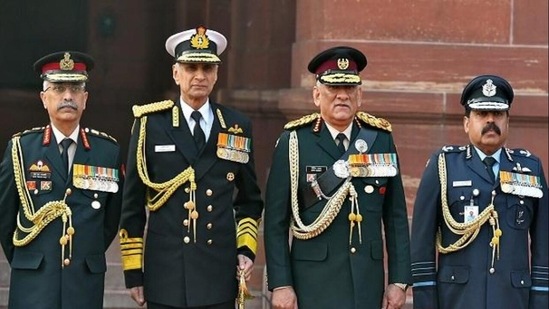
Given the ideological and operational affiliation of the Taliban, a UN designated global terrorist group, with Pakistan based terror groups like Tehreek-e-Taliban, Jaish-e-Mohammed and Haqqani Network, the military brass including all the three service chiefs will study and assess the security imperatives of rise of Taliban in Kabul. The topic is a matter of concern as for the first time there will be no US forces on ground in Afghanistan.
Also Read | Haqqani network is the sword arm of Taliban with Pakistan the common parent
The Indian military has a few areas of security concerns. Firstly, with the US leaving behinds billions of dollars’ worth hardware in Afghanistan, there will be serious proliferation of conventional weapons among the jihadists in the Indian sub-continent with sophisticated M-4 and M-16 rifles replacing the ubiquitous AK-47. The biggest worry are the military grade night vision devices, which are normally subjected to US export control regimes, the tactical drones and loitering ammunition. These US made military hardware is expected to find its way to Punjabi Islamists group like Jaish-e-Mohammed and Lashkar-e-Tayebba (LeT) targeting India in Kashmir. The security situation will become dire when the Taliban cadre are able to fly the abandoned squadrons of Blackhawk helicopters and operate the all-terrain military vehicles.
The other worry is that the umbilical linkages between the Taliban and Pakistan based terrorist groups will also give deniability to Islamabad in case of any terror strike in India. As in Taliban 1.0, the terror groups are expected to shift training camps to Afghanistan under the protection of the Taliban 2.0 and the Haqqani Network, which has known links with Pakistani deep state. The jihadists from the west will be calibrated by China through Pakistan and by Islamabad to pressure India on the western front while the eastern and northern front is far from settled due to belligerent PLA.
{{/usCountry}}The other worry is that the umbilical linkages between the Taliban and Pakistan based terrorist groups will also give deniability to Islamabad in case of any terror strike in India. As in Taliban 1.0, the terror groups are expected to shift training camps to Afghanistan under the protection of the Taliban 2.0 and the Haqqani Network, which has known links with Pakistani deep state. The jihadists from the west will be calibrated by China through Pakistan and by Islamabad to pressure India on the western front while the eastern and northern front is far from settled due to belligerent PLA.
{{/usCountry}}Watch | ISIS, Taliban, Al Qaeda: Terror rivals or sinister partners?
While the Indian military is confident of handling the rise of jihadist pressure from the west, it is concerned about the terror attack on India’s huge coastline with Pakistan based groups providing the logistics on sea. It is in this context, the Indian Navy and the coast-guard will have to plan for such emergency.
The Indian Air Force will have to sharpen its air defence radar network as the Pak based jihadists are not averse to using drones to not only cart weapons inside Indian territory but also use them to drop explosives on key installations. The drone attack on Jammu air base by LeT last June was just the beginning.