Indian soldiers are polishing their Muay Thai skills during ongoing joint drills in Thailand aimed at boosting interoperability between the two armies, the Indian Army said on Friday.
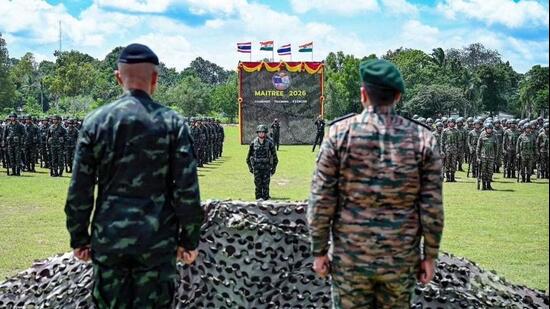
The 15th edition of the India-Thailand joint military exercise Maitree also focuses on deploying unmanned aerial vehicles (UAVs) in joint operations, combining tactical skills with modern technology. This comes as the Indian Army plans to induct tens of thousands of locally-made unmanned aerial systems and loitering munitions over the next five years to boost its battlefield capabilities. This is driven by the growing impact of these systems on military operations and how they have reshaped modern warfare as visible in ongoing global conflicts including the US-Israel war with Iran.
“Muay Thai training introduced the Indian contingent to Thailand’s traditional martial art, often referred to as the “Art of Eight Limbs” for its coordinated use of fists, elbows, knees and shins. The training enhanced physical conditioning, agility and close-combat skills while promoting cultural understanding and camaraderie between the two contingents,” the army said.
Also Read: Joint counter-terrorism mock drill conducted by Indian army, Karnataka police in Bengaluru
The two-week exercise, conducted at Vibhavadi Rangsit Camp, Surat Thani, Thailand, will conclude on August 31. The exercise involves 85 personnel each from the Indian Army and the Royal Thai Army, represented by troops from the 9 Gorkha Rifles and the 3rd Battalion, 25th Infantry Brigade, respectively.
“It aims to enhance interoperability and exchange operational experience in conducting joint counter-insurgency and counter-terrorism operations in jungle and semi-urban environments,” the army said in a statement. “Both contingents undertook joint training in jungle survival, first aid and casualty evacuation. Training also covered trench-clearing drills and the employment of UAVs in support of joint operations.”
{{/usCountry}}“It aims to enhance interoperability and exchange operational experience in conducting joint counter-insurgency and counter-terrorism operations in jungle and semi-urban environments,” the army said in a statement. “Both contingents undertook joint training in jungle survival, first aid and casualty evacuation. Training also covered trench-clearing drills and the employment of UAVs in support of joint operations.”
{{/usCountry}}Drone warfare has emerged as a priority for the Indian military amid the evolving demands of modern combat. The army’s requirement spans 80 different types of unmanned systems for specific roles including intelligence, surveillance, and reconnaissance, precision strikes, munition dropping, air defence, jamming, mine warfare, data relay, and logistics, according to a Technology Roadmap for Unmanned Aerial Systems and Loitering Munitions unveiled in April.
Last year, India and Thailand upgraded their relations to a strategic partnership as Prime Minister Narendra Modi and his then Thai counterpart Paetongtarn Shinawatra explored ways to enhance trade and investment and bolster cooperation in defence, security and countering cyber-crimes and human trafficking.