E-Paper



Odisha tragedy: Balasore hospitals crumble under a deluge of patients
At 7pm on Friday night, the Coromandel Express carrying 150 passengers crashed into a stationary goods train at Bahanaga Bazar railway station

 Prefer HTon Google


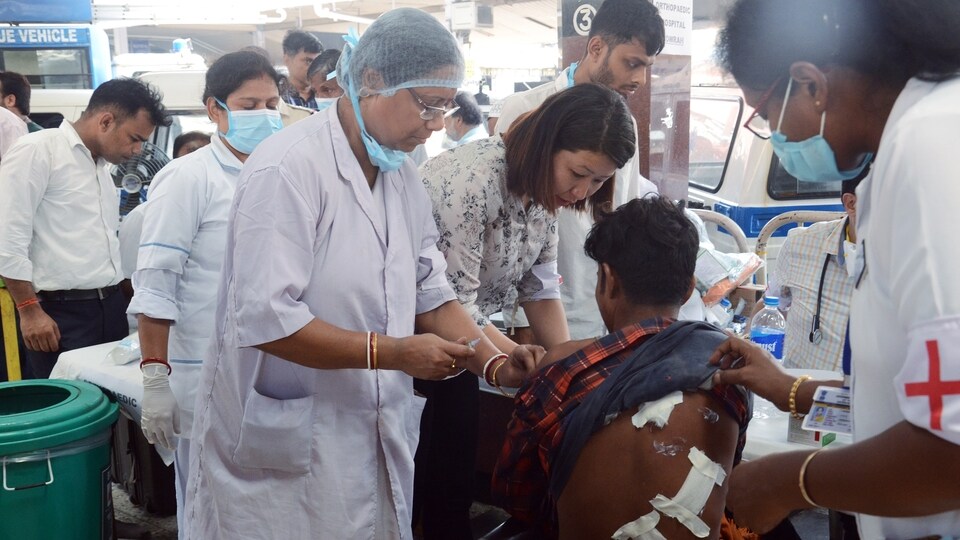
The first prone bodies began to arrive at the Balasore district hospital by 10pm on Friday. But within a few hours it became clear to health officials manning the gates of hospitals big and small- from PHC’s to district headquarters- the deluge of the injured, or of the dead, was of a magnitude Odisha had not seen before. Dr Mrutunjay Mishra, Additional District Medical Officer (ADMO), Balasore district headquarters hospital said, “I have been in the profession for many decades. But I have never seen such chaos in my life. Almost all together, 251 accident victims were rushed to our hospital, and to be honest, we were not prepared. But our staff worked through the night and provided medical aid to all.”
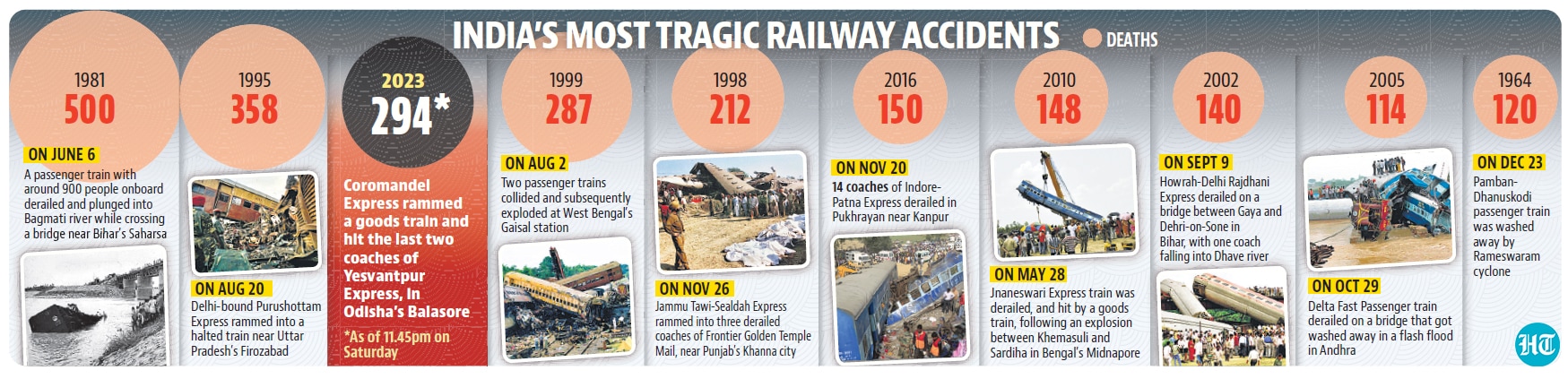
At 7pm on Friday night, the Coromandel Express carrying 150 passengers crashed into a stationary goods train at Bahanaga Bazar railway station. With several compartments derailing onto an adjacent track, they were then hit by the Bengaluru Howrah Superfast Express train on the parallel line, in what is India’s biggest train accident in 28 years that has left 294 dead and 1,110 injured at last count. For the medical institutions in rural Odisha that dealt with the aftermath of the accident, this meant dealing with a scale of tragedy they had never seen before.
At the Balasore district hospital and government Soro hospital nearby where most of the injured were rushed, for hours medical staff ran from one over-crowded room to the next, arranging for scarce supplies, and attempting to communicate with passengers, many of whom didn’t speak either Oriya or Hindi. “Though it is a district headquarters hospital, the scale of the tragedy was too big to immediately handle. I can only imagine the state at the primary health centres, and the community health centres near the accident site where there are no more than two doctors,” Dr Mishra said. By noon on Saturday, 526 victims had already been admitted to the hospital.
At the hospital, the morgue was a pile of white shrouds, most yet to be identified. Through the day, family members would arrive at the morgue, and tearfully hunt for their loved ones. But most bodies still lie untouched. “With train services cancelled or delayed because of the accident on a major railway trunk route, getting to Balasore has been a problem,” an Odisha government official said.
Dr Subhajit Giri, medicine specialist at the district hospital said, “We had more than 500 trauma cases on a single day when we deal with 100 at the most on a heavy day. We had to requisition medical students to deal with the emerging crisis.”
Through the day, Odisha state government officials said that they strengthened the medical assistance available, and deployed 200 ambulances and 45 Mobile Health Teams in Balasore, Bahanaga and Soro, as well as 50 additional doctors. “We mobilised a team of 25 doctors from SCB Medical College and Hospital in Cuttack, PRM medical college and hospital in Baripada. Sixty-four patients were referred to SCB Medical College Hospital in Cuttack,” said state health secretary Shalini Pandit.
To coordinate with the health teams, director Health Services along with Director Blood Safety, and 3 additional directors of the health department were stationed at Balasore. Union Health Minister Mansukh Mandaviya said, “Two teams of doctors from AIIMS-Bhubaneswar have been dispatched for Balasore and Cuttack to assist in relief operations at the rail accident site in Odisha. We are providing all required help and medical assistance to the victims of the tragic train accident to save precious lives.”
But what did help on a day of crisis, in Balasore, Bhadrak, and Cuttack, was help from locals, lining up outside hospitals through the night to donate blood, crucial in the treatment of trauma. “We were surprised as a large number of youths made a beeline to donate blood. We collected around 500 units of blood overnight. Normally we find it difficult to convince people to donate, particularly in the summer,” Dr Mishra said.
At Cuttack’s SCB Medical College, a man that identified himself as Sudhanshu told news agency ANI, “Injured people are being brought here. I felt that I should donate blood. I hope it will save some lives.”