
 E-Paper



JD(U), RJD to propose seat-sharing formula based on last 3 poll results at Patna meeting
Emphasis will be laid on both seats won by the party and its vote share in the three previous elections, both assembly and Lok Sabha, leaders of the two parties said

 Prefer HTon Google


PATNA: A seat-sharing formula based on the performance of a party in the past three elections — for assembly or Lok Sabha — is likely to be proposed by the Janata Dal (United) and the Rashtriya Janata Dal (RJD) during the crucial Opposition meeting scheduled in Patna on June 23, people familiar with the matter said on Wednesday.
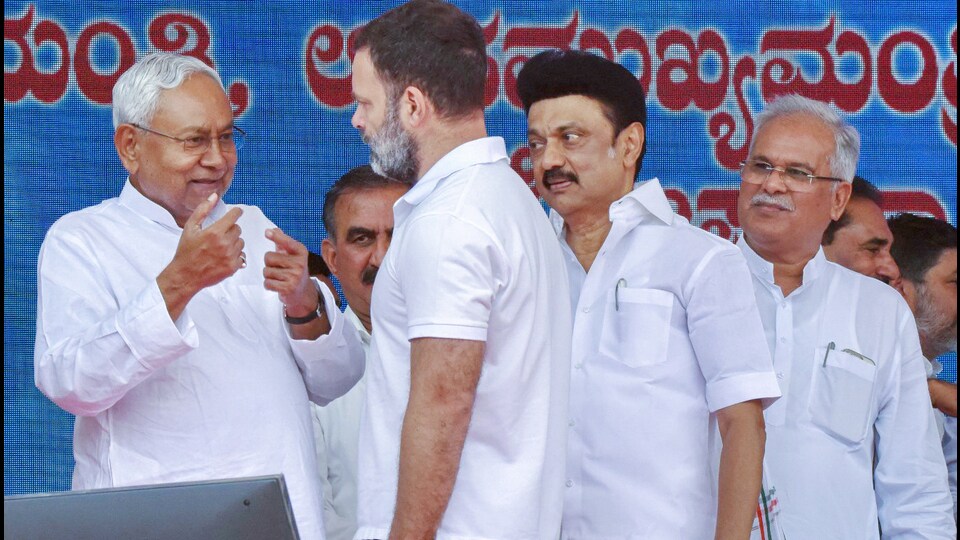
Emphasis will be laid on both seats won by the party and its vote share in the three previous elections, leaders of the two parties said, requesting anonymity. They added that this proposed formula would be part of the blue print for discussion at the meeting of top leaders of various opposition and regional parties to firm up a broad outline for a united front to take on the Bharatiya Janata Party (BJP) in the 2024 Lok Sabha polls.
“There has to be a mechanism to decide how many seats each party in any state deserves to contest. So, a formula will be used wherein performance of a party in the last three elections such as seats won and vote share achieved by it will be taken into consideration,” a senior leader from Bihar’s ruling grand alliance said, declining to be named. “Calculations will be done in terms of percentile and based on the results, seats would be allotted.”
Bhola Yadav, national general secretary of the RJD, said a formula is needed to work out a seat-sharing arrangement. “Once the front takes place, the exercise of seat-sharing would be done. We will apply the method of assessing the strength of each party based on a formula and of course, vote share would be a part of it,” he added.
The grand alliance leaders said the proposed formula would present fairness in the seat-sharing exercise, especially in states with strong regional parties.
“It would be a useful method to avoid disputes and help in amicable seat sharing between regional parties and the Congress in states where the grand old party is in coalition with regional allies like in Bihar and Jharkhand,” the senior leader quoted above said.
The Patna meeting, called at the invitation of Bihar chief minister Nitish Kumar, is likely to be attended by top leaders from nearly 15 opposition parties. Congress president Mallikarjun Kharge, party leader Rahul Gandhi, Aam Aadmi Party (AAP) national convener and Delhi chief minister Arvind Kejriwal, Trinamool Congress (TMC) supremo and West Bengal CM Mamata Banerjee, Tamil Nadu CM and Dravida Munnetra Kazhagam (DMK) chief MK Stalin, Samajwadi Party president Akhilesh Yadav, Jharkhand chief minister Hemant Soren and top leaders of Left parties and some smaller outfits are likely to participate in the meeting.
A senior RJD leader, familiar with the ongoing preparations for the meeting, said the proposed seat-sharing formula could work even in states such as West Bengal and Uttar Pradesh, where an amicable distribution of seats between the Congress and regional outfits the TMC and the Samajwadi Party is seen as a major hurdle in the united opposition front bid. “This could be a broad outline for an amicable seat-sharing arrangement,” the RJD leader added.
Speculations are rife that the Congress is keen on staking claim on at least 350 seats across the country, including in Bihar, Jharkhand, West Bengal and Delhi, where regional parties RJD-JD(U), Jharkhand Mukhi Morcha (JMM), TMC and AAP, respectively, are the ruling parties with bigger vote share in the past three polls.
KC Tyagi, JD(U) chief spokesperson and advisor to CM Nitish Kumar, said at the moment, the June 23 meeting in Patna is significant as it would showcase how Kumar’s bid to unite the opposition along with Congress is bearing fruit.
“We will sit on June 23 and discuss on uniting the opposition. We have identified around 450 seats where there is a scope of straight fight between opposition and BJP on the one against one formula,” he said.
Giving details about the formula to be proposed in the meeting, another grand alliance functionary said it will give weightage to the party that has won higher number of seats in the state over the vote share polled. This, the leader functionary added, could help the JD(U) getting more Lok Sabha seats as compared to the RJD, which failed to win a single seat in Bihar in the 2019 general elections, though it outperformed the JD(U) in 2015 and 2020 assembly polls.
Nitish Kumar’s JD(U), which realigned with the RJD in August 2022 after snapping ties with the Bharatiya Janata Party (BJP), won 16 Lok Sabha seats in 2019 as part of the NDA. In the 2020 assembly elections, the party won only 43 seats whereas RJD (then in opposition as part of the GA) won 75 seats and Congress bagged 19 seats in the 243-member assembly.
Leaders of the RJD and JD(U) said the two parties are pitching for this methodology as the same arithmetic was used for seat sharing among constituents that joined the Janata Party-led alliance in 1977 such as the Socialist Party and the Bhartiya Lok Dal. The Janata Party trounced the Congress in the 1977 general elections, which were held after the removal of Emergency imposed in June 1975.
A declaration of intent by all participants on opposition unity and related issues is likely be discussed in the June 23 meeting and a statement could be issued. A common minimum programme (CMP), however, is unlikely to be inked at the meeting by the opposition parties set to attend the mega event.
Bihar BJP spokesperson Nikhil Anand alleged the opposition parties will not be able to come to a consensus on leadership.
“Parties involved in massive corruption and loot, individual-owned pocket organisations and family-based political outfits are desperate to get united to save their respective parties and leadership. Where is the common agenda and consensus on leadership?” Anand said. “Surprisingly, the parties that accused, thrashed and abused each other are now trying to collaborate leaving behind their ideology and morality.”
Nawal Kishore Choudhary, political observer and former principal of Patna College, said the idea of using a formula to decide seat sharing among allies of the larger opposition front is an “over optimism”.
“Politics is not arithmetic where two plus two adds to four. Using a formula to decide seat sharing can only facilitate the process, but it would not be enough. There are far more challenges as the front will comprise of parties that play identity politics and have regional dominance in their respective states. The seat-sharing work would be a complex process,” he said.
Choudhary also pointed out that the opposition unity was achieved in 1977 as the scenario was different and many parties had merged to form the Janata Party. “Over the past four decades, regional parties have grown and have their own identity. Unless, there is sacrifice of their egos and dynastic interests, it is doubtful parties would agree on a common term,” he added.


