India and China agreed on Friday to hold the next meeting of senior military commanders as soon as possible to discuss complete disengagement at friction points on the Line of Actual Control (LAC) while working to maintain stability on the ground.
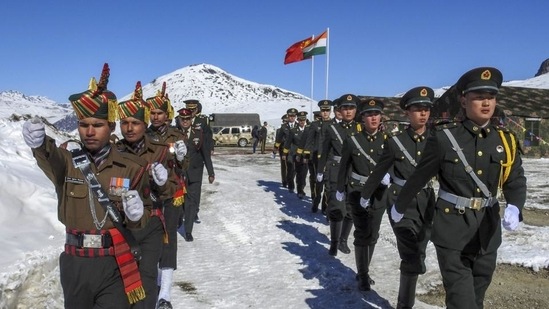
This was the only tangible outcome from a virtual meeting of the Working Mechanism for Consultation and Coordination (WMCC) on border affairs, which resulted in what the external affairs ministry described as a “frank exchange of views” on the situation along the LAC in the western sector. The last meeting of the military commanders at the Chushul-Moldo border meeting point was held on April 9.
Following a drawdown of troops and armoured units from the north and south banks of Pangong Lake in February, India and China haven’t made any headway on disengagement and de-escalation at other friction points such as Depsang, Gogra and Hot Springs. The two sides have also engaged in a war of words this week, blaming each other for the year-long standoff on the LAC.
On Thursday, India blamed China’s actions of amassing troops in border areas and attempting to unilaterally change the status quo on the LAC for the standoff, and dismissed Beijing’s contention that New Delhi’s policies were to blame for the tensions.
{{/usCountry}}On Thursday, India blamed China’s actions of amassing troops in border areas and attempting to unilaterally change the status quo on the LAC for the standoff, and dismissed Beijing’s contention that New Delhi’s policies were to blame for the tensions.
{{/usCountry}}Following the WMCC meeting, a statement issued by the external affairs ministry said: “The two sides agreed to hold the next (12th) round of the senior commanders meeting at an early date to achieve the objective of complete disengagement from all the friction points along the LAC in the Western Sector in accordance with the existing bilateral agreements and protocols.”
The two sides also agreed to maintain dialogue and communication through diplomatic and military mechanisms to reach a “mutually acceptable solution for complete disengagement from all friction points so as to ensure full restoration of peace and tranquillity to enable progress in the bilateral relations”, the statement said.
In the interim, the two sides will “continue to ensure stability on the ground and prevent any untoward incident”, the statement said. It added that both sides also agreed on finding an early resolution to remaining issues along the LAC in eastern Ladakh in line with the agreement reached between the two foreign ministers in September 2020.
This was the eighth round of diplomatic talks under the WMCC mechanism since the standoff began in May last year.
The Indian delegation was led by additional secretary (East Asia) Naveen Srivastava, and the director general of the boundary and oceanic department of China’s foreign ministry, Hong Liang, led the Chinese delegation.
A separate readout in Mandarin from China’s foreign ministry described the discussions as a “candid and in-depth” exchange of views and said the two sides agreed to “consolidate the results of the disengagement of border troops” and “properly resolve the remaining issues” in the western sector of the border.
The Chinese readout also referred to the consensus reached by the foreign ministers, and said the two sides will continue to “promote further de-escalation of the situation at the border, avoid the recurrence of the situation on the ground, and jointly safeguard peace and tranquillity”.
It added that specific time and arrangements for the next round of military talks will be determined through the “border hotline as soon as possible”.