Sign in

Legal aid services neglected in the country, says CJI Lalit

Speaking at the ninth convocation ceremony of National Law University in Odisha’s Cuttack, the CJI said that he had been associated with legal aid work for the past year-and-a-half and that work in this field is a “bit neglected” across the country.

Updated on: Sep 17, 2022, 23:07:14 IST
By , Bhubaneswar
Share
Share via
  • facebook
  • twitter
  • linkedin
  • whatsapp
Copy link
  • copy link

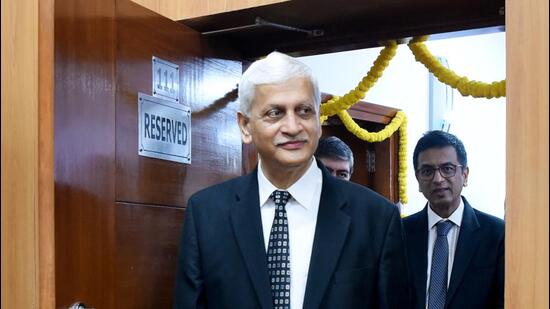
Stressing that legal aid work in the country is neglected, Chief Justice of India Uday Umesh Lalit on Saturday said young law graduates should devote as much time and energy as possible to providing legal aid services.

Chief Justice of India Uday Umesh Lalit said young law graduates should devote time and energy to providing legal aid services. (Shrikant Singh)

Speaking at the ninth convocation ceremony of National Law University in Odisha’s Cuttack, the CJI said that he had been associated with legal aid work for the past year-and-a-half and that work in this field is a “bit neglected” across the country.

“You are the young torch-bearers now. Think of legal aid to a certain extent. Devote your time, energy to the extent possible to legal aid work and it will again bring you back to that level of compassion. That compassion will drive you in the right direction. Legal aid services will also instill a sense of compassion,” said CJI Lalit, who is also the patron-in-chief of the National Legal Services Authority.

The CJI also urged young law graduates to pursue judicial services in fields other than conventional options such as corporate law or litigation.

The legal profession has been among the frontrunners when it comes to keeping civil rights intact, he said, adding that the history of every society shows that legal minds have been the beacons and path-breakers when it comes to raising a voice against injustice.

CJI Lalit inaugurated paperless courts in 30 districts of Odisha at a special function. Under the new system, touch-enabled laptops will be provided to judicial officers for the paperless courts.

The paperless courts were inaugurated in presence of justices D Y Chandrachud and M R Shah and Orissa high court chief justice S Muralidhar.

Talking about the several advantages of technological advancement, he highlighted how a common man sitting in the remotest part of the country now has access to justice.

“Covid-19 pandemic has taught us to adapt, change and modernise ourselves. The advantages of technology are here for us not only to witness but assimilate into our lifestyle,” CJI Lalit said.

The CJI recalled how he was brought up in an environment where there was a culture of looking up to the library and books in physical form for reference, and added that he still considered himself to be in a nursery school with respect to technology.
  • Debabrata Mohanty
    ABOUT THE AUTHOR
    Debabrata Mohanty

    Debabrata Mohanty is a senior assistant editor of Hindustan Times who works as state correspondent from Odisha covering the state's politics, governance, public policy, natural disasters, environment and its society for close to three decades. With his long years of reporting from the state capital of Bhubaneswar, Mohanty has been known as one of the most experienced and credible journalists covering Odisha for the national English dailies. His reporting combines on-ground detail with deep institutional knowledge detailing the state's changing politics, governance issues, administrative reforms and the functioning of its public institutions. He has regularly reported on issues ranging from legislative developments and public policy implementation. Politics is his core areas of expertise as he closely tracks Odisha's political landscape, including the rise and transformation of the Bharatiya Janata Party (BJP), the Biju Janata Dal (BJD), the two principal political parties in Odisha. His long association with the state's political establishment enables him to write on contemporary developments in a larger political context. Mohanty takes a deep interest in writing human interest stories, environmental issues and documenting the impact of cyclones, floods, heatwaves, and other climate-related events in one of the most disaster-prone states. His coverage extends to public health, governance reforms and stories on accountability of government institutions. Before joining Hindustan Times, Mohanty worked with The Indian Express, Mail Today, and The Telegraph, where he covered at least six general elections and as many assembly elections. In 2007, he was selected for the prestigious Chevening Young Indian Print Journalist Programme at the University of Lincoln, United Kingdom, where he received advanced training in print journalism. In 2009 he won the Press Institute of India-International Committee of Red Cross award on conflict reporting for his on-ground reportage of 2008 Kandhamal riots.Read More

Get the latest India News, breaking headlines and real-time updates from across the country. Stay informed about politics, government policies, crime, weather and major national developments.