...
...
Next Story

Number theory: Management of peak power demand will test India’s renewable push

A look at how government’s efforts to bring down power demand during peak hours is a recognition of a crucial structural challenge facing India’s power sector.

Updated on: Aug 12, 2023, 04:40:12 IST
Advertisement

In June, the government announced that power tariffs would be linked to the time of consumption in the country. “Under the Time of Day (ToD) system, tariff during solar hours (duration of eight hours in a day as specified by the State Electricity Regulatory Commission) of the day would be 10%-20% less than the normal tariff, and the tariff during peak hours, 10-20% higher. “ToD tariff will be applicable for commercial and industrial consumers having maximum demand of 10 KW

PREMIUMRising income levels and the changing share of renewables in power production are transforming India's power patterns.
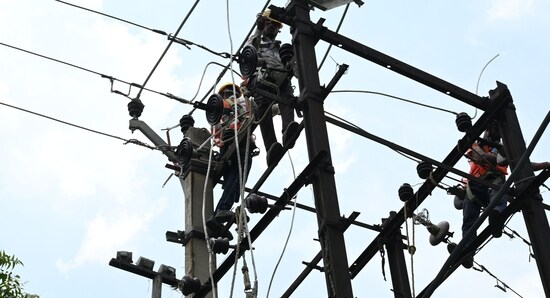
Rising income levels and the changing share of renewables in power production are transforming India's power patterns.
The charts that matter
  • India’s peak power demand has increased at a faster rate than overall power demand
    That India’s power consumption has increased with rising incomes is a no-brainer. However, what needs to be underlined is the fact that the peak power demand has increased at a faster rate than overall power demand in the recent past. Data from Centre for Monitoring Indian Economy (CMIE) shows this clearly. In 2009-10, India’s overall power demand and peak power demand was 1.73 times and 1.64 times that in 1999-2000, the earliest year for which data is available in the CMIE database. These numbers were 1.29 and 1.24 between 2009-10 and 2014-15 and became 1.41 and 1.46 between 2014-15 and 2022-23, the latest year for which this data is available.
  • This has happened at a time when domestic demand has overtaken commercial demand for power
    What explains the recent acceleration in peak demand? While there is no sector-wise breakup of peak demand, data on connected load by sector can give us an idea into what is happening. The Central Electricity Authority (CEA) gives data on connected load by sector, which is just the sum of the power rating of each electrical equipment. While a household or factory is unlikely to use all their electrical equipment at once even at the time of peak demand, connected load can tell us which sector has the potential to increase peak demand the most. This shows that domestic consumers are now the leaders in connected load, accounting for over 40% of it since 2016-17. This trend started in the last decade. Domestic consumers have consistently surpassed commercial and industrial users combined consistently since 2008-09. None of this should be surprising however. The growth in connected load of domestic consumers has been higher than the growth of commercial and industrial users (combined) regularly since the 1980s. With developments such as rising ownership of air-conditioners, household peak demand is expected to maintain its momentum.
  • And meeting peaks may become less feasible with more renewables in the mix
    As part of its green transition strategy, India has been increasing the share of renewables in its power production basket. This share has increased from 5.6% in 2015-16 to 12.5% in 2022-23. To be sure, the share of non-thermal power (this includes large hydropower and nuclear power apart from renewable power) has also increased from 19.1% in 2015-16 to 25.3% in 2022-23, which the government aims to increase to 50% by 2030. However, nuclear sources and large hydropower projects are not considered renewable sources generally because the former involves mining a finite mineral and the latter adversely affects the environment by restricting water flow, submerging forests, and thus becoming a source of greenhouse gas emissions. While renewable power generation does not have such disadvantages, it suffers from a crucial handicap as far as meeting peak demand is concerned. Power production from sources such as solar energy cannot be scheduled to meet peak demand outside daylight timings. Doing this will require either better storage of power generated during off-peak hours or efficient sharing of power between grids. Both of these strategies will require significant investment in India’s power grid infrastructure. By increasing tariff rates during peak demand hours, the government might be hoping to achieve two desired objectives: reduce peak demand and gather much needed finances for boosting India’s power grid infrastructure. Whether or not the policy delivers on its promise, especially given the track record of previous reforms in the power sector, remains to be seen.
All Access.
One Subscription.

Get 360° coverage—from daily headlines
to 100 year archives.

E-Paper
Full
Archives
Full Access to
HT App & Website
Games
 
ABOUT THE AUTHOR
Abhishek Jha

Abhishek Jha is Assistant Editor-Data at Hindustan Times. He uses statistical programming to generate newsworthy insights from large datasets. He is part of the team that produces Number Theory, a daily data story feature of the paper’s print edition. Since March 2024, he has been writing Weather Bee, a weekly column for the Hindustan Times website. He is a chemical engineer by training, who specialises in stories related to weather, climate, and the environment. Jha has been at HT since 2018, where he offers data-driven perspective and analysis on politics, environment, weather, climate, economy and society. His work includes data coverage of elections in India and abroad, including the 2019 and 2024 Lok Sabha elections; the disasters and extreme weather resulting from changing climate, such as floods, droughts, heat waves, cold waves, and dwindling snow cap in the Himalayas; the factors that drive poor air quality in northern India; the changing patterns of land use; the Covid-19 pandemic and its impact on labour market conditions; the changing pattern of consumer spending seen in the new consumer spending surveys; and social norms seen in the surveys such as the National Family Health Survey.

Get the latest India News, breaking headlines and real-time updates from across the country. Stay informed about politics, government policies, crime, weather and major national developments.
SHARE THIS ARTICLE ON
Hindustantimes wants to start sending you push notifications. Click allow to subscribe