
 E-Paper



Former J-K CMs Mehbooba Mufti, Omar Abdullah booked under Public Safety Act
The PSA allows for detention without trial for up to two years if a person is deemed acting “in any manner prejudicial to the security of the state”. .

 Prefer HTon Google


Former Jammu and Kashmir chief ministers Mehbooba Mufti and Omar Abdullah were booked under the stringent Public Safety Act (PSA) on Thursday along with two other leaders of their People’s Democratic Party (PDP) and National Conference (NC) , officials aware of the matter said.
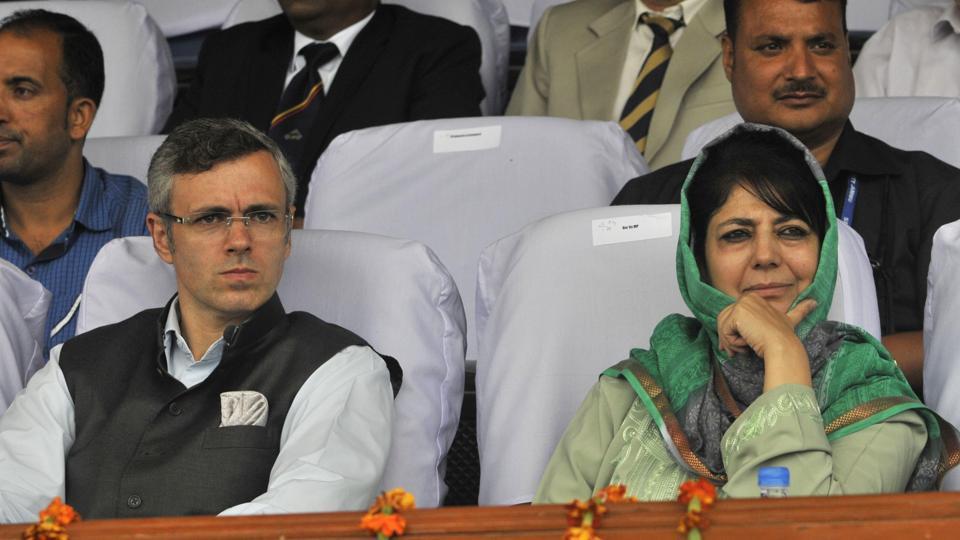
The PSA allows for detention without trial for up to two years if a person is deemed acting “in any manner prejudicial to the security of the state”.
The officials said a magistrate accompanied by police served the detention order to Mufti at the bungalow, where she has been under detention. Omar Abdullah was also booked under the PSA, they added.
A police officer, who spoke on condition of anonymity, said the former chief ministers have been booked under the PSA since their preventive detention ended on Thursday.
ALSO WATCH | How J&K celebrated its 1st Republic Day after special status removal
Mufti’s daughter, Iltija, told HT that her mother was handed over the PSA detention order on Thursday evening. “The PSA has been slapped on Mehbooba Mufti and she would not be shifted to her residence.”
She later tweeted. “Ms Mufti received a PSA order sometime back. Slapping the draconian PSA on 2 ex J&K CMs is expected from an autocratic regime that books 9-year-olds for ‘seditious remarks’.”
The four leaders were slapped with the PSA on a day Prime Minister Narendra Modi quoted in Parliament comments by the former chief ministers in August when Parliament cleared the nullification of Constitution’s Article 370 to suggest that they were not in sync with the spirit of the Indian Constitution.
He said Mufti called the move a “betrayal”, while Omar Abdullah warned of an “earthquake” in the aftermath of the decision. Modi added Farooq Abdullah said people would stop waving the Indian flag in the region and asked if any “true Indian” would “advocate the cause of such people”.
The two other leaders booked under the PSA include NC’s Ali Mohammed Sagar and PDP leader Sartaj Madani.
The four were among hundreds of people, who were detained in August to prevent protests against the nullification of Article 370 that gave Jammu and Kashmir a special status. A communications blackout and a lockdown were also imposed in August when the region was also divided into two Union territories. Most restrictions have since been eased.
In December, another former chief minister Farooq Abdullah’s detention was extended by three months under the PSA.
On Wednesday, former minister Sajjad Lone and PDP leader Waheed Parra were released even as the government told Rajya Sabha that 437 people, including the three former chief ministers, remain under detention.
Lone and Parra’s release came exactly six months to the day after Parliament passed laws and resolutions bifurcating Jammu and Kashmir into two Union territories and nullified constitutional provisions that gave the region special status and its residents’ special privileges.
Opposition parties in Parliament raised the issue of Farooq Abdullah’s incarceration as he completed six months in detention on Wednesday. “Three former chief ministers, including Farooq Abdullah, are languishing in jails for the past six months. They have been put behind bars without giving any proper reason,” Congress leader Adhir Ranjan Chowdhury said.
News agency Press Trust of India quoted an unnamed PDP spokesperson saying the government was “testing the patience” of the people by such “undemocratic moves” while condemning the slapping of the PSA on the prominent Kashmiri leaders.
Former legislator and Communist Party of India (Marxist) leader M Y Tarigami said the decision puts a question mark on the Centre’s claim that the situation is normal in Jammu and Kashmir after the abrogation of its special status.
Congress spokesman Ravinder Sharma termed the slapping of the PSA on the four leaders as unfortunate. “There is no justification for it...the mainstream leaders served the erstwhile state in different capacities,” Sharma said. He added the move does not match with the claims of normalcy and comes at a time when the government is encouraging a section of leaders to restart the political activity.


