New Delhi: The ministry of home affairs (MHA) will provide security to the election commission of India with all the forces the poll body needs to conduct the upcoming assembly elections in the Union Territory of Jammu and Kashmir, chief election commissioner Rajiv Kumar said after meeting home secretary Ajay Kumar Bhalla on Wednesday along with other senior ECI officials.
“The meeting went well. Such meetings are held to assess the requirement of forces. The home ministry was ready to provide [forces] as per EC’s assessment. We are determined to conduct and build on the democratic surpluses created during the parliamentary elections,” Kumar told HT.
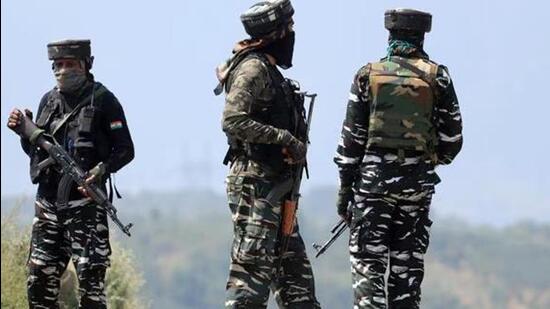
People familiar with the development said the deployment of troops in J&K was discussed in detail, particularly in the wake of frequent terror attacks in the Jammu region for the past four-five months. “These concerns [related to the recent attacks] have been factored in,” Kumar said. He refused to give details about the number of troops that will be deployed for the polling, citing security concerns.
The five-judge constitution bench, headed by the chief justice of India, DY Chandrachud, while upholding the abrogation of Article 370 in December 2023, had instructed the poll body to conduct assembly elections in Jammu and Kashmir by September 30. “Restoration of statehood shall take place at the earliest and as soon as possible,” the operative part of the judgement said.
Also Read: J&K leaders positive of timely assembly polls after ECI meet
{{/usCountry}}Also Read: J&K leaders positive of timely assembly polls after ECI meet
{{/usCountry}}“We are assessing when we might announce the polls. It depends on scheduling, weather, phases, movement of migratory voters, and festivals,” Kumar said. Weather is an important factor because it directly affects voter turnout. For instance, during the thick of winter, people migrate from the Kashmir Valley to Jammu, and holding elections then would see a very low voter turnout in the high-lying areas.
To conduct elections, the ECI has to take stock of the situation on the ground for which it depends on central government. Factors include local law and order situation, weather conditions, and availability of Central Armed Police Forces (CAPF) and other persons required to hold the elections. ECI makes its own assessment after consulting with the relevant stakeholders, which include the local government, Union home secretary, local chief secretary, local director general of police, and district magistrates. EC officials also usually choose to visit the location to assess the situation.
Also Read: J&K terror attacks: MHA lists steps being taken to contain terrorism
Senior ECI officials, led by Kumar and including election commissioners Gyanesh Kumar and Sukhbir Singh Sandhu, visited Jammu and Kashmir from August 8 to 10, where they met leaders of the political parties and administrative and police officials. Almost all leaders urged the ECI to hold assembly polls at the earliest as the region has been deprived of elected government for the last six years, HT had reported on August 9.
The ECI also met deputy commissioners and senior superintendents of police on the security situation, where the officials were briefed about the security situation in particular. On August 9, they met chief secretary Atul Duloo and director general of police RR Swain in Srinagar, and then went to Jammu.
Currently there are about 70 battalions (about 70,000 personnel) of central paramilitary forces permanently deployed in J&K to deal with insurgency and law and order issues. Besides, the Border Security Force (BSF) and army are responsible for maintaining vigil at the border.
Around 500 companies (50,000 personnel) of paramilitary forces sent to the Valley for the Amarnath Yatra may be asked to stay there for election duty as well.
“A key concern is terror attacks, not just on security personnel and camps but civilians by Pakistan-backed outfits’ proxies. 28 people have been killed already this year in 11 attacks, and there is information of the presence of several foreign fighters,” said an officer, who didn’t want to be named.
Also Read: Time absolutely apt, assembly polls in J&K at the earliest: CEC
To deal with the situation, the J&K police and central agencies are working together to identify strategic supporters of terrorists, and a crackdown is continuing on terror financing.
According to data shared by Union minister of state for home affairs Nityanand Rai in Parliament last month, at least 14 security personnel and as many civilians have been killed in 11 terror incidents and 24 encounter/counter-terrorism operations in the Union territory till July 21 this year. In comparison, 30 security personnel and 14 civilians were killed in 46 terror incidents and 48 encounters in 2023. In 2018, a total of 91 security personnel and 55 civilians were killed in 228 terror-related incidents and 189 encounters/operations, the government data showed.
After the abrogation of Article 370 in 2019 and the conversion of the erstwhile state into two UTs, both under President’s rule, the Union government has always maintained that elections would follow delimitation, with Jammu & Kashmir’s statehood being restored after that. Regional parties have insisted that statehood be restored before the elections.
The delimitation exercise ended in May 2022, and its recommendations are part of the law passed by Parliament—one provision increases the number of seats in the assembly from 83 to 90, adding six seats to Jammu and one to Kashmir.
(with inputs from Mir Ehsan)