Till the early 1990s, Jantar Mantar, an 18th century astronomical observatory built by Maharaja Sawai Jai Singh II of Jaipur, was a part of the list of places to sightsee in Delhi, and school students were taken there for annual excursions. In fact, the Misra Yantra inside the Jantar Mantar observatory complex was the inspiration behind the logo of the Asian Games held in New Delhi in 1982.
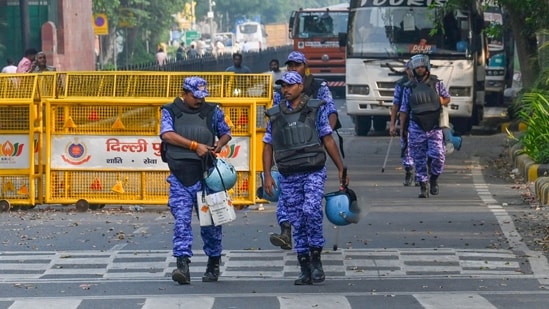
Also read: Jantar Mantar in Lutyens’ Delhi de-notified as protest site; 3 new venues named
But Jantar Mantar was not always associated with protesters and posters or barricades and banners. In fact, Boat Club lawns were the preferred protest site, and in 1988, farmer leader Mahendra Singh Tikait led the most significant protest there that lasted a week and saw lakhs of people. Five years later, protests and rallies were banned at Boat Club and the road abutting Jantar Mantar was notified as a designated protest site.
How Jantar Mantar transitioned into a protest site
Deep Dive
Why did Jantar Mantar become a major protest site in Delhi?
What rules governed protests at Jantar Mantar before it was de-notified?
Where can protests be held in Delhi after Jantar Mantar was de-notified?
Called “Mini India” by historian Ramchandra Guha, neem-lined Jantar Mantar is the site that people from across the country gather hoping to be heard. Guha in 'India After Gandhi' describes the transition in 1990s. He notes that Rajpath, where the grounds meant to be empty except on ceremonial days, had become a village of tents, each with colourful placards hung outside it. The people within these tents and the causes they upheld were ever changing. The hill peasants replaced by industrial workers; the Maharashtra farmers by Tibetan refugees; the Konkani speakers by Hindu monks demanding a ban on cow slaughter.
{{/usCountry}}Called “Mini India” by historian Ramchandra Guha, neem-lined Jantar Mantar is the site that people from across the country gather hoping to be heard. Guha in 'India After Gandhi' describes the transition in 1990s. He notes that Rajpath, where the grounds meant to be empty except on ceremonial days, had become a village of tents, each with colourful placards hung outside it. The people within these tents and the causes they upheld were ever changing. The hill peasants replaced by industrial workers; the Maharashtra farmers by Tibetan refugees; the Konkani speakers by Hindu monks demanding a ban on cow slaughter.
{{/usCountry}}Also read: Jantar Mantar denotified as protest site: A look back at landmark protests
"In the early nineties, these tents were summarily dismantled by a government worried about the impression made on foreign visitors by such open expression of dissent. Rajpath was vacated of encroachments and the lawns restored to their former glory but the protesters regrouped, and relocated. They now placed themselves a mile to the north-west, next to the Jantar Mantar observatory in Connaught Place. Here they were away from the eyes of the state, but directly in view of the citizens who daily passed through this busy shopping district," Guha writes.
For 33 years, the half a kilometer stretch near the observatory has provided space for all, measuring public discontent, bringing together farmers, workers, veterans, students, activists and citizens protesting against decisions they believed had left them unheard. On an average, the Parliament Street police station receives more than 24,000 requests for permission to hold protests every year. One could walk on this half a kilometer stretch on single street to get a glimpse of grievances across India.
Landmark protests at Jantar Mantra
In 2017, Tamil Nadu farmers with mice in their hands or their mouths who wanted to draw attention of the government to the agrarian crisis reached Jantar Mantar. In same year, a man from Madhya Pradesh had spent years protesting against government documents declaring him dead and lived in Jantar Mantar. Eleven ex-servicemen recorded the over 700 days of their relay hunger strike for one-rank-one-pension to followers of Asaram Bapu and Rampal who had spent years camping on Mantar, trying to persuade the authorities to free their jailed gurus.
The initial protests of the Anna Hazare movement started from Jantar Mantar in April 2011. Not to forget the annual Delhi Queer Pride parade. In 2105, retired Indian military and paramilitary personnel sat there and demanded fair implementation of One Rank One Pension (OROP), with subsequent demonstrations and re-gatherings taking place in 2016, 2019. Parents, relatives and friends of murdered Noida teen Arushi Talwar demanded justice at Jantar Mantar in 2011 and 2013. Even followers of jailed self-styled godmen; animal lovers against use of cow’s milk; dog haters; members of Akhil Bharatiya Joota Maaro Andolan; and a sole protester from Chandauli who believed satellites hacked into people’s brains in his hometown have found themselves at Jantar Mantar over the years.
On Monday, the Jantar Mantar has been de-notified as a designated protest venue. An order issued by the Delhi Commissioner of Police Anurag Kumar states that based on recommendations of committee Ministry of Home Affairs (MHA), the Jantar Mantar as a protest venue has been de-notified. Three new venues-- Ramlila ground, Burari ground and CBD ground in East Delhi have been designated as new venues for protests and demonstrations.
Author and city chronicler Sohail Hashmi said that the shift from boat club laws to Jantar Mantar was itself an undemocratic move and further shift away from the parliament makes it worse. "It was an open space for people to gather and present their demand to government. We have attended many democratic protests at India gate laws, boat club where government ministers, leader of oppositions or senior bureaucrats would come to receive the representations. Tens of thousands of people could assemble near the center of power. In Washington, people cab gather right outside the Capitol Hill. Why should we be moving people away to Burari, CBD ground," he added.
Jantar Mantar's tryst with bans and protests
This is not the first instance when protests have been officially stopped at Jantar Mantar. In Varun Seth & Ors. v. Police Commissioner, Delhi Police, local residents of Jantar Mantar Road complained of severe noise pollution, blockage of residential entryways, trash accumulation, and sanitation issues from continuous demonstrations. In 2017, tribunal directed authorities to stop protests in the area, citing residents’ right to a clean and noise-free environment under Article 21 of the Constitution. The Supreme Court in July 2018 subsequently observed that a blanket ban on all protests at Jantar Mantar was not viable, leaving authorities to balance the right to peaceful assembly with residents’ concerns.
Seth said that his problems are exactly the same as they were in 2016-17. “I was born here, and the area used to be peaceful. Protests happened elsewhere, and even in the early 2000s, the problems were not as severe. Our troubles began with the Anna Hazare movement in 2011. It is not just me; residents of hundreds of homes along Curzon Road, Barakhamba Road and Tolstoy Marg have been affected.We hope everyone will finally get some breathing space,” Seth said.
He added that for one year year after the NGT order, we lived peacefully, but locality now faces the same issues all over again. "Roads leading to our homes are barricaded, there is noise and garbage, and our daily lives are disrupted. If you were living in my place, you would argue the same way. We are relieved by the order because we hope this decision will finally bring us some peace," he added.
Over the decades, Jantar Mantar has developed its own ecosystem to support protests. Besides the Neem lined stretch providing shade in Delhi's harsh summer, there are eight small eateries including Kutty's South Indian food, and a dozen tea services. A grossly overused NDMC public restroom and a few mobile toilets. Bangla Sahib Gurdwara in the vicinity is generous with both food and toilets and sometimes shelter from police crackdowns.
In the last two prominent protests at the site, Jantar Mantar in January 2023 saw Indian female wrestlers protesting for an investigation into allegations of sexual harassment of female wrestlers by Brij Bhushan Sharan Singh during his tenure as the president of the Wrestling Federation of India (WFI). More recently, the protest and hunger strike undertaken by Sonam Wangchuk and CJP took place in between June 6 and July 25, 2026. The protest was so massive that the gathering repeatedly spilled over to nearby Tolstoy marg and Sansad Marg. It eventually resulted in resignation of the education minister Dharmendra Pradhan.
Cockroach Janta Party (CJP) founder Abhijeet Dipke on Monday criticised the decision to remove Jantar Mantar as a designated protest venue, accusing the government of targeting the right to dissent. "Delhi is once again flooded with people standing up to save democracy. If Modi thinks taking away Jantar Mantar will put an end to protests, he is mistaken. Jantar Mantar is not just a location but a spirit of resistance that nobody can ever take away," he said.
So where will citizens express their grievances in the national capital? Delhi police has named three venues. Ramila Maidan, which has a history of hosting agitations, is the closest to Lutyens' Delhi among the three designated venues at a distance of about four kilometres. While the Burari Ground is around 18 kilometres away, the CBD Ground in Shahdara is at a distance of over 12 kilometers from Jantar Mantar. Both CBD ground and Ramlila ground are currently hosting Ramlila with fairs. RWAs in East Delhi have flagged CBD ground area is too congested .
City chronicler Hashmi said that the protest is meant to be a dialogue between citizen and the government. "Protest site are spaces to be heard, where media can come, people's representatives can come. Jantar Mantar had access issues and it was a smaller space but Burari, Ramlila Maidan and CBD ground are farther away and have their own problems. The protests should be moved back to India Gate laws which have broader roads, larger space and it is closer to Parliament. People have a right to be heard," he added.