
 E-Paper



Modi, Nitish meet day after Bankipur defeat
According to people aware of the details, the agenda for the first meeting between the PM and Kumar, after he became a Rajya Sabha MP, was largely confined to “Bihar’s development

 Prefer HTon Google


Prime Minister Narendra Modi on Tuesday met former Bihar Chief Minister and Janata Dal United (JDU) president Nitish Kumar, a day after the Bharatiya Janata Party (BJP) failed to retain its stronghold of Bankipura in the by-poll, the first election after Kumar stepped down as CM. The seat earlier held by BJP’s national president Nitin Nabin has been wrested by Jan Suraaj Party’s Prashant Kishore.
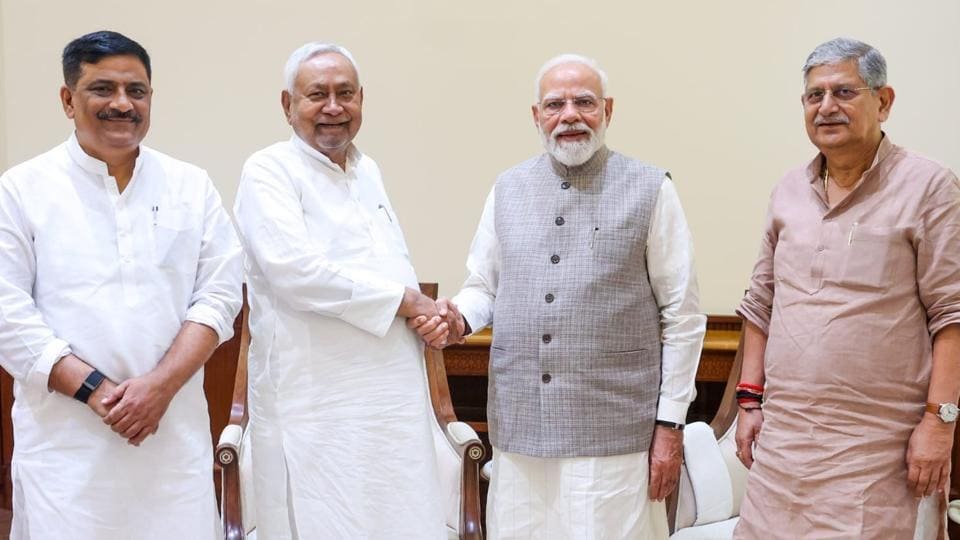
According to people aware of the details, the agenda for the first meeting between the PM and Kumar, after he became a Rajya Sabha MP, was largely confined to “Bihar’s development, the roadmap for the future of the state and the alliance.”
The JDU is a key ally of the BJP led National Democratic Alliance and the two parties run a coalition government in Bihar.
“The meeting was about issues related to the development of Bihar. The former CM discussed some issues that needed attention and sought support for the state…it was largely about development and infrastructure enhancement,” said a person privy to the meeting.
The person quoted above said “some political issues” were discussed but declined to comment on whether the by-poll results were specifically addressed by the two leaders.
While the PM’s office put out a photograph of the meeting, Kumar who was accompanied by JDU working president and MP Sanjay Jha and union minister Rajiv Ranjan Singh in a post on ‘X’ said, “Today, I had the courtesy of a meeting with the Honourable Prime Minister Shri Narendra Modi Ji in his office chamber at Parliament House..”
Post the meeting, a BJP leader responding to a question on the implications of the by-poll for the alliance said, “Both the BJP and the JDU will assess the result of the by-poll although the Jan Suuraj winning the seat has more grave implications for the Rashtriya Janata Dal whose candidate (Rekha Kumari) forfeited her security deposit (for failing to win at least one-sixth of the total votes polled)...”
While the BJP on Monday attributed the loss to a raft of issues, the JD(U) for its part has been largely silent.
On Tuesday, a JD(U) leader said the emergence of a new outfit in Bihar’s polity dominated by caste will ring an alarm for the established parties particularly the BJP, which banks on a wider coalition of castes and does not have a stronghold in terms of electorate. He said the party will also have to “consider the acceptability” of CM Samrat Choudhary among the electorate and its own votebank.
“This election has established the credentials of Nitish Kumar as a popular leader. There is also an indication of the voters showing inclination for a new outfit rather than the established ones. For instance the Muslim voters have moved from the RJD to the Jan Suuraj not the Congress. In the 90s they had similarly moved from the Congress to the RJD...this shows that there is space for an outfit that can pose a challenge to the established parties,” said a JDU leader.
The JDU counts the Kurmis (nearly 3%), the non-Yadav OBCs (7%), the Extremely Backward Classes (EBCs) (36.01%) and the Mahadalits (19.65%) as their core votebank. The BJP gets support from the Forward Castes, which includes Bhumihars, Rajputs, Brahmins, and Kayasthas, (15.52%), OBCs (Baniya/Vaishya) and some EBC communities that are drawn to its labarthi schemes or welfare schemes.
In the 243- member assembly, the BJP has 88 legislators, the JDU 85, the RJD has 25, the LJP(R)-19, Congress has 6 and the AIMIM and HAM have 5 legislators each. Other parties the RLM has 4, the CPI(ML) has 2, the CPI(M) has 1, the India Inclusive Party, the BSP and Jan Suraaj have one each.


